
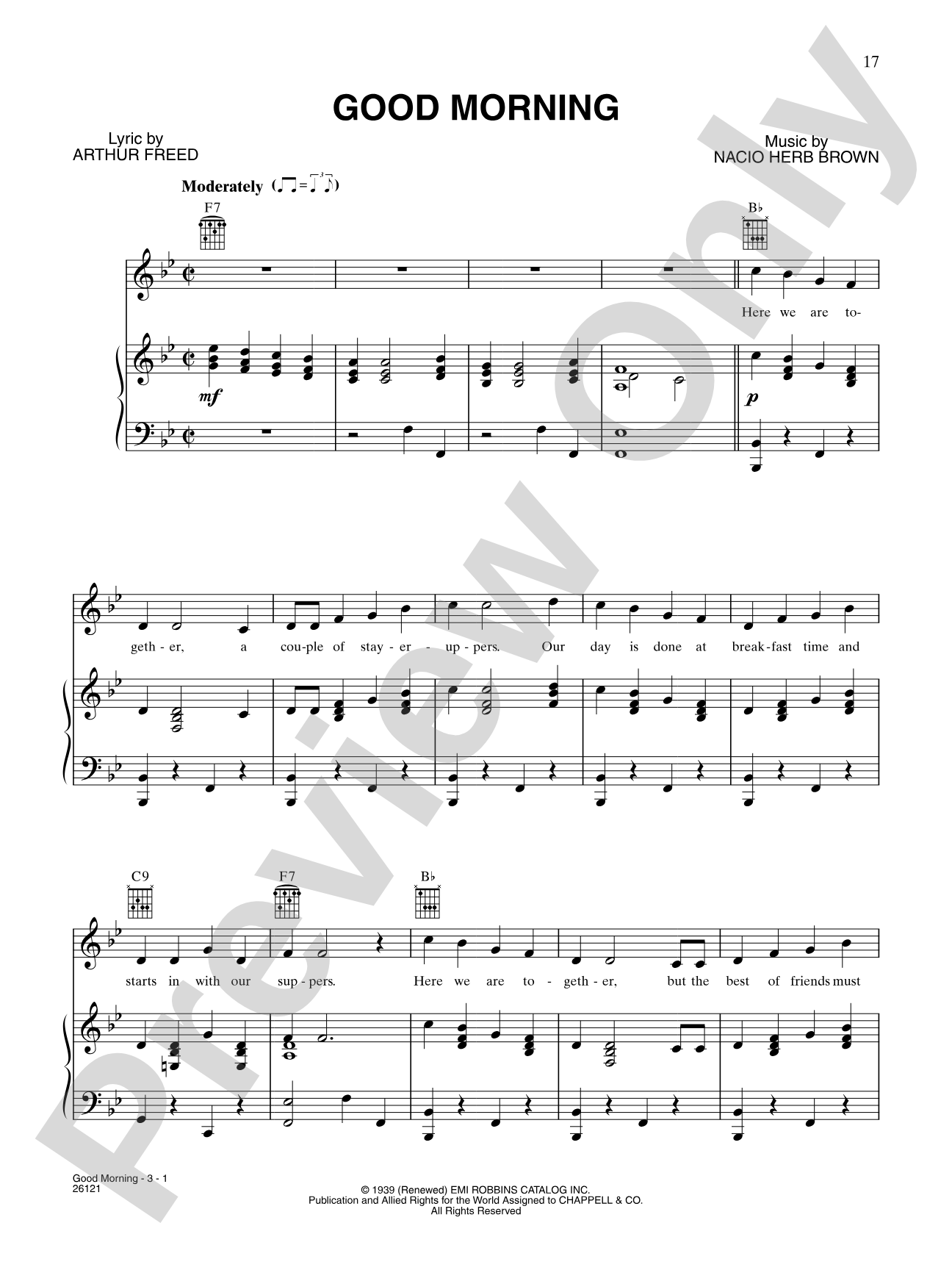

Good Morning (from "Singin' in the Rain"): Piano/Vocal/Chords
Item: 00-PSP-000148
$4.99
One moment…
Related Items
All I Do Is Dream Of You (from "Singin' in the Rain"): Piano/Vocal/Chords |
$4.99
|
View | |
Broadway Melody (from "Singin' in the Rain"): Piano/Vocal/Chords |
$4.99
|
View | |
Broadway Rhythm (from "Singin' in the Rain"): Piano/Vocal/Chords |
$4.99
|
View | |
I've Got A Feelin' You're Foolin' (from "Singin' in the Rain"): Piano/Vocal/Chords |
$4.99
|
View | |
Make 'em Laugh (from "Singin' in the Rain"): Piano/Vocal/Chords |
$4.99
|
View | |
Moses (from "Singin' in the Rain"): Piano/Vocal/Chords |
$4.99
|
View | |
Should I? (from "Singin' in the Rain"): Piano/Vocal/Chords |
$4.99
|
View | |
Temptation (from "Singin' in the Rain"): Piano/Vocal/Chords |
$4.99
|
View | |
Would You (from "Singin' in the Rain"): Piano/Vocal/Chords |
$4.99
|
View | |
You Are My Lucky Star (from "Singin' in the Rain"): Piano/Vocal/Chords |
$4.99
|
View | |
You Were Meant For Me (from "Singin' in the Rain"): Piano/Vocal/Chords |
$4.99
|
View | |
Singin' in the Rain: Deluxe 50th Anniversary Edition: Piano/Vocal/Chords Book |
$14.99
|
View |
Description
Alfred is pleased to release Singin' in the Rain: Deluxe 50th Anniversary Edition.
Singin' in the Rain, starring classic film stars Gene Kelly, Donald O'Conner, and Debbie Reynolds, is considered one of the best musicals ever made. This book features music from the movie, providing the lyrics along with piano and chord arrangements for all the songs included.
Titles: All I Do Is Dream of You * Broadway Melody * Broadway Rhythm * Fit As a Fiddle (And Ready for Love) * Good Morning * I've Got a Feeling Your Foolin' * Make 'Em Laugh * Moses * Should I * Singin' in the Rain * Temptation * The Wedding of the Painted Doll * Would You? * You Are My Lucky Star * You Were Meant for Me.


Singin' in the Rain, starring classic film stars Gene Kelly, Donald O'Conner, and Debbie Reynolds, is considered one of the best musicals ever made. This book features music from the movie, providing the lyrics along with piano and chord arrangements for all the songs included.
Titles: All I Do Is Dream of You * Broadway Melody * Broadway Rhythm * Fit As a Fiddle (And Ready for Love) * Good Morning * I've Got a Feeling Your Foolin' * Make 'Em Laugh * Moses * Should I * Singin' in the Rain * Temptation * The Wedding of the Painted Doll * Would You? * You Are My Lucky Star * You Were Meant for Me.
Good Morning (from "Singin' in the Rain"): Piano/Vocal/Chords isn't in MakeMusic Cloud just yet...but it could be. Let us know you'd like to see it, and you'll help shape what comes next. In the meantime, start a free trial and dive into thousands of interactive titles your students can play along with today.
Request This Title
Tell us you want it.
Start Your Free Trial
Explore everything that's ready to play right now.
Sample Audio
No sample audio found.
Sample Video
No sample videos found.
Additional Details
Publisher:
Alfred Music
Page Count:
68
SKU:
00-PSP-000148
More about this title
About the Composer: Arthur Freed
Arthur Freed (1894-1973) was a lyricist and producer who fundamentally shaped the Golden Age of Hollywood musicals. Though often paired with composers like Nacio Herb Brown and later Miklós Rózsa, Freed's gift for crafting singable, emotionally direct lyrics made standards of "Good Morning," "Singin' in the Rain," and "The Way You Look Tonight." His work in film established the template for how songs could advance narrative and character in cinema.
As a producer, Freed championed the movie musical as a complete art form, surrounding himself with the era's finest composers, arrangers, and choreographers. His influence extended far beyond the screen; the songs he shaped remain central to American musical theater education and performance.
Why we love this
This collection captures the playful sophistication of "Singin' in the Rain"—a score where melody and lyric are so perfectly married that singers intuitively understand phrasing and intention. The vocal arrangements are vocally friendly without being simplistic, giving singers material that builds confidence while sounding thoroughly polished at any skill level.
What to expect
Stepping into these songs feels like stepping into a world of unforced charm. The melodies are pure and direct; they land immediately without irony or self-consciousness. There's joy here, but also grace—these are songs about connection, longing, and playfulness told through music that never wears its heart on its sleeve too obviously.
Who it's for
This collection serves singers (classical, musical theater, and jazz-adjacent performers), pianists building their accompaniment skills, and anyone studying American song. It's equally valuable for voice students preparing recital repertoire and for pianists seeking songs that marry technical musicality with cultural touchstones.
How to get the most out of it
- The lyrical passages like "Good Morning" benefit from legato pedaling on the piano; be selective about lifting the sustain pedal during chord changes to keep harmonies clean and the melody floating above.
- Attend to the rhythmic precision in upbeat numbers such as "Make 'Em Laugh"; the piano drives the comedic timing, so clarity in articulation between singer and accompanist is essential.
- Balance vocal projection carefully in softer moments—these standards rely on intimacy, not volume, to land emotionally with an audience.
- Use the chord symbols as your entry point to harmonic understanding; these classic progressions are worth analyzing and internalizing for both stylistic authenticity and flexibility in performance.
How to use it
Feature "Good Morning" or "Singin' in the Rain" as a concert opener or upbeat set-closer; both songs energize an audience. In a musical theater unit or an American song survey course, these pieces anchor discussions of how melody and lyrics create character and mood. Pianists can use this collection for sight-reading practice, while voice students building a repertoire recital will find multiple options at various emotional registers.
Skills your students will build
- Singing legit pop/musical theater style with stylistic accuracy
- Reading and interpreting chord symbols in real time
- Coordinating vocal phrasing with piano accompaniment
- Understanding melodic contour and emotional intent in classic American songs
- Building confidence with material that sounds and feels professional