
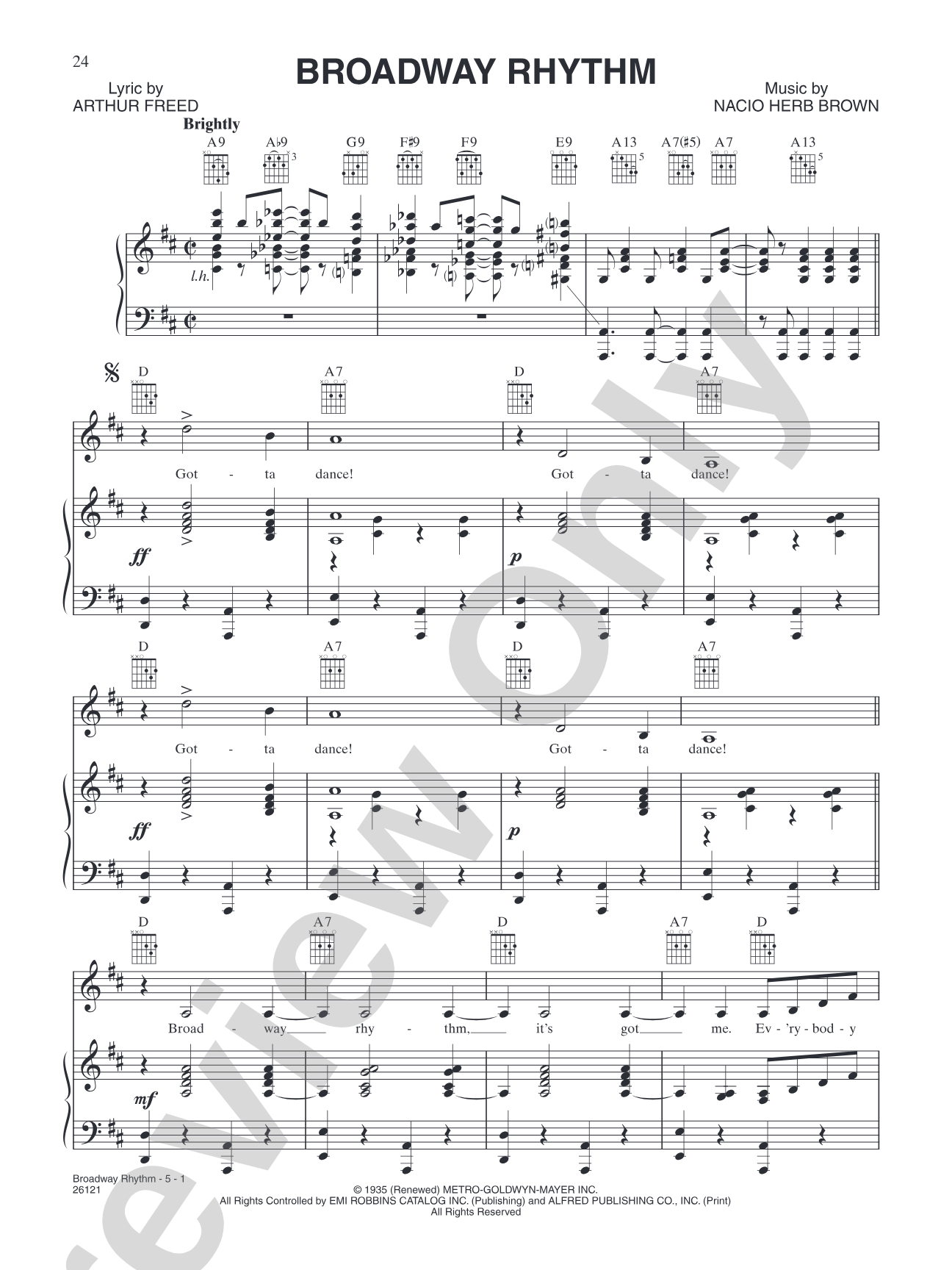

Broadway Rhythm (from "Singin' in the Rain"): Piano/Vocal/Chords
Item: 00-PSP-000147
$4.99
One moment…
Related Items
All I Do Is Dream Of You (from "Singin' in the Rain"): Piano/Vocal/Chords |
$4.99
|
View | |
Broadway Melody (from "Singin' in the Rain"): Piano/Vocal/Chords |
$4.99
|
View | |
Good Morning (from "Singin' in the Rain"): Piano/Vocal/Chords |
$4.99
|
View | |
I've Got A Feelin' You're Foolin' (from "Singin' in the Rain"): Piano/Vocal/Chords |
$4.99
|
View | |
Make 'em Laugh (from "Singin' in the Rain"): Piano/Vocal/Chords |
$4.99
|
View | |
Moses (from "Singin' in the Rain"): Piano/Vocal/Chords |
$4.99
|
View | |
Should I? (from "Singin' in the Rain"): Piano/Vocal/Chords |
$4.99
|
View | |
Temptation (from "Singin' in the Rain"): Piano/Vocal/Chords |
$4.99
|
View | |
Would You (from "Singin' in the Rain"): Piano/Vocal/Chords |
$4.99
|
View | |
You Are My Lucky Star (from "Singin' in the Rain"): Piano/Vocal/Chords |
$4.99
|
View | |
You Were Meant For Me (from "Singin' in the Rain"): Piano/Vocal/Chords |
$4.99
|
View | |
Singin' in the Rain: Deluxe 50th Anniversary Edition: Piano/Vocal/Chords Book |
$14.99
|
View |
Description
Alfred is pleased to release Singin' in the Rain: Deluxe 50th Anniversary Edition.
Singin' in the Rain, starring classic film stars Gene Kelly, Donald O'Conner, and Debbie Reynolds, is considered one of the best musicals ever made. This book features music from the movie, providing the lyrics along with piano and chord arrangements for all the songs included.
Titles: All I Do Is Dream of You * Broadway Melody * Broadway Rhythm * Fit As a Fiddle (And Ready for Love) * Good Morning * I've Got a Feeling Your Foolin' * Make 'Em Laugh * Moses * Should I * Singin' in the Rain * Temptation * The Wedding of the Painted Doll * Would You? * You Are My Lucky Star * You Were Meant for Me.


Singin' in the Rain, starring classic film stars Gene Kelly, Donald O'Conner, and Debbie Reynolds, is considered one of the best musicals ever made. This book features music from the movie, providing the lyrics along with piano and chord arrangements for all the songs included.
Titles: All I Do Is Dream of You * Broadway Melody * Broadway Rhythm * Fit As a Fiddle (And Ready for Love) * Good Morning * I've Got a Feeling Your Foolin' * Make 'Em Laugh * Moses * Should I * Singin' in the Rain * Temptation * The Wedding of the Painted Doll * Would You? * You Are My Lucky Star * You Were Meant for Me.
Broadway Rhythm (from "Singin' in the Rain"): Piano/Vocal/Chords isn't in MakeMusic Cloud just yet...but it could be. Let us know you'd like to see it, and you'll help shape what comes next. In the meantime, start a free trial and dive into thousands of interactive titles your students can play along with today.
Request This Title
Tell us you want it.
Start Your Free Trial
Explore everything that's ready to play right now.
Sample Audio
No sample audio found.
Sample Video
No sample videos found.
Additional Details
Publisher:
Alfred Music
Page Count:
68
SKU:
00-PSP-000147
More about this title
About the Composer: Arthur Freed
Arthur Freed (1894-1973) was one of Hollywood's most prolific and influential songwriters, crafting lyrics for some of the greatest musicals of the golden age. His partnership with composers like Nacio Herb Brown produced standards that defined an era, and his work as a producer at MGM helped shape the sound of American musical theater on film. For educators, Freed's catalog offers enduring melodic material with clear harmonic structures that engage both singers and pianists.
Why we love this
These are standards with genuine theatrical weight. The vocal lines sit naturally for singers across ranges, and the piano arrangements strike a balance between accessibility and sophistication, making them ideal for recitals, classroom performance, or building a solid repertoire of classic American musical theater. The accompanying chord symbols give pianists room to interpret while maintaining harmonic clarity.
What to expect
Stepping into the world of 1950s MGM glamour: these songs sparkle with melody, swing with ease, and carry the warmth of an era when musical storytelling was paramount. The piano writing captures the sophistication of a professional pit orchestra condensed to two hands.
Who it's for
Vocalists preparing for auditions, recitals, or cabaret-style performances will find reliable, singable arrangements of beloved standards. Piano students interested in accompanying will appreciate the coordination skills required to balance a vocal part with an engaging accompaniment. Music teachers can use individual songs for classroom performance or as springboards for discussing classic American musical theater.
How to get the most out of it
- Balance vocal projection so the piano part remains audible. These arrangements are intimate enough for smaller venues but need careful dynamic control to prevent the voice from overwhelming the accompaniment.
- Pay attention to rhythmic precision in the piano line, particularly in syncopated passages common to these numbers. The groove drives the song forward.
- Coordinate the piano introduction carefully with the vocalist. Know exactly how many bars set up each vocal entrance so you can establish tempo and mood confidently.
- Use the chord symbols as a guide for stylistic touches. These songs thrive when the accompanist understands jazz and swing conventions of the era, even when playing the written arrangement.
How to use it
Feature individual numbers in a vocal recital, pairing them with other American songbook standards for a cohesive program. Use them in a variety show or cabaret setting where singers rotate through classic theater repertoire. For music classes studying musical theater history, assign one or two songs as performance assignments so students internalize how melody and lyrics intertwine.
Skills your students will build
- Coordinating vocal phrasing with piano accompaniment
- Interpreting swing and syncopation in written arrangements
- Sight-reading chord symbols and understanding jazz harmony
- Balancing vocal and instrumental dynamics in ensemble performance