
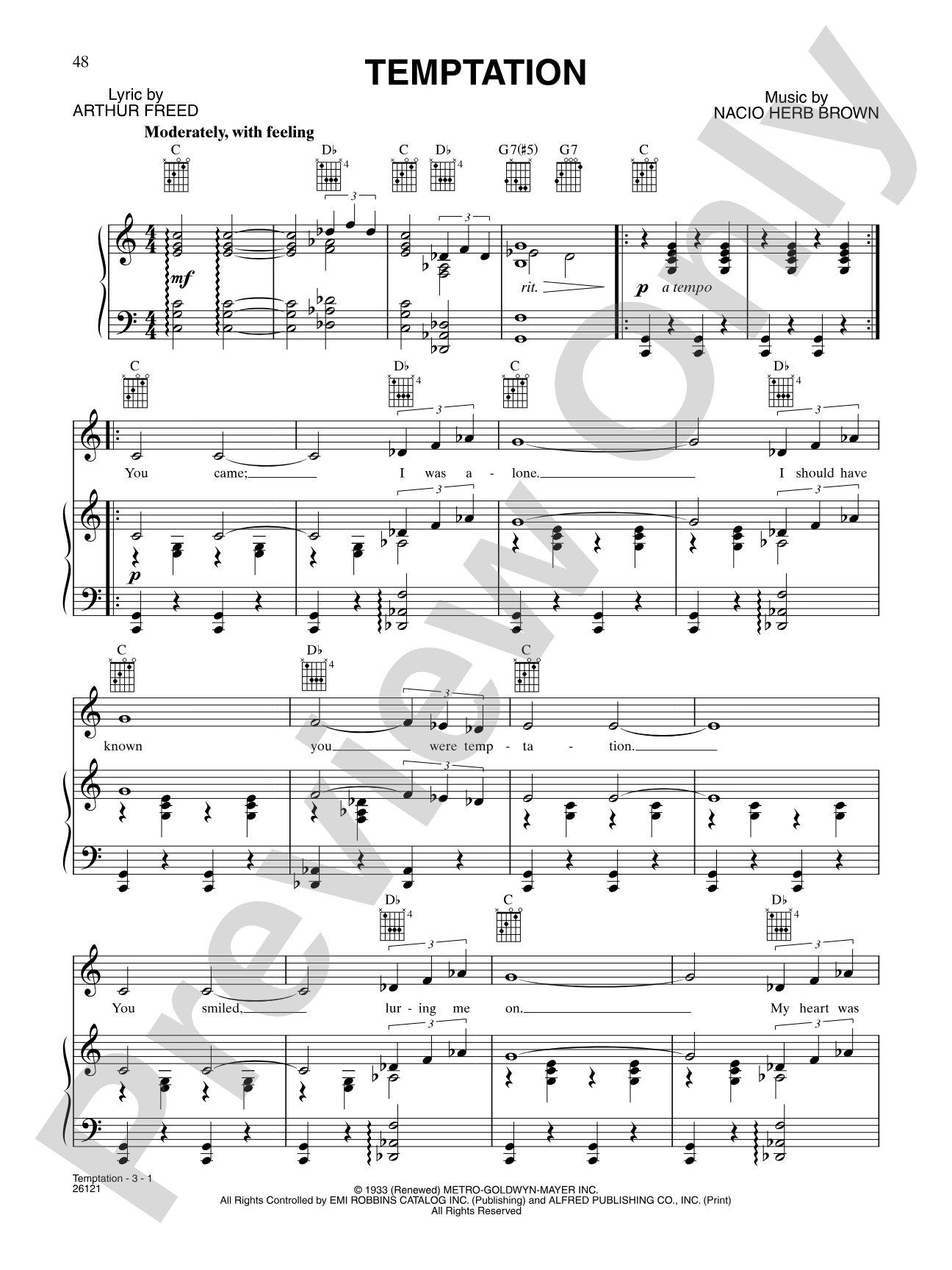

Temptation (from "Singin' in the Rain"): Piano/Vocal/Chords
Item: 00-PSP-000154
$4.99
One moment…
Related Items
All I Do Is Dream Of You (from "Singin' in the Rain"): Piano/Vocal/Chords |
$4.99
|
View | |
Broadway Melody (from "Singin' in the Rain"): Piano/Vocal/Chords |
$4.99
|
View | |
Broadway Rhythm (from "Singin' in the Rain"): Piano/Vocal/Chords |
$4.99
|
View | |
Good Morning (from "Singin' in the Rain"): Piano/Vocal/Chords |
$4.99
|
View | |
I've Got A Feelin' You're Foolin' (from "Singin' in the Rain"): Piano/Vocal/Chords |
$4.99
|
View | |
Make 'em Laugh (from "Singin' in the Rain"): Piano/Vocal/Chords |
$4.99
|
View | |
Moses (from "Singin' in the Rain"): Piano/Vocal/Chords |
$4.99
|
View | |
Should I? (from "Singin' in the Rain"): Piano/Vocal/Chords |
$4.99
|
View | |
Would You (from "Singin' in the Rain"): Piano/Vocal/Chords |
$4.99
|
View | |
You Are My Lucky Star (from "Singin' in the Rain"): Piano/Vocal/Chords |
$4.99
|
View | |
You Were Meant For Me (from "Singin' in the Rain"): Piano/Vocal/Chords |
$4.99
|
View | |
Singin' in the Rain: Deluxe 50th Anniversary Edition: Piano/Vocal/Chords Book |
$14.99
|
View |
Description
Alfred is pleased to release Singin' in the Rain: Deluxe 50th Anniversary Edition.
Singin' in the Rain, starring classic film stars Gene Kelly, Donald O'Conner, and Debbie Reynolds, is considered one of the best musicals ever made. This book features music from the movie, providing the lyrics along with piano and chord arrangements for all the songs included.
Titles: All I Do Is Dream of You * Broadway Melody * Broadway Rhythm * Fit As a Fiddle (And Ready for Love) * Good Morning * I've Got a Feeling Your Foolin' * Make 'Em Laugh * Moses * Should I * Singin' in the Rain * Temptation * The Wedding of the Painted Doll * Would You? * You Are My Lucky Star * You Were Meant for Me.


Singin' in the Rain, starring classic film stars Gene Kelly, Donald O'Conner, and Debbie Reynolds, is considered one of the best musicals ever made. This book features music from the movie, providing the lyrics along with piano and chord arrangements for all the songs included.
Titles: All I Do Is Dream of You * Broadway Melody * Broadway Rhythm * Fit As a Fiddle (And Ready for Love) * Good Morning * I've Got a Feeling Your Foolin' * Make 'Em Laugh * Moses * Should I * Singin' in the Rain * Temptation * The Wedding of the Painted Doll * Would You? * You Are My Lucky Star * You Were Meant for Me.
Temptation (from "Singin' in the Rain"): Piano/Vocal/Chords isn't in MakeMusic Cloud just yet...but it could be. Let us know you'd like to see it, and you'll help shape what comes next. In the meantime, start a free trial and dive into thousands of interactive titles your students can play along with today.
Request This Title
Tell us you want it.
Start Your Free Trial
Explore everything that's ready to play right now.
Sample Audio
No sample audio found.
Sample Video
No sample videos found.
Additional Details
Publisher:
Alfred Music
Page Count:
68
SKU:
00-PSP-000154
More about this title
About the Composer: Arthur Freed
Arthur Freed (1894-1973) stands as one of Hollywood's most prolific songwriting lyricists, composing alongside Nacio Herb Brown during the golden age of American musical theater and film. His work for "Singin' in the Rain" exemplifies his gift for writing lyrics that capture both the sophistication of Broadway and the infectious charm of popular song, blending witty wordplay with melodies that endure across generations. Freed's influence on music education extends through the standard repertoire he helped establish—songs that remain central to the training of singers, pianists, and accompanists.
Why we love this
This excerpt gives you one of cinema's most iconic songs in a practical format that works equally well for a singer preparing for an audition, a pianist accompanying a vocalist, or an ensemble learning a classic arrangement. The piano part sits comfortably on the keyboard while the chord symbols support flexible interpretation—whether your student needs to play from lead sheet notation or work from a fully notated accompaniment.
What to expect
Temptation captures the film's sophisticated glamour—a sultry, jazz-inflected ballad wrapped in the elegance of 1950s Hollywood production. The melody unfolds with knowing charm, and the harmonic language sits somewhere between Tin Pan Alley refinement and the slightly darker edge of film noir.
Who it's for
This is essential material for voice students preparing standards repertoire, pianists who accompany singers in lessons or recitals, and anyone teaching or learning the musical theater canon. Music theater programs and vocal jazz ensembles will find the chord symbols particularly useful for generating variations and working with different instrumentation.
How to get the most out of it
- Balance the vocal line so it sits naturally above the accompaniment; resist the urge to play the piano part heavily, especially in the verses where the lyric should shine through clearly.
- Establish the song's languorous swing feel by letting the quarter notes breathe slightly—this isn't march time, and the seduction in the melody depends on a relaxed, confident tempo.
- Pay attention to the harmonic movement in the chorus; the chord changes are sophisticated and move quickly, requiring clean voice leading that doesn't muddy the underlying harmony.
How to use it
Feature this in a recital celebrating American popular song standards, pair it with other "Singin' in the Rain" selections for a thematic evening, or use it to introduce students to the harmonic language of mid-century musical theater. It works equally well as a solo vocal recital piece or as part of a pianist's arrangement of classic film music.
Skills your students will build
- Interpreting jazz-influenced harmony and understanding chord substitutions common to film standards
- Balancing vocal line with piano accompaniment in a sophisticated harmonic context
- Accompanying from chord symbols while reading a notated melody line
- Sustaining a legit singing technique over a rhythmically sophisticated accompaniment pattern