

Psallite: Let All Nations Sing: 2-Part Choral Octavo
Music by Jay Althouse
Item: 00-PO-0003969
$2.25
Minimum order quantity: 20 copies
Pickup currently not available
Related Items
Psallite: Let All Nations Sing: SAB Choral Octavo |
$2.25
|
View | |
Psallite: Let All Nations Sing: SATB Choral Octavo |
$1.30
|
View | |
Psallite: Let All Nations Sing: SAB Choral Octavo |
$2.25
|
View | |
Psallite: Let All Nations Sing: 2-Part Choral Octavo |
$2.25
|
View | |
Psallite: Let All Nations Sing: Choral Octavo SoundTrax CD |
$16.95
|
View | |
Psallite: Let All Nations Sing: Choral SoundPax |
$15.00
|
View |
Description
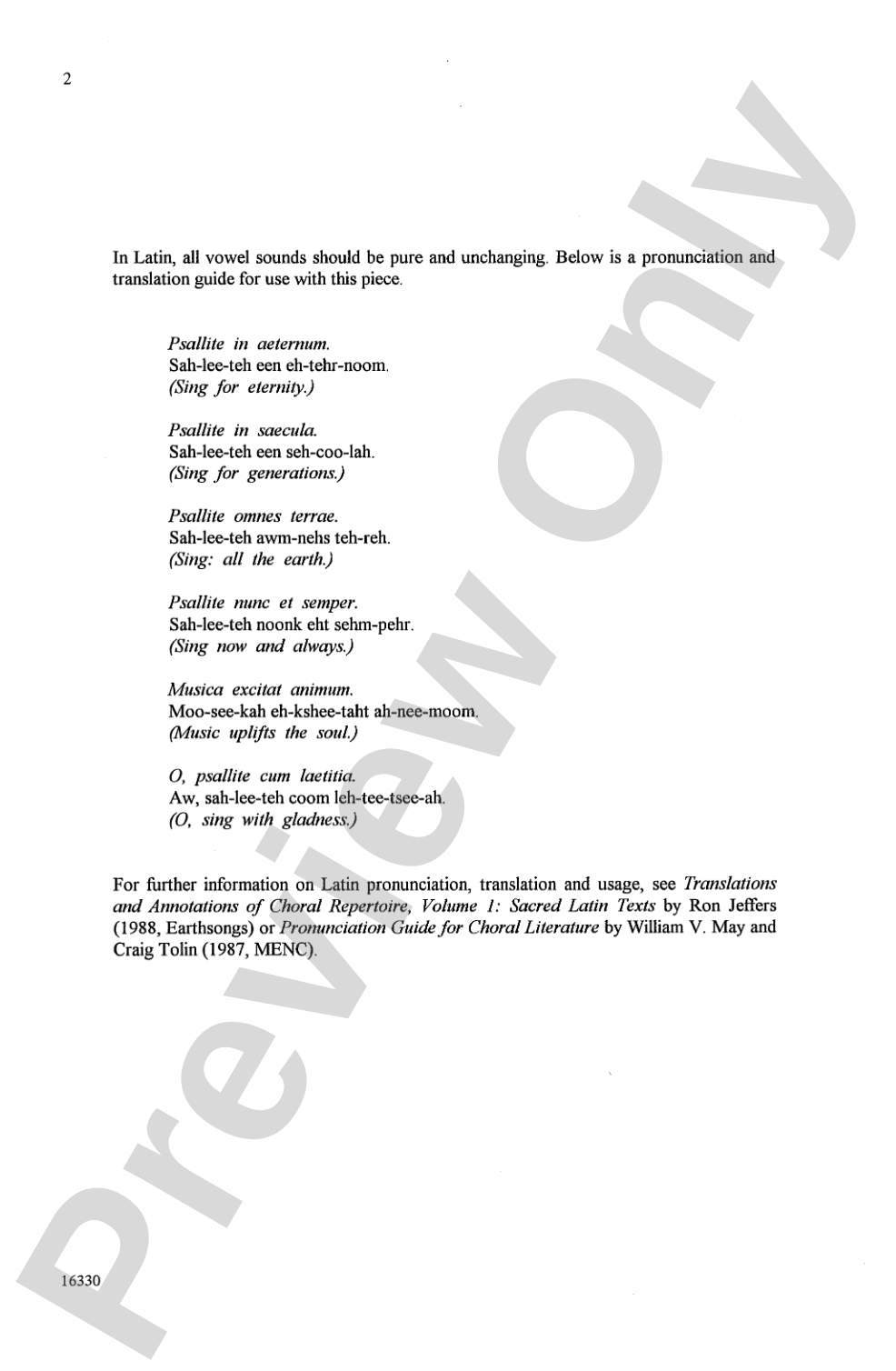
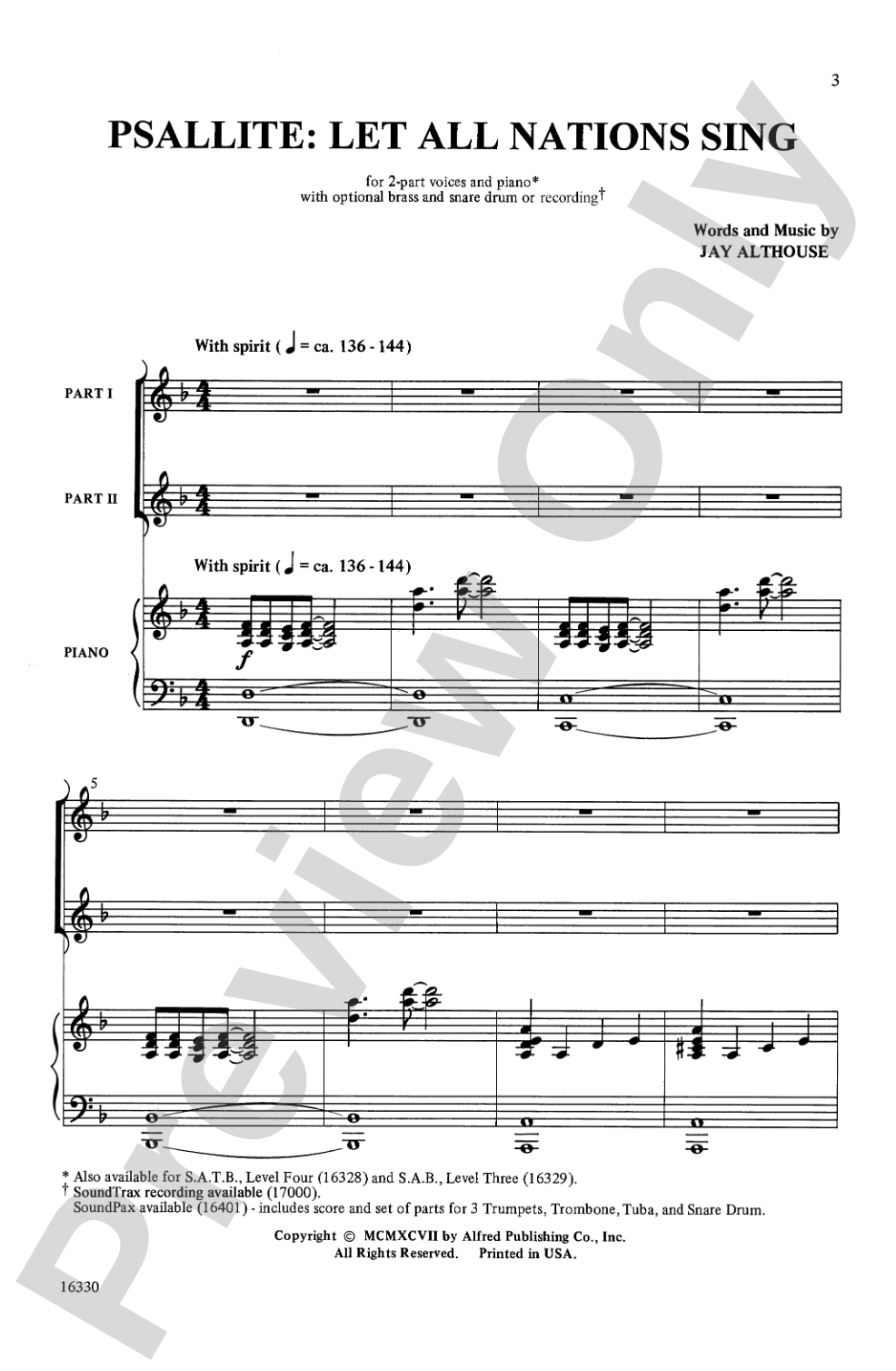
An exuberant concert work featuring a secular text combining Latin and English. Strong choral writing will make your choir sound its best. Includes descant for soprano and tenor.


Psallite: Let All Nations Sing: 2-Part Choral Octavo isn't in MakeMusic Cloud just yet...but it could be. Let us know you'd like to see it, and you'll help shape what comes next. In the meantime, start a free trial and dive into thousands of interactive titles your students can play along with today.
Request This Title
Tell us you want it.
Start Your Free Trial
Explore everything that's ready to play right now.
Sample Audio
No sample audio found.
Sample Video
No sample videos found.
Additional Details
Series:
Alfred Archive Edition: Alfred Choral Designs
Publisher:
Alfred Music
Page Count:
12
SKU:
00-PO-0003969
More about this title
About the Composer: Jay Althouse

Jay Althouse earned his B.S. in Music Education and M.Ed. in Music from Indiana University of Pennsylvania, where he later received the Distinguished Alumni award. He spent eight years working as a rights and licenses administrator for a major educational music publisher and served on the Executive Board of the Music Publishers Association of America during that tenure.
With over 800 choral works in print across all skill levels, Althouse has established himself as one of the most prolific and widely performed composers in English-speaking choral music. He holds membership in ASCAP as a writer and is a regular recipient of the ASCAP Special Award. Beyond composition, he has co-written children's musicals with Sally K. Albrecht, compiled respected vocal solo collections, and authored instructional resources including The Complete Choral Warm-up Book and Accent on Composers. His choral work I Hear America Singing, co-written with Albrecht, was performed by the San Francisco Girls and Boys Choirs at President Barack Obama's inauguration in 2009.
Why we love this
Althouse knows how to write for singers. The part writing here sits comfortably in young voices while maintaining genuine musicality; the descant option gives your advanced singers something to sink their teeth into without overshadowing the ensemble sound. The bilingual text creates immediate interest and the piece builds with infectious energy that translates directly to audience response.
What to expect
Psallite radiates joy and forward momentum. The alternation between Latin and English creates rhythmic variety and intellectual interest, while the part writing ensures all singers feel invested in a sound that's bigger and richer than the sum of its parts.
Who it's for
This works for intermediate choirs with a blend of experienced and developing singers. The 2-part writing is accessible enough for choirs building confidence, yet the musical content remains engaging for ensembles with more advanced voices.
How to get the most out of it
- Balance the two parts from the start of rehearsals so neither voice dominates; the strength of this piece comes from voices blending rather than competing.
- If you're using the descant, introduce it after the choir has learned the main material, treating it as an enrichment layer rather than the primary focus.
- Shape the Latin and English sections distinctly. The language shift creates natural opportunities for a change in tone, tempo feel, or articulation.
- The recorded accompaniment works best when you've drilled the parts independently first; use it primarily in final rehearsals and performance to reinforce tuning and tempo, not as a learning tool.
How to use it
Program this as a concert opener or closer to establish an energetic tone. Its secular, multilingual text pairs well alongside sacred repertoire in a mixed program, providing tonal contrast without feeling out of place. The piece also works effectively as a spring concert feature or end-of-year celebration selection.
Skills your students will build
- Maintaining independent lines in 2-part writing
- Singing with clear articulation in both Latin and English
- Blending voices across different vowel sounds and language transitions
- Reading descant parts and understanding soprano/tenor harmony expansion
- Sustaining ensemble energy and ensemble cohesion in faster-moving passages