

Psallite: SSA, a cappella Choral Octavo
By Michael Praetorius / arr. Russell Robinson
Item: 00-PO-0005296
$2.25
Minimum order quantity: 20 copies
Pickup currently not available
Related Items
Psallite: SATB, a cappella Choral Octavo |
$2.25
|
View | |
Psallite: SAB, a cappella Choral Octavo |
$2.25
|
View | |
Psallite: TBB, a cappella Choral Octavo |
$2.25
|
View | |
Psallite: SATB, a cappella Choral Octavo |
$2.25
|
View | |
Psallite: SAB, a cappella Choral Octavo |
$2.25
|
View | |
Psallite: SSA, a cappella Choral Octavo |
$2.25
|
View | |
Psallite: TBB, a cappella Choral Octavo |
$2.25
|
View |
Description
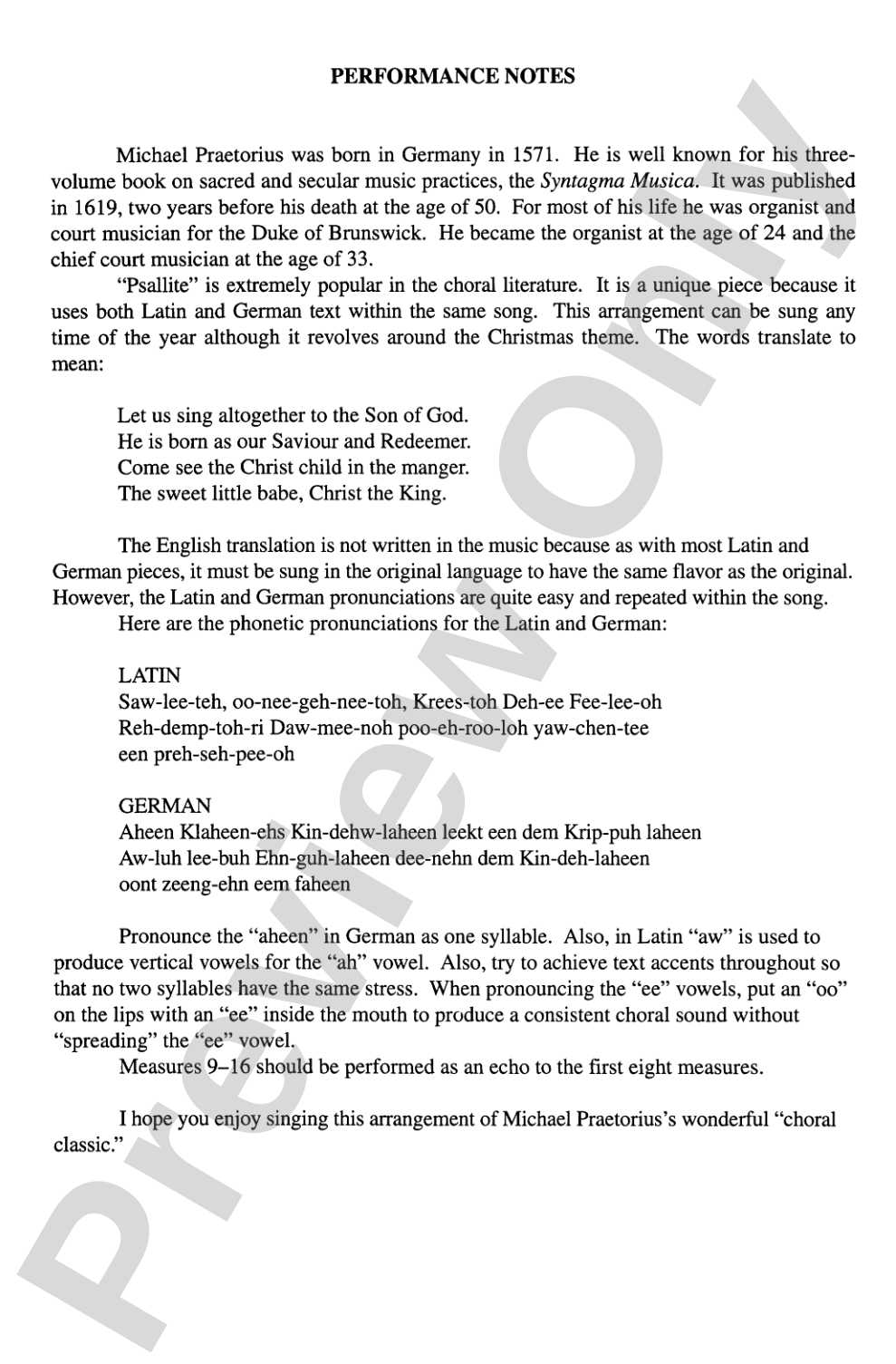
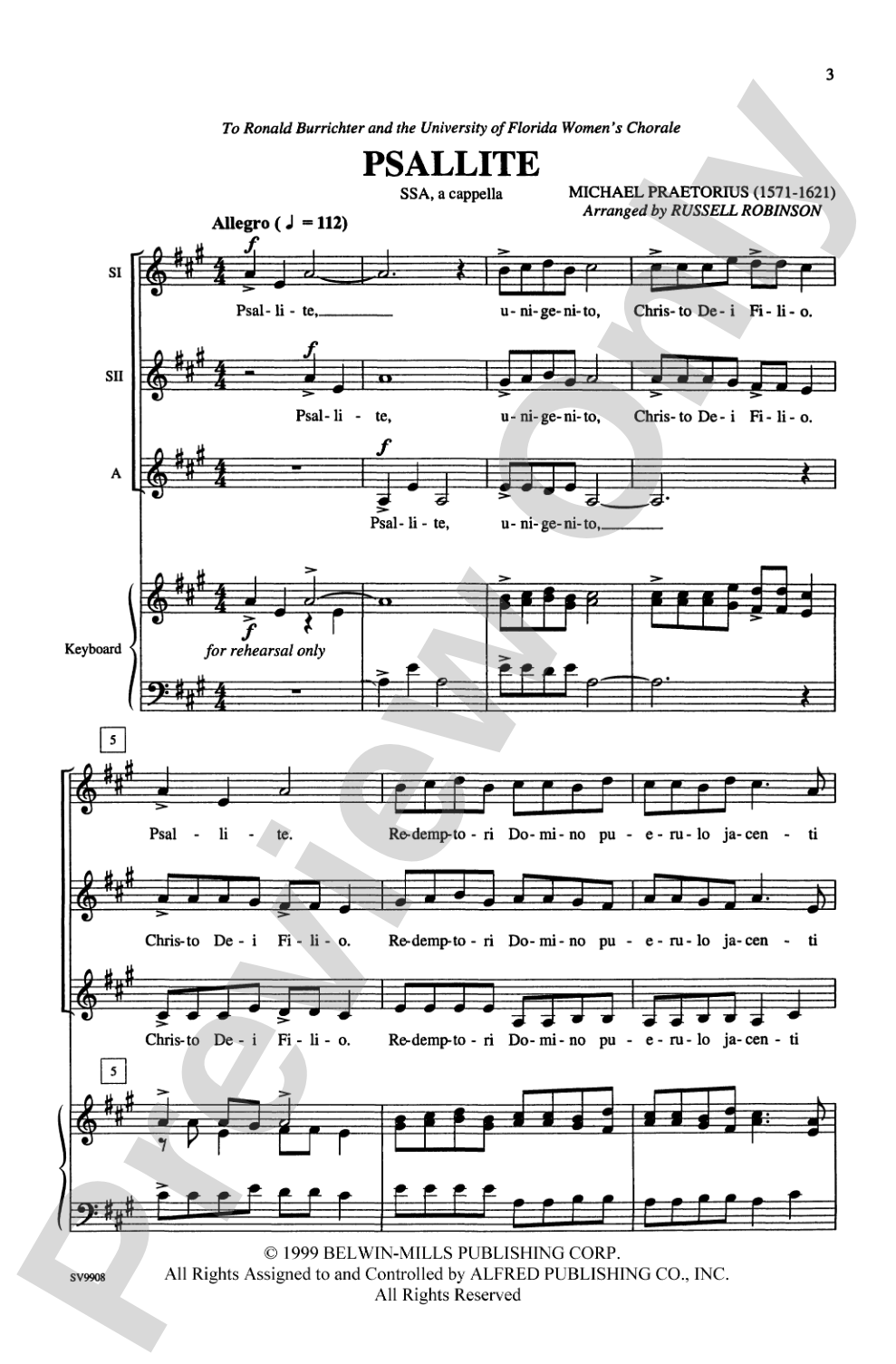
This well-known song by Praetorius from the German Renaissance period has long been a part of our choral repertoire. Russell Robinson has created an easy-to-sing SATB setting as well as a three-part men's edition. A perfect way to present standard choral repertoire to your developing choirs.


Psallite: SSA, a cappella Choral Octavo isn't in MakeMusic Cloud just yet...but it could be. Let us know you'd like to see it, and you'll help shape what comes next. In the meantime, start a free trial and dive into thousands of interactive titles your students can play along with today.
Request This Title
Tell us you want it.
Start Your Free Trial
Explore everything that's ready to play right now.
Sample Audio
No sample audio found.
Sample Video
No sample videos found.
Additional Details
Series:
Alfred Archive Edition: Belwin Festival Series
Publisher:
Alfred Music
Page Count:
8
SKU:
00-PO-0005296
More about this title
About the Composer: Michael Praetorius
Michael Praetorius (1571-1621) was a prolific German composer, theorist, and music director whose output spanned sacred and secular genres during a pivotal moment in European music history. His work bridges the Renaissance and early Baroque periods, and his compositions remain central to choral pedagogy because they balance accessibility with genuine artistic substance.
Why we love this
Russell Robinson's SSA arrangement preserves the melodic integrity of this Renaissance masterwork while making it genuinely singable for treble choirs at the developing level. The a cappella texture keeps the focus on blend and intonation, and the piece sits comfortably enough in the voices that singers can focus on musicality rather than struggling with range or difficult intervals.
What to expect
The piece carries the quiet dignity and gentle reverence characteristic of German Renaissance sacred music, with warm harmonic movement and a modest range that feels comfortable rather than showy. Performed well, it conveys an understated beauty that rewards careful listening.
Who it's for
This arrangement suits developing SSA choirs, particularly those ready to engage with early music repertoire but not yet prepared for more complex Renaissance polyphony. It works equally well for festival presentations, holiday programs, or singers seeking an introduction to Praetorius in a manageable setting.
How to get the most out of it
- Establish a clear, steady pulse without rushing; let the harmonic movement breathe naturally rather than pushing the tempo forward.
- Balance the parts so the soprano line sings through without dominating; this is polyphonic writing, not a melody-with-harmony arrangement.
- Shape phrases by thinking of text underlay and natural speech rhythms, which will help the choir avoid a metronomic feel.
- Tune carefully in the unaccompanied texture, paying particular attention to thirds and the movement between chord roots to keep intonation centered.
How to use it
Program this during winter or holiday concerts when SSA repertoire is needed, or use it as a bridge between folk-influenced pieces and more structured Renaissance literature. It also works effectively as a closing number or as a meditation between larger, more dramatic works.
Skills your students will build
- Reading and performing a cappella music with stable intonation
- Balancing independent vocal lines in four-part harmony
- Shaping Renaissance-era phrasing and harmonic rhythm
- Blending treble voices with control and evenness across different registers