

Psallite: TBB, a cappella Choral Octavo
By Michael Praetorius / arr. Russell Robinson
Level: Moderate
Item: 00-PO-0003048
$2.25
Minimum order quantity: 20 copies
Pickup currently not available
Related Items
Psallite: SATB, a cappella Choral Octavo |
$2.25
|
View | |
Psallite: SAB, a cappella Choral Octavo |
$2.25
|
View | |
Psallite: SSA, a cappella Choral Octavo |
$2.25
|
View | |
Psallite: SATB, a cappella Choral Octavo |
$2.25
|
View | |
Psallite: SAB, a cappella Choral Octavo |
$2.25
|
View | |
Psallite: SSA, a cappella Choral Octavo |
$2.25
|
View | |
Psallite: TBB, a cappella Choral Octavo |
$2.25
|
View |
Description
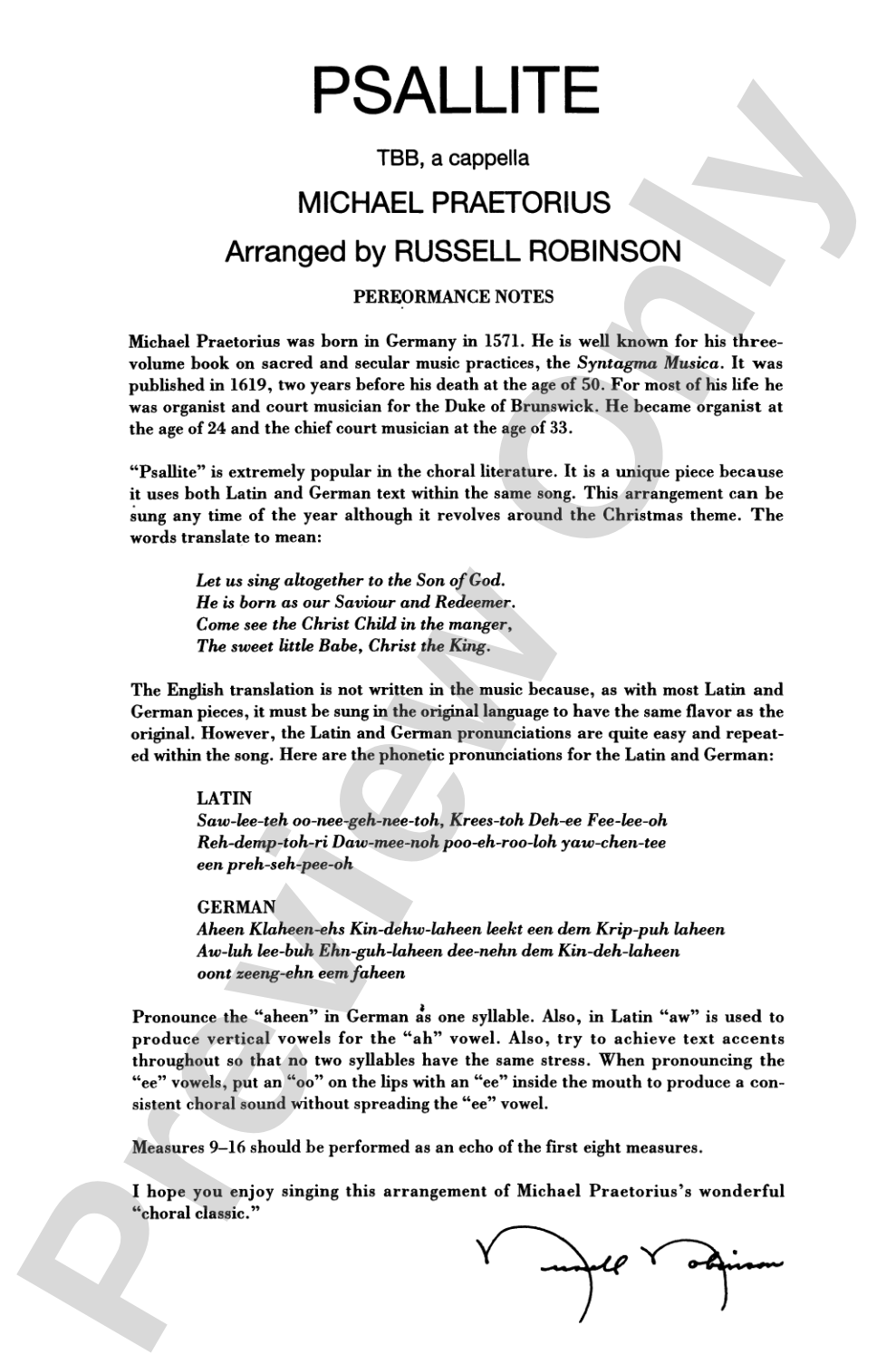
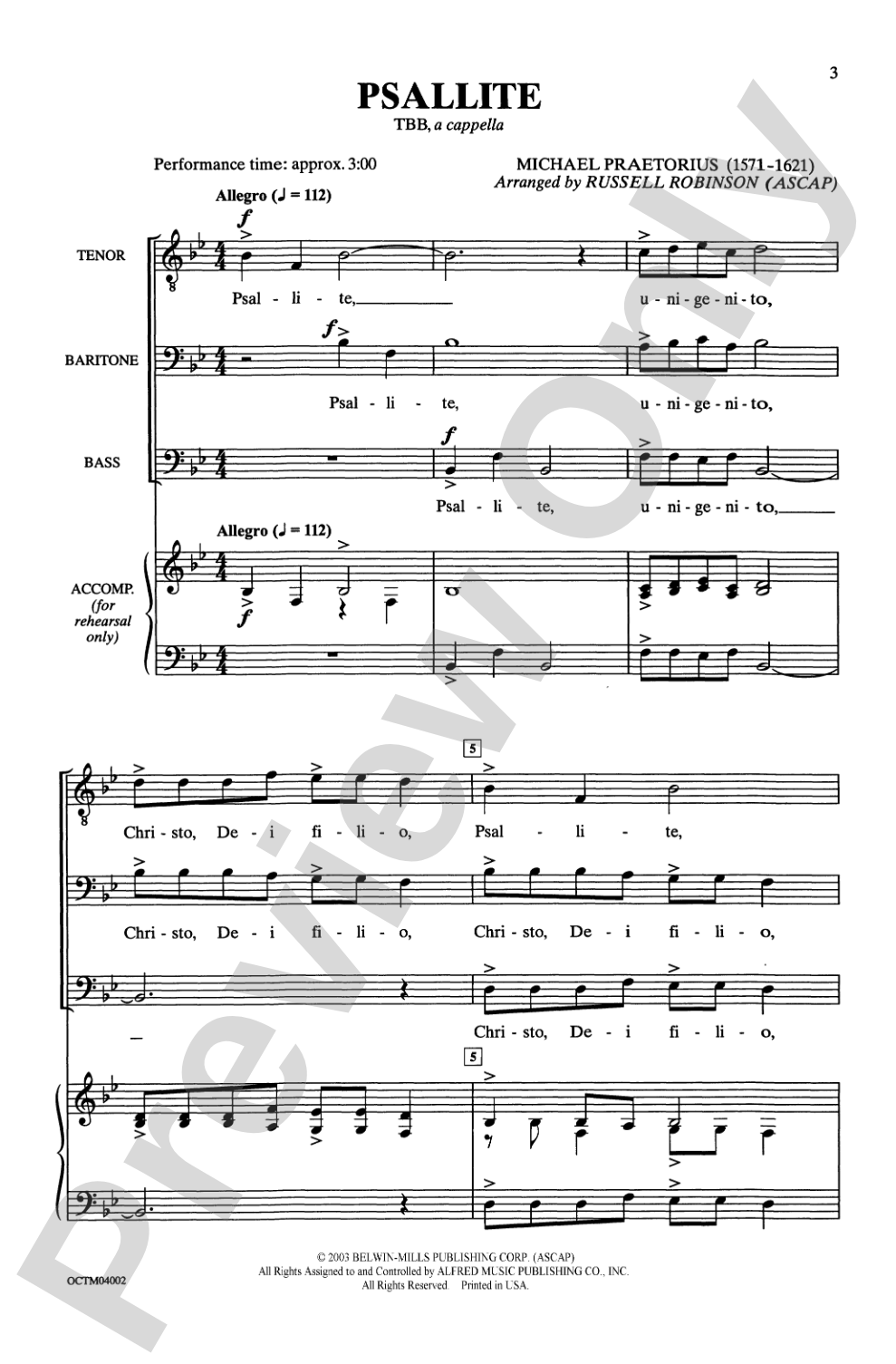
This well-known song by Praetorius from the German Renaissance period has long been a part of our choral repertoire. Russell Robinson has created an easy-to-sing SATB setting as well as a three-part men's edition. A perfect way to present standard choral repertoire to your developing choirs.


Psallite: TBB, a cappella Choral Octavo isn't in MakeMusic Cloud just yet...but it could be. Let us know you'd like to see it, and you'll help shape what comes next. In the meantime, start a free trial and dive into thousands of interactive titles your students can play along with today.
Request This Title
Tell us you want it.
Start Your Free Trial
Explore everything that's ready to play right now.
Sample Audio
No sample audio found.
Sample Video
No sample videos found.
Additional Details
Series:
Alfred Archive Edition: Belwin Festival Series
Publisher:
Alfred Music
Page Count:
12
SKU:
00-PO-0003048
More about this title
About the Composer: Michael Praetorius
Michael Praetorius (1571-1621) was a prolific German composer, theorist, and organist whose output shaped the transition from Renaissance to Baroque music across Northern Europe. His vast catalog includes over 1200 compositions spanning sacred vocal works, instrumental music, and liturgical settings, many of which remain foundational to choral pedagogy today.
Pretorius served as Kapellmeister at the court of the Duke of Brunswick-Lüneburg and documented his compositional methods in his three-volume treatise Syntagma Musicum, making him both a creator and a theorist of enduring influence. His settings are prized in education for their accessibility, clear voice leading, and ability to convey sacred meaning without technical overreach.
Why we love this
Russell Robinson's three-part men's arrangement makes this Renaissance masterwork singable for developing choirs without diluting its musical substance. The moderate difficulty level and a cappella format let young singers focus on blend, intonation, and the elegant simplicity that makes Praetorius's writing so enduring, and the piece fits naturally into both liturgical and concert programs.
What to expect
A serene, processional quality with moments of quiet dignity. The piece unfolds with Renaissance restraint, favoring clarity and balance over drama, creating a calm, meditative space that feels both ancient and immediate.
Who it's for
Treble-bass choirs and developing men's ensembles looking to build skill and confidence with a cappella repertoire. This arrangement suits singers in grades 6-9 who are ready for part-singing clarity but benefit from music that sounds sophisticated without overwhelming technical demands.
How to get the most out of it
- Balance the melodic line across all three parts; avoid letting the top voice dominate. Praetorius's voice leading distributes musical interest intentionally.
- Shape phrases with long, sustained breath support rather than artificial breaks. A cappella singing reveals every intonation shift, so steady tone and collective listening are essential.
- Let the text shape your phrasing and articulation. Even without a translation, the rhythm and contour of the German words will guide natural expression.
How to use it
Program this during winter concerts or holiday services where you want to anchor the program with something substantive and recognizable. It also works well as a festival selection, paired with a contemporary piece to show range, or as a concert opener to set a reverent tone.
Skills your students will build
- A cappella intonation and blend in three-part voicing
- Phrase shaping without instrumental support
- Clear enunciation of Renaissance German text
- Voice independence while maintaining harmonic awareness
- Reading and performing Baroque-era sacred music