

Psallite: SATB, a cappella Choral Octavo
By Michael Praetorius / arr. Russell Robinson
Level: Moderate
Item: 00-PO-0005177
$2.25
Minimum order quantity: 20 copies
Pickup currently not available
Related Items
Psallite: SAB, a cappella Choral Octavo |
$2.25
|
View | |
Psallite: SSA, a cappella Choral Octavo |
$2.25
|
View | |
Psallite: TBB, a cappella Choral Octavo |
$2.25
|
View | |
Psallite: SATB, a cappella Choral Octavo |
$2.25
|
View | |
Psallite: SAB, a cappella Choral Octavo |
$2.25
|
View | |
Psallite: SSA, a cappella Choral Octavo |
$2.25
|
View | |
Psallite: TBB, a cappella Choral Octavo |
$2.25
|
View |
Description
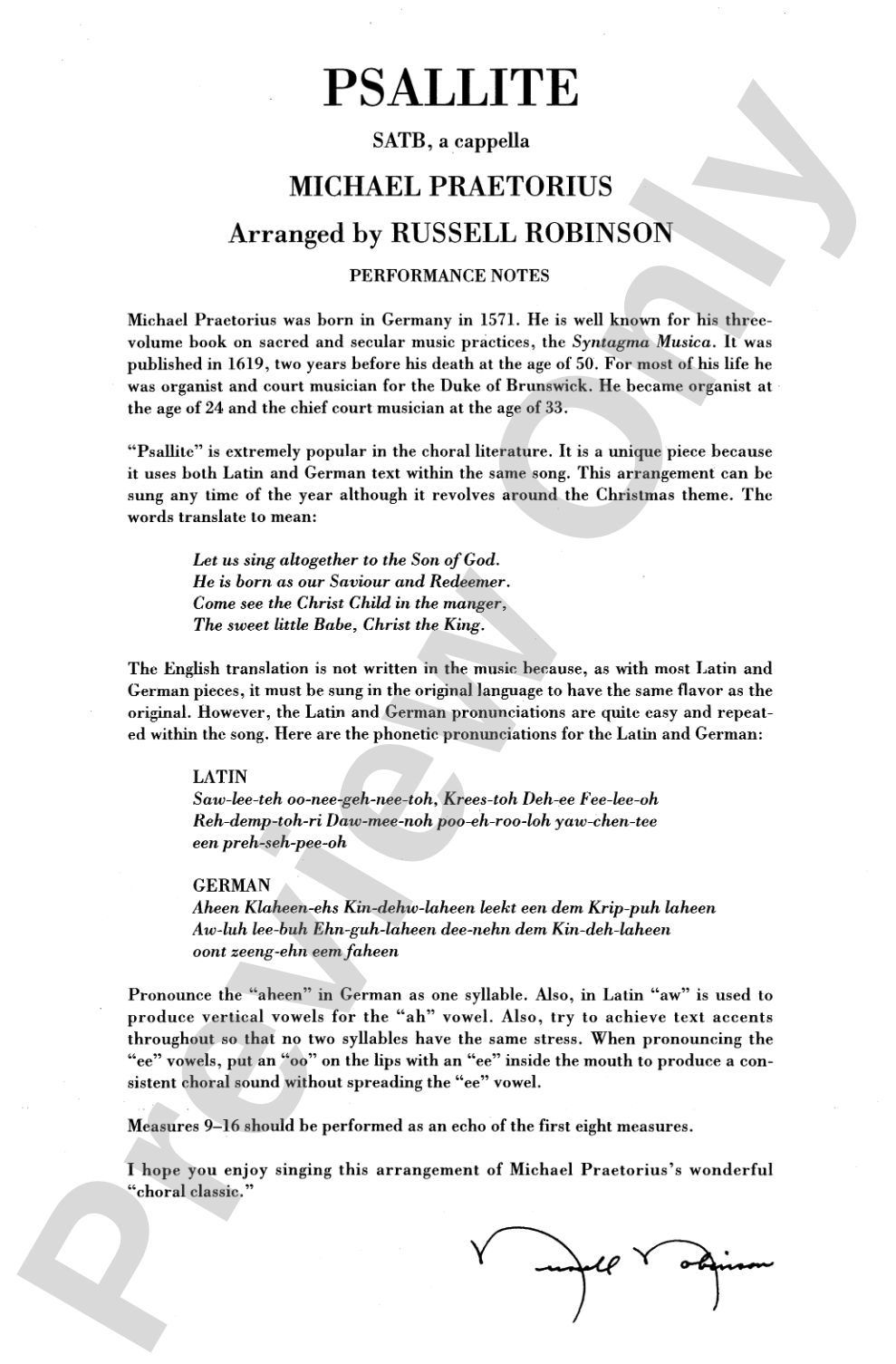
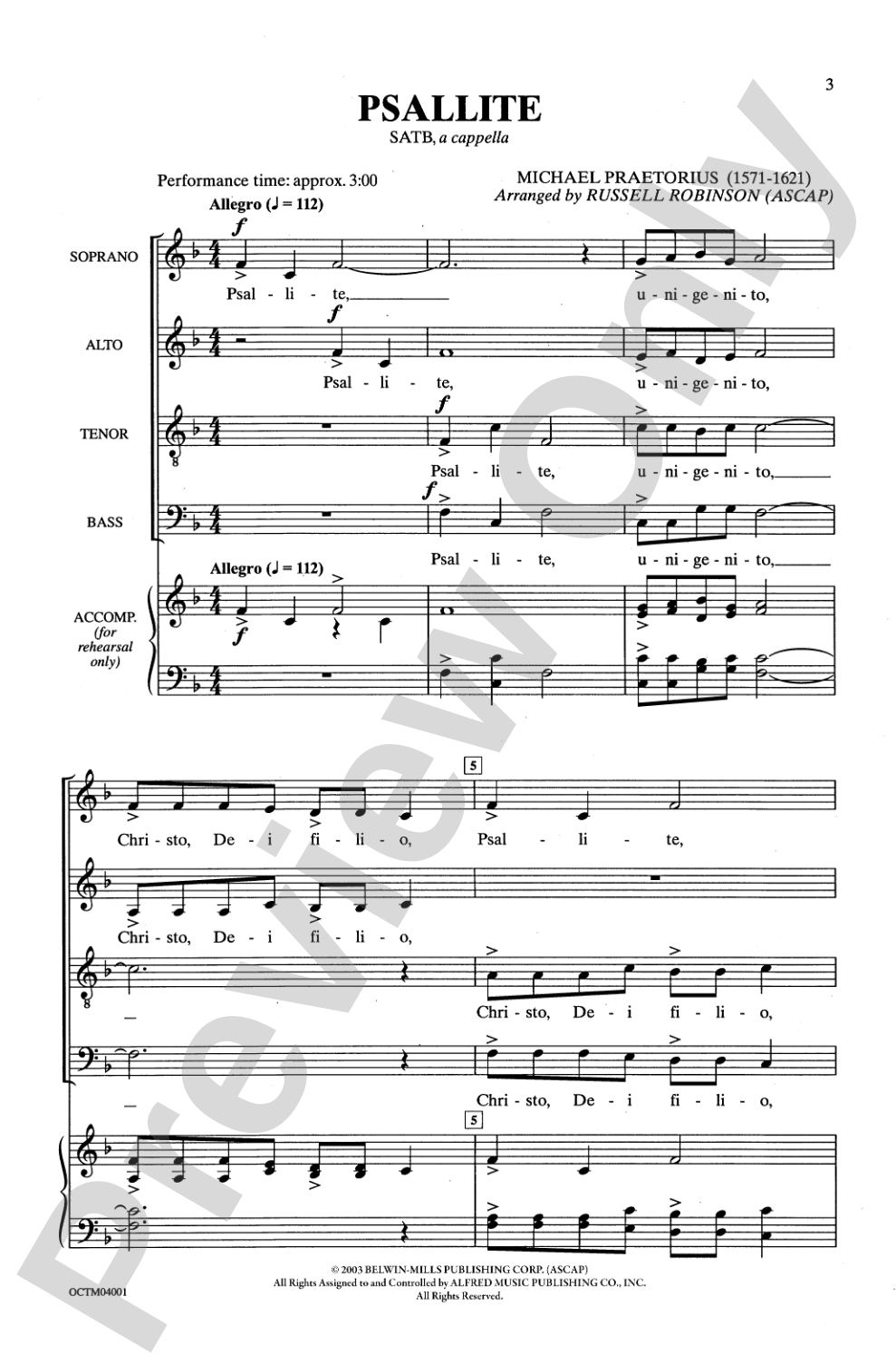
This well-known song by Praetorius from the German Renaissance period has long been a part of our choral repertoire. Russell Robinson has created an easy-to-sing SATB setting as well as a three-part men's edition. A perfect way to present standard choral repertoire to your developing choirs.


Psallite: SATB, a cappella Choral Octavo isn't in MakeMusic Cloud just yet...but it could be. Let us know you'd like to see it, and you'll help shape what comes next. In the meantime, start a free trial and dive into thousands of interactive titles your students can play along with today.
Request This Title
Tell us you want it.
Start Your Free Trial
Explore everything that's ready to play right now.
Sample Audio
No sample audio found.
Sample Video
No sample videos found.
Additional Details
Series:
Alfred Archive Edition: Belwin Mills Catalog
Publisher:
Alfred Music
Page Count:
12
SKU:
00-PO-0005177
More about this title
About the Composer: Michael Praetorius
Michael Praetorius (1571-1621) was a German composer, theorist, and music director whose prolific output shaped the musical language of the late Renaissance and early Baroque. Working primarily in Saxony, he composed over 1,200 works across nearly every genre available to him: sacred motets, chorale settings, dances, and instrumental music. His compositional approach balanced the formal structures of the Renaissance with emerging Baroque sensibilities, making his music accessible to both skilled musicians and developing ensembles.
Praetorius remains central to choral education because his melodies are singable, his harmonic writing is direct, and his understanding of how voices fit together reflects decades of practical experience directing choirs and musicians. His arrangements and settings of traditional melodies demonstrated how to honor a tune while giving it new life, a principle that continues to guide choral arrangers today.
Why we love this
Russell Robinson's setting brings Praetorius into the reach of Grade 3 choirs without sacrificing the piece's dignity or musical substance. The arrangement respects the original melody while using accessible voice leading and straightforward harmonic rhythm, giving developing singers a genuine encounter with Renaissance masterwork literature rather than a simplified approximation of it.
What to expect
Psallite carries a quiet joy, the kind of song that feels both ancient and intimate. The a cappella texture creates stillness; without instrumental support, each voice becomes essential to the sound, and the singers themselves become the instrument. There is clarity in simplicity here, and dignity in restraint.
Who it's for
This octavo serves Grade 3 choirs seeking to program Renaissance repertoire without requiring advanced technical skills or extensive rehearsal time. It works equally well for festival programming, holiday concerts, or chapel services where singers need a piece that sounds polished while remaining achievable.
How to get the most out of it
- Shape each phrase with gentle dynamic rise and fall rather than singing at a single volume throughout; allow the text and melodic contour to guide your shaping decisions.
- Balance the soprano line (which carries the primary melody) so it leads without overwhelming the other voices, particularly when lower voices move in supporting motion.
- Establish clear vowel shapes before adding text; the a cappella context means every vowel color affects tuning and blend, so standardize your approach across all four parts.
- Consider the historical context of this carol as an invitation to sing; approach the piece with warmth rather than formality, allowing the text to come through naturally.
How to use it
Program this alongside other seasonal music during holiday concerts to anchor your program with literature that has endured for centuries; its moderate demands mean you can rehearse it efficiently while still achieving a meaningful performance. It also pairs well in a concert sequence that moves between different eras of choral writing, providing a bridge between secular and sacred repertoire or between Renaissance and modern pieces.
Skills your students will build
- Blending voices in a cappella SATB texture without instrumental reference
- Sustaining pure vowel sounds while maintaining intonation across phrase lengths
- Balancing four independent melodic lines so each voice is heard but the ensemble sounds unified
- Reading and performing Renaissance-era harmonic progressions and text expression