

Psallite: SAB, a cappella Choral Octavo
By Michael Praetorius / arr. Russell Robinson
Item: 00-PO-0003076
$2.25
Minimum order quantity: 20 copies
Pickup currently not available
Related Items
Psallite: SATB, a cappella Choral Octavo |
$2.25
|
View | |
Psallite: SSA, a cappella Choral Octavo |
$2.25
|
View | |
Psallite: TBB, a cappella Choral Octavo |
$2.25
|
View | |
Psallite: SATB, a cappella Choral Octavo |
$2.25
|
View | |
Psallite: SAB, a cappella Choral Octavo |
$2.25
|
View | |
Psallite: SSA, a cappella Choral Octavo |
$2.25
|
View | |
Psallite: TBB, a cappella Choral Octavo |
$2.25
|
View |
Description
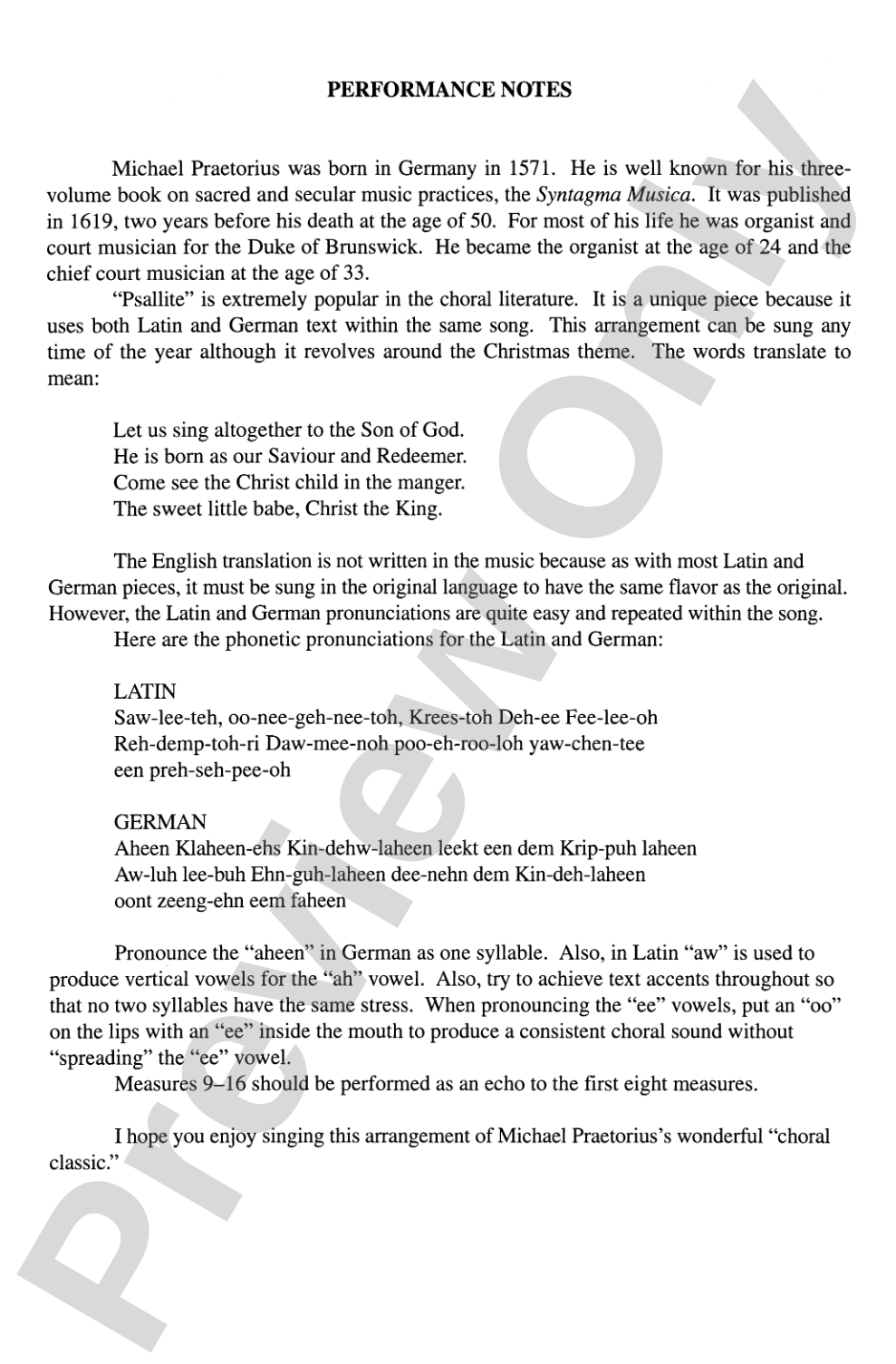
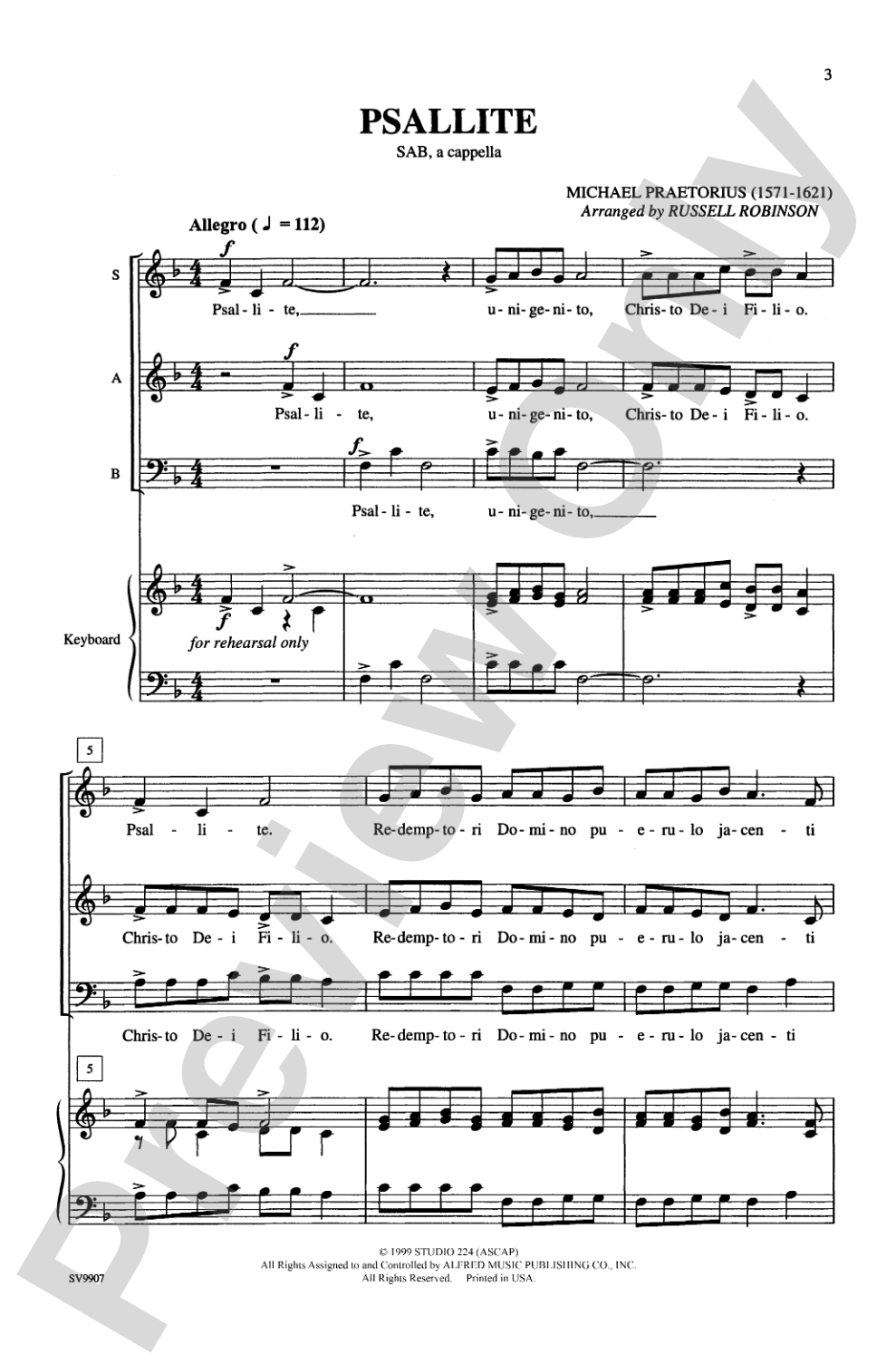
This well-known song by Praetorius from the German Renaissance period has long been a part of our choral repertoire. Russell Robinson has created an easy-to-sing SATB setting as well as a three-part men's edition. A perfect way to present standard choral repertoire to your developing choirs.


Psallite: SAB, a cappella Choral Octavo isn't in MakeMusic Cloud just yet...but it could be. Let us know you'd like to see it, and you'll help shape what comes next. In the meantime, start a free trial and dive into thousands of interactive titles your students can play along with today.
Request This Title
Tell us you want it.
Start Your Free Trial
Explore everything that's ready to play right now.
Sample Audio
No sample audio found.
Sample Video
No sample videos found.
Additional Details
Series:
Alfred Archive Edition: Studio PR Catalog
Publisher:
Alfred Music
Page Count:
8
SKU:
00-PO-0003076
More about this title
About the Composer: Michael Praetorius
Michael Praetorius (1571-1621) was a German composer, theorist, and editor whose vast output shaped the musical landscape of the late Renaissance and early Baroque. Working primarily in the court and church music traditions of northern Germany, he composed over 1,200 works across virtually every genre of his era, from sacred motets to instrumental dances. His practical approach to composition and his gift for memorable melodic lines made his music accessible to singers of varying abilities, a characteristic that ensured his pieces remained central to choral repertoires for centuries.
Beyond his compositional legacy, Praetorius documented the musical practices of his time in his three-volume treatise Syntagma Musicum, which remains an invaluable resource for understanding Renaissance and Baroque performance practice. His ability to balance musical sophistication with singability made him a favorite among choral directors seeking repertoire that engages developing singers without sacrificing artistic substance.
Why we love this
Robinson's arrangement opens this Renaissance masterwork to singers who aren't yet ready for four-part writing, preserving the essence of Praetorius's melody while creating natural voice lines that build confidence. The a cappella texture strips away any harmonic crutches, forcing your singers to listen to each other and develop genuine ensemble awareness. It's the kind of piece that sounds substantial in performance but won't drain rehearsal time on technical hurdles.
What to expect
Psallite radiates quiet reverence with an almost hymn-like simplicity that lets text and melody speak without decoration. The three-part texture creates warmth and intimacy rather than architectural grandeur, inviting singers into a more conversational relationship with the music.
Who it's for
Developing mixed choirs seeking Renaissance masterworks without the complexity of full four-part writing. This voicing serves middle school choirs, community ensembles, and high school groups transitioning into more sophisticated repertoire.
How to get the most out of it
- Balance the soprano line carefully; it carries the familiar melody and will naturally project, so shape it with restraint to let the alto and bass parts emerge as independent voices rather than mere accompaniment.
- Emphasize the text-driven phrasing over metric regularity. Allow the words to guide your singers' breath and musical gestures, which strengthens diction and creates a more organic, less mechanical sound.
- Lock in the harmonic foundation by spending time on the bass part first. Once the lowest voices establish the harmonic rhythm confidently, the sopranos can sing with freedom and the middle voices will find their place.
How to use it
Program this during the winter concert season alongside other Renaissance sacred works to create a short thematic set, or pair it with a modern a cappella arrangement to show your audience the through-line of choral writing across centuries. Its modest technical demands also make it an ideal opener for a concert, warming up both singers and listeners before tackling more demanding repertoire.
Skills your students will build
- Reading three-part treble-alto-bass voicing
- Sustaining intonation in a cappella performance
- Text-driven phrasing in Renaissance vocal music
- Listening for independent voice lines while maintaining ensemble blend
- Historical context for Baroque/Renaissance sacred repertoire