

Peaceful Things: 2-Part Choral Octavo
Words and music by Mary Donnelly and George L. O. Strid
Item: 00-PO-0003668
$1.90
Minimum order quantity: 20 copies
Pickup currently not available
Description
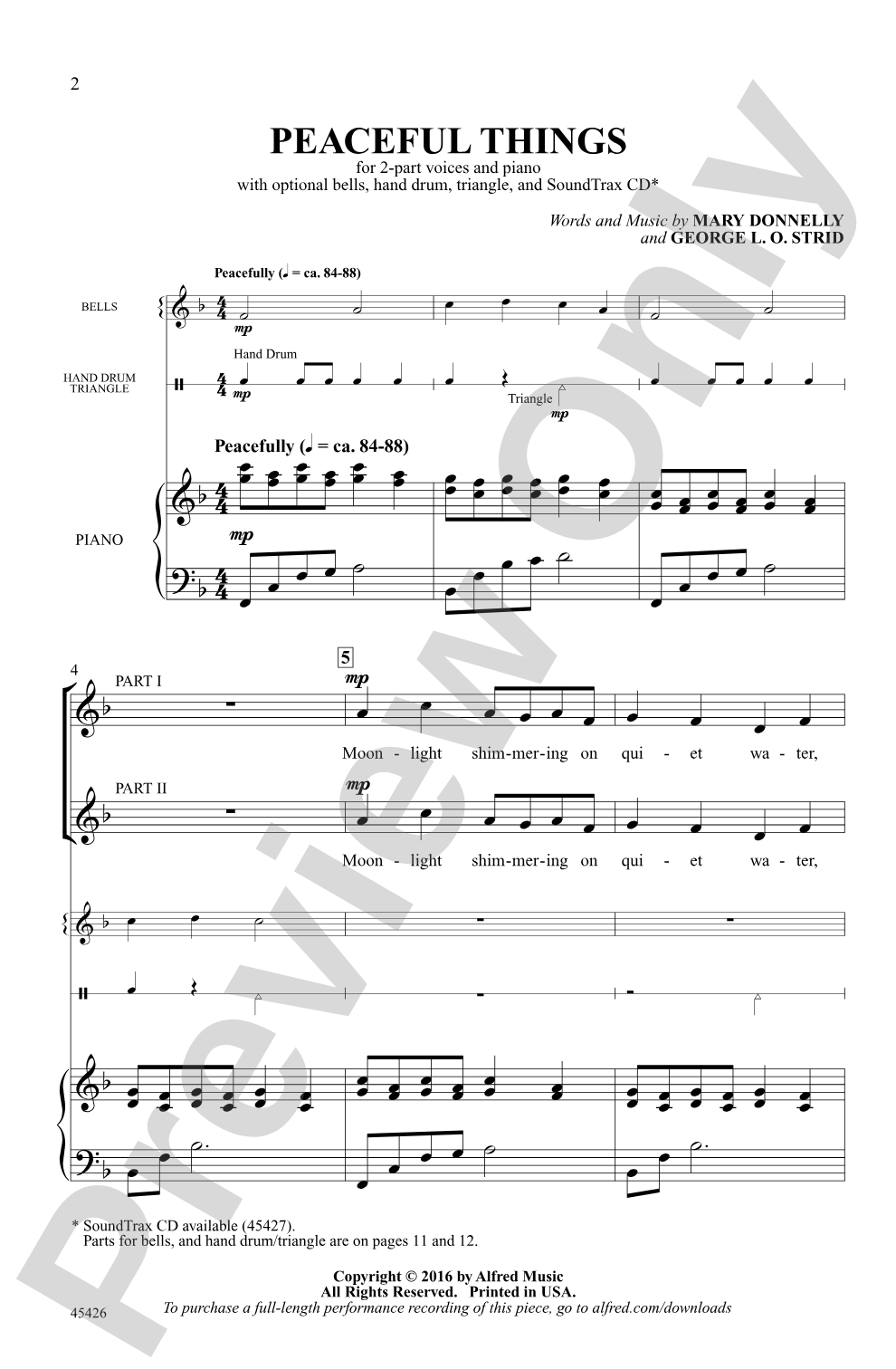
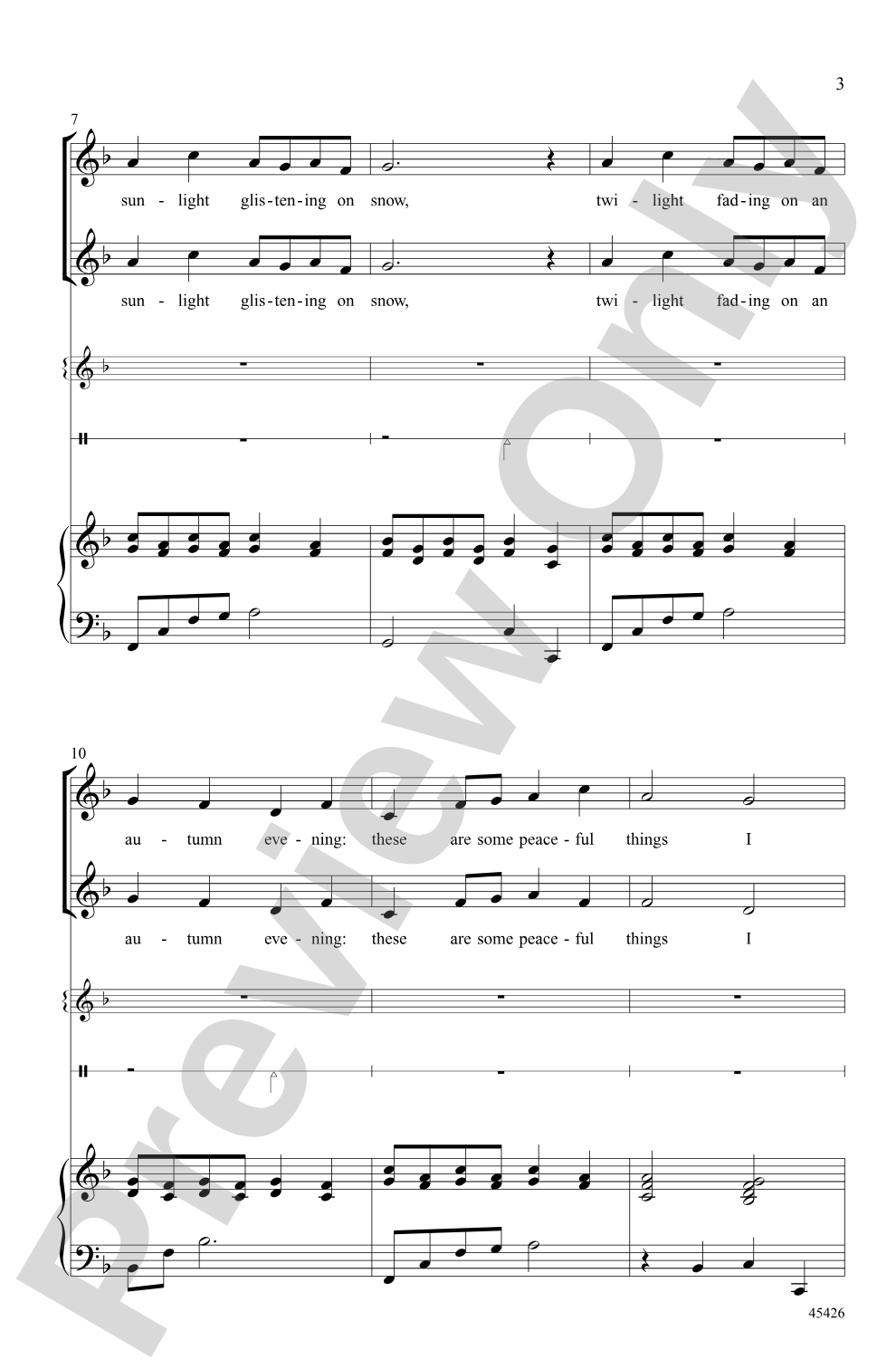
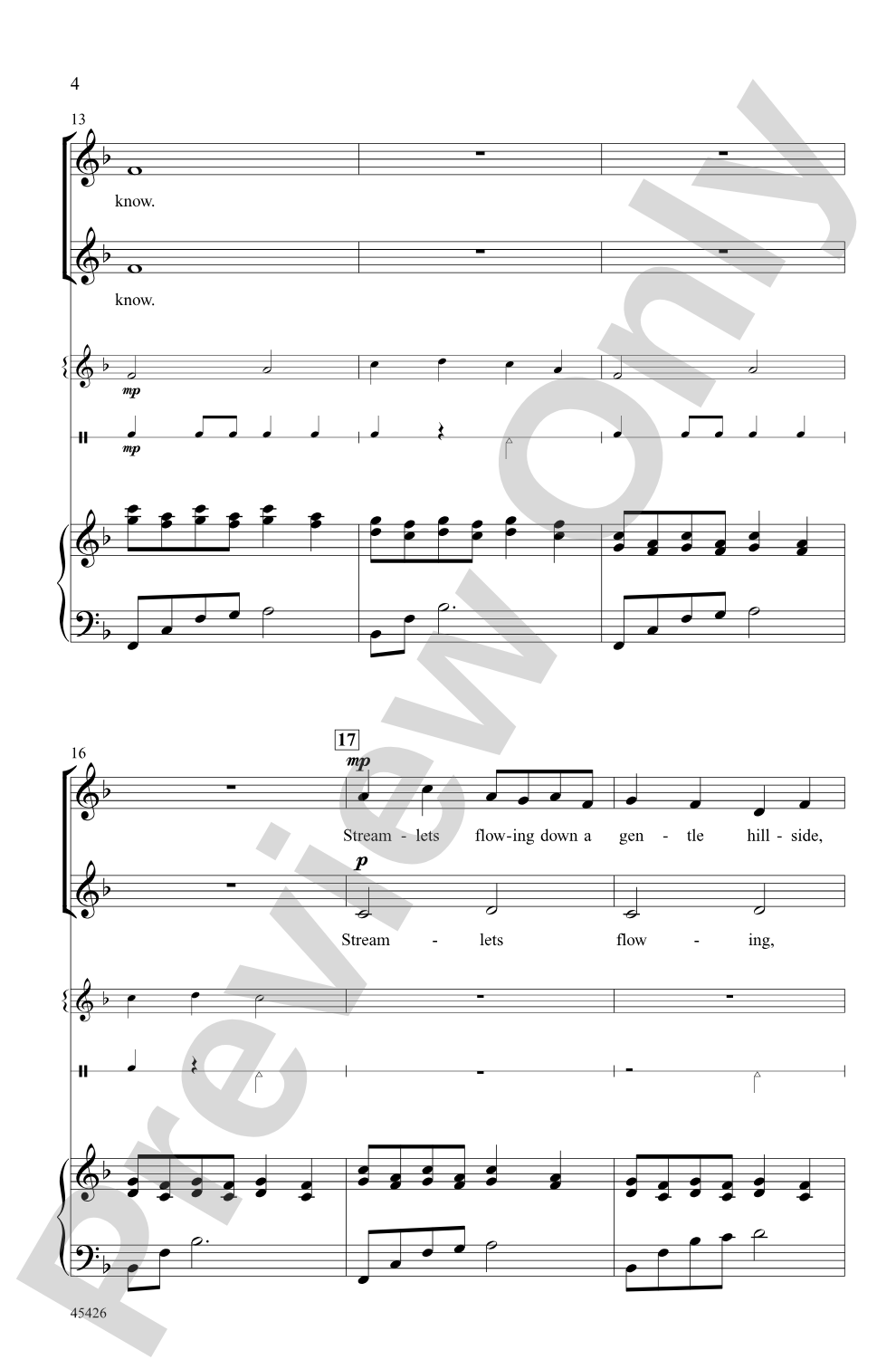
An easily-sung pentatonic melody, a text rich in imagery, and a supportive piano part make this soothing song an ideal selection for beginning choirs. The patterning of the optional bell, triangle, and hand drum parts make them easy to learn for young players: a great way to incorporate classroom and Orff instruments!


Peaceful Things: 2-Part Choral Octavo isn't in MakeMusic Cloud just yet...but it could be. Let us know you'd like to see it, and you'll help shape what comes next. In the meantime, start a free trial and dive into thousands of interactive titles your students can play along with today.
Request This Title
Tell us you want it.
Start Your Free Trial
Explore everything that's ready to play right now.
Sample Audio
1
Audio File
--:--
0:00
0:00
Sample Video
Additional Details
Series:
Alfred Choral Designs
Publisher:
Alfred Music
Page Count:
12
SKU:
00-PO-0003668
Instrumentation:
with Opt. Bell, Triangle & Hand Drum
More about this title
About the Composer: Mary Donnelly

Mary Donnelly grew up in Reno, Nevada, and completed her Bachelor of Arts in English and French at the University of Nevada, Reno. While still an undergraduate, she discovered her passion for choral work by helping establish two children's choruses, a experience that redirected her toward music education. She went on to earn a Master's Degree in Education from Lesley College in Cambridge, Massachusetts, where she studied the integration of arts across the curriculum.
Donnelly spent thirty years teaching general music and choir in the Washoe County School District, retiring as an active educator. In 1985, while team-teaching a sixth-grade general music class with George Strid, their principal requested they compose a musical for Reading Week. That collaboration produced "The Million Dollar Mystery" and launched a prolific partnership that has generated over two hundred songs and twenty-five musicals. She holds memberships in ACDA, NEA, and ASCAP.
Why we love this
Donnelly and Strid have crafted a piece that respects young singers' abilities while creating a genuinely musical experience. The pentatonic melody removes the anxiety of accidental notes, allowing singers to focus on tone, blend, and text interpretation. The optional percussion parts (bell, triangle, hand drum) provide a natural entry point for classroom instrument integration without overwhelming rehearsal time.
What to expect
Calm and contemplative, with an unhurried quality that invites reflection. The pentatonic melody sits naturally in the voice and creates an almost hymn-like quality, while the imagery-rich text anchors singers in a peaceful, meditative space. There's a quiet confidence in the writing that makes young singers feel capable and musical.
Who it's for
Beginning and developing choirs in elementary and middle school will find this piece immediately rewarding to learn and sing. The pentatonic framework eliminates reading difficulty while the lyrical, accessible text keeps young singers engaged in storytelling. This is also an excellent choice for choirs seeking to incorporate Orff instruments into their programming without complex coordination.
How to get the most out of it
- Balance the two parts by having singers listen across parts during warm-ups; the supportive piano voicing makes this easier than it might be otherwise.
- If using classroom instruments, introduce the percussion parts after the choir has settled the melody and second part; the rhythmic patterning Donnelly and Strid built in makes this a quick add.
- Let the text imagery guide your interpretation. Though the music is soothing, encourage singers to paint the scenes with their phrasing rather than singing in a flat, undifferentiated way.
- Record a practice track featuring just the piano part and distribute it; young singers often internalize their line more effectively when they can sing against the accompaniment at home.
How to use it
Program this as a concert opener to establish a reflective tone, or place it strategically as a palate-cleansing piece between more energetic selections. It works equally well as a festival or contest entry for beginning-level choirs, or as a classroom performance piece when you want to showcase both vocal and instrumental learning in one number.
Skills your students will build
- Reading and singing pentatonic melody
- Two-part vocal blend and balance
- Sustaining tone in longer phrases
- Interpreting text through musical phrasing
- Basic rhythm in optional percussion parts
- Listening across parts while singing