
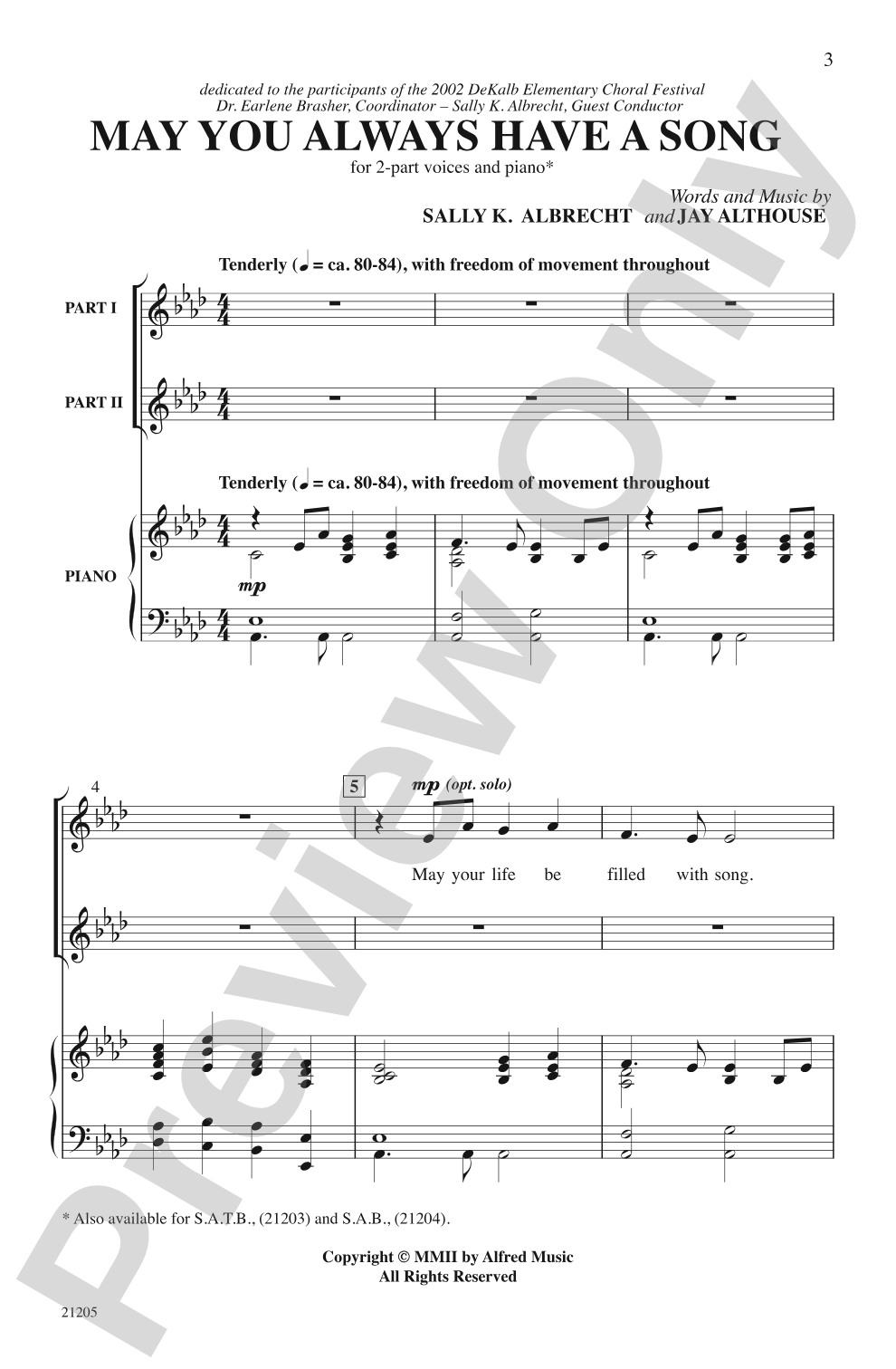

May You Always Have a Song: 2-Part Choral Octavo
Music by Sally K. Albrecht and Jay Althouse
Item: 00-PO-0002894
$2.25
Minimum order quantity: 20 copies
Pickup currently not available
Related Items
May You Always Have a Song: SATB Choral Octavo |
$2.25
|
View | |
May You Always Have a Song: SAB Choral Octavo |
$2.25
|
View | |
May You Always Have a Song: SATB Choral Octavo |
$2.25
|
View | |
May You Always Have a Song: SAB Choral Octavo |
$2.25
|
View | |
May You Always Have a Song: 2-Part Choral Octavo |
$2.25
|
View |
Description
"May your life be filled with song. And may your friends all sing along." These two simple sentences begin the heartfelt text of this lovely choral ballad. The melodies are equally beautiful in their simplicity. Easy piano accompaniment and conventional vocal writing make this piece an excellent choice for any concert. Use it as a concert closer throughout the year; by spring it will be a meaningful work for your graduating students.


May You Always Have a Song: 2-Part Choral Octavo isn't in MakeMusic Cloud just yet...but it could be. Let us know you'd like to see it, and you'll help shape what comes next. In the meantime, start a free trial and dive into thousands of interactive titles your students can play along with today.
Request This Title
Tell us you want it.
Start Your Free Trial
Explore everything that's ready to play right now.
Sample Audio
1
Audio File
--:--
0:00
0:00
Sample Video
No sample videos found.
Additional Details
Series:
Alfred Archive Edition: Alfred Choral Designs
Publisher:
Alfred Music
Page Count:
8
SKU:
00-PO-0002894
More about this title
About the Composer: Sally K. Albrecht
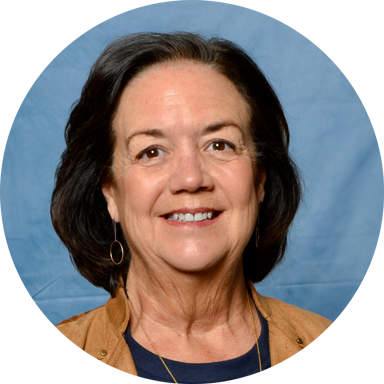
Sally K. Albrecht has shaped American choral music for over three decades, earning the ASCAP Special Music Award annually since 1987 and publishing more than 600 choral works alongside 75 large-scale musicals and songbooks. Her reputation rests on a distinctive ability to blend accessibility with artistic integrity, a gift she honed through conducting honor choirs at venues including Lincoln Center, Carnegie Hall, and The Kennedy Center, and through her extensive tenure directing school choral publications at major educational publishers including Alfred Music.
Albrecht holds degrees from Rollins College (B.A. in Music and Theater, 1976), the University of Miami (M.A. in Drama, 1977; M.M. in Accompanying, 1979), and has taught at Oakland University, Jersey City State College, and Meredith College. She is a native of Cleveland, Ohio, and currently resides in Wake Forest, North Carolina, where she continues to compose alongside her husband, arranger and composer Jay Althouse. In 2021, she received the Distinguished Alumna Award from both the University of Miami Frost School of Music and Rollins College.
Why we love this
Albrecht and Althouse have crafted a piece that works as both an immediate success and a growing touchstone. The text is genuinely moving without being manipulative, and the melodies sit so naturally in the voices that students can focus on expression rather than mechanics. Its perfect balance of accessibility and substance makes it equally valuable as an early-season trust-builder or a spring finale that carries real emotional weight.
What to expect
Simple, sincere, and completely unpretentious. The melodies bloom naturally from the text, and the harmonic movement feels like a warm conversation rather than a composition. There's quiet wisdom here, the kind that stays with students long after the final note.
Who it's for
This piece sits perfectly in the repertoire of any choir working with developing or mixed voices in grades 5 and up. It's equally at home with a school choir, community ensemble, or church group seeking literature that teaches musicality without demanding technical virtuosity.
How to get the most out of it
- Let the text drive the phrasing. These simple, direct sentences work best when singers understand the underlying wish and sing through to the period rather than dividing phrases artificially.
- The piano accompaniment supports rather than surrounds the voices. Ensure the pianist doesn't rush the tempo or cover the two-part blend; clarity and restraint serve the piece.
- Build dynamic contrast gradually across the piece. Starting softly and allowing the piece to grow creates the sense of accumulation that makes the final statements land with meaning.
How to use it
Program this as your closer for any concert where you want to leave the audience with something genuinely felt. Its particular power emerges when used throughout the year, becoming a touchstone that connects each performance and arrives at graduation as a shared memory the class will carry forward.
Skills your students will build
- Singing sustained lines with phrase continuity in two-part writing
- Balancing ensemble blend while maintaining individual voice part clarity
- Responding to text as a guide for musical expression and phrasing
- Performing music that prioritizes emotional communication over technical display