
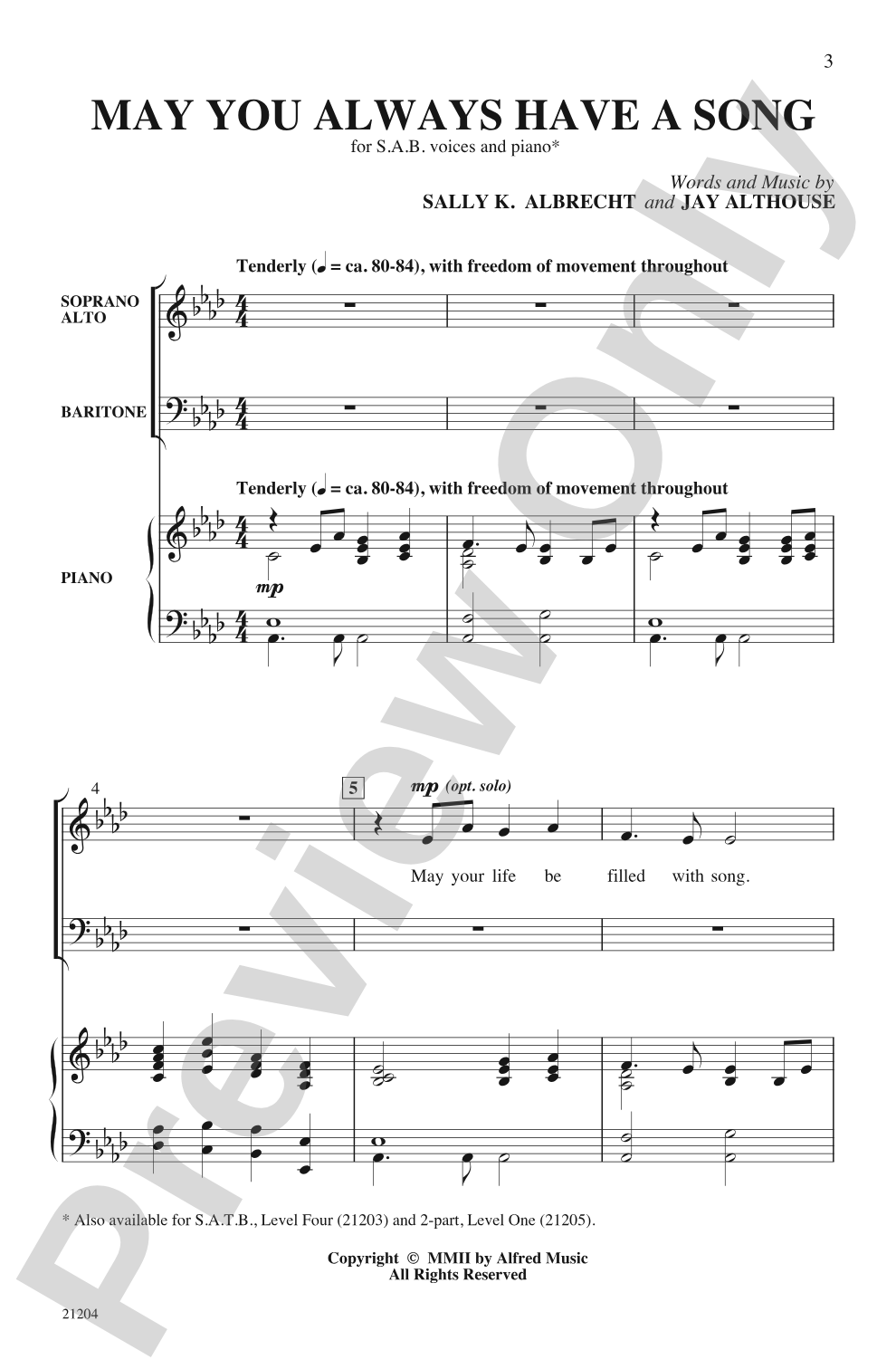

May You Always Have a Song: SAB Choral Octavo
Music by Sally K. Albrecht and Jay Althouse
Item: 00-PO-0002198
$2.25
Minimum order quantity: 20 copies
Pickup currently not available
Related Items
May You Always Have a Song: SATB Choral Octavo |
$2.25
|
View | |
May You Always Have a Song: 2-Part Choral Octavo |
$2.25
|
View | |
May You Always Have a Song: SATB Choral Octavo |
$2.25
|
View | |
May You Always Have a Song: SAB Choral Octavo |
$2.25
|
View | |
May You Always Have a Song: 2-Part Choral Octavo |
$2.25
|
View |
Description
"May your life be filled with song. And may your friends all sing along." These two simple sentences begin the heartfelt text of this lovely choral ballad. The melodies are equally beautiful in their simplicity. Easy piano accompaniment and conventional vocal writing make this piece an excellent choice for any concert. Use it as a concert closer throughout the year; by spring it will be a meaningful work for your graduating students.


May You Always Have a Song: SAB Choral Octavo isn't in MakeMusic Cloud just yet...but it could be. Let us know you'd like to see it, and you'll help shape what comes next. In the meantime, start a free trial and dive into thousands of interactive titles your students can play along with today.
Request This Title
Tell us you want it.
Start Your Free Trial
Explore everything that's ready to play right now.
Sample Audio
1
Audio File
--:--
0:00
0:00
Sample Video
No sample videos found.
Additional Details
Series:
Alfred Archive Edition: Alfred Choral Designs
Publisher:
Alfred Music
Page Count:
8
SKU:
00-PO-0002198
More about this title
About the Composer: Sally K. Albrecht
Sally K. Albrecht has shaped choral music education for over thirty years as a composer, conductor, and clinician with a distinctive focus on movement and engagement. Her catalog of more than 600 published choral works and 75 larger songbooks and musicals reflects her deep understanding of what works in rehearsal and on stage. She has conducted honor choirs at prestigious venues including Lincoln Center, Carnegie Hall, and The Kennedy Center, and served as Director of School Choral, Vocal, and Elementary Publications at major educational music publishers, most notably Alfred Music.
Albrecht holds degrees from Rollins College (B.A. in Music and Theater, 1976), the University of Miami (M.A. in Drama, 1977; M.M. in Accompanying, 1979), and has taught at Oakland University, Jersey City State College, and Meredith College. An annual ASCAP Special Music Award recipient since 1987, she has also received the Distinguished Alumna Award from both the University of Miami Frost School of Music and Rollins College. She lives in Wake Forest, North Carolina, with her husband, composer and arranger Jay Althouse.
Why we love this
The text itself becomes your teaching tool here. Those opening lines about living a life filled with song resonate deeply with students, especially seniors, and the piece invites genuine emotional investment rather than technical display. The straightforward vocal writing and accessible piano accompaniment mean your singers can focus on expressive singing and meaning rather than wrestling with ranges or rhythmic complexity, which allows the emotional message to land with real impact.
What to expect
Genuine and unhurried. The melodies sit naturally in the voice, inviting singers to deliver the message with warmth rather than strain. There's a quiet dignity here, the kind that comes from simplicity done with sincerity, making it particularly moving in moments of passage and reflection.
Who it's for
Choirs at any level who need a meaningful, emotionally grounded closing number. Works equally well for middle school groups looking for accessible three-part writing and high school or community choirs seeking a piece that honors transitions and celebrates lasting connection.
How to get the most out of it
- Bring out the text's warmth by encouraging singers to think about specific friends and moments as they sing, not just the melody line. The simplicity of the writing is actually an asset for authentic phrasing.
- Balance the three parts so the melody remains clear without overwhelming the supporting voices; this piece relies on blend and resonance rather than dramatic contrast.
- Give the accompanist time to shape the piano part expressively. The conventionality of the writing gives them room to add gentle rubato and dynamic shaping that the singers will follow naturally.
How to use it
Program this as your final selection in any concert, especially those celebrating milestones. Graduating classes and their families will recognize themselves in the message immediately, and the piece gains emotional weight through repeated performance across the school year, becoming a meaningful ritual by the time spring arrives.
Skills your students will build
- Three-part blend and balance in SAB writing
- Singing with expressive intention and emotional ownership
- Maintaining vocal line independence while listening to supporting parts
- Ensemble tone production that prioritizes warmth over volume