

Little Tree: 2-Part Choral Octavo
Inspired by a poem by e. e. cummings. Words by Sally K. Albrecht, music by Sally K. Albrecht and Jay Althouse
Item: 00-PO-0000383
$1.75
Minimum order quantity: 20 copies
Pickup currently not available
Related Items
Little Tree: SATB Choral Octavo |
$1.75
|
View | |
Little Tree: 3-Part Mixed Choral Octavo |
$1.75
|
View | |
Little Tree: SSA Choral Octavo |
$1.75
|
View | |
Little Tree: SATB Choral Octavo |
$1.75
|
View | |
Little Tree: 3-Part Mixed Choral Octavo |
$1.75
|
View | |
Little Tree: SSA Choral Octavo |
$1.75
|
View | |
Little Tree: 2-Part Choral Octavo |
$1.75
|
View |
Description
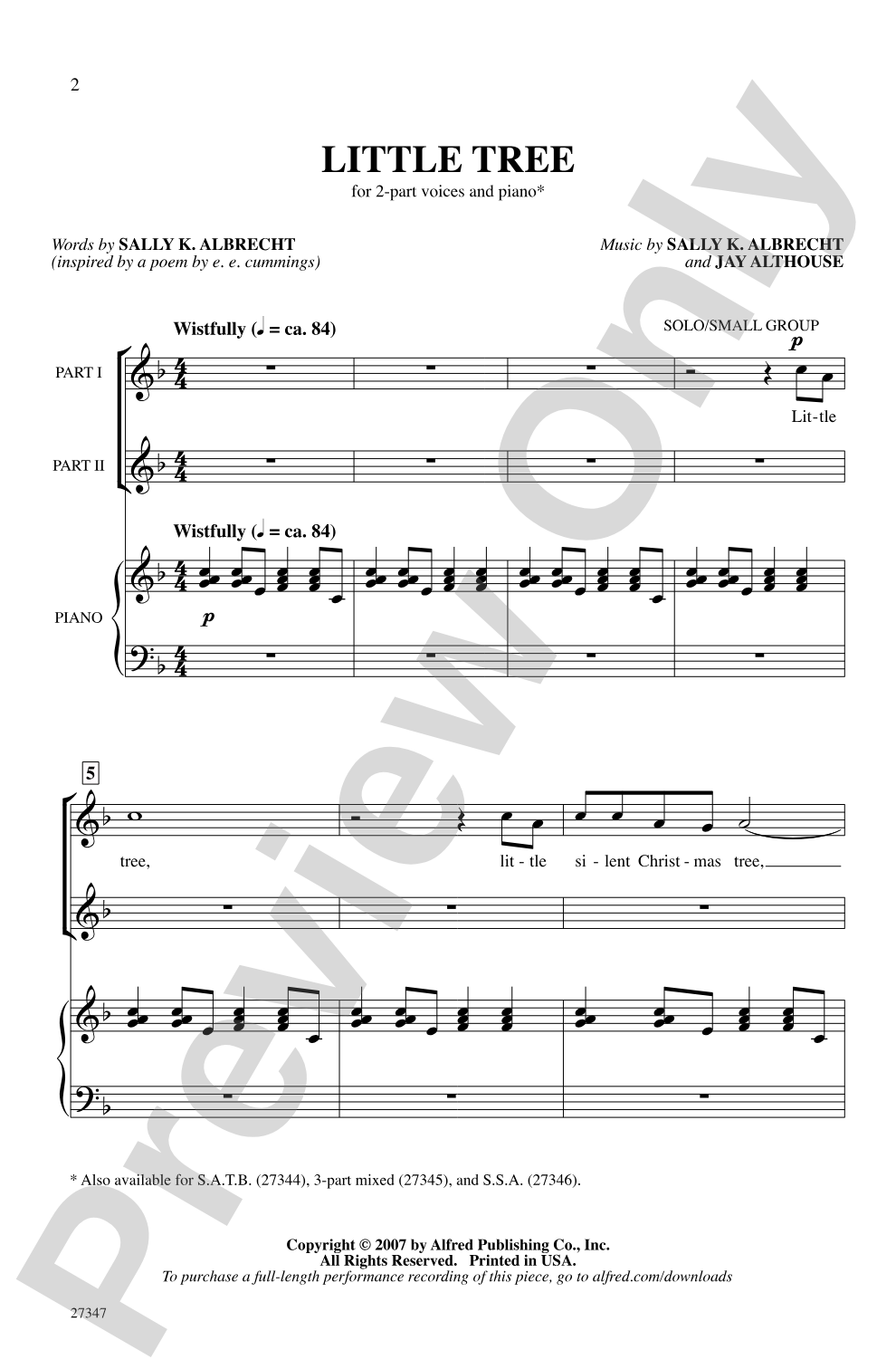
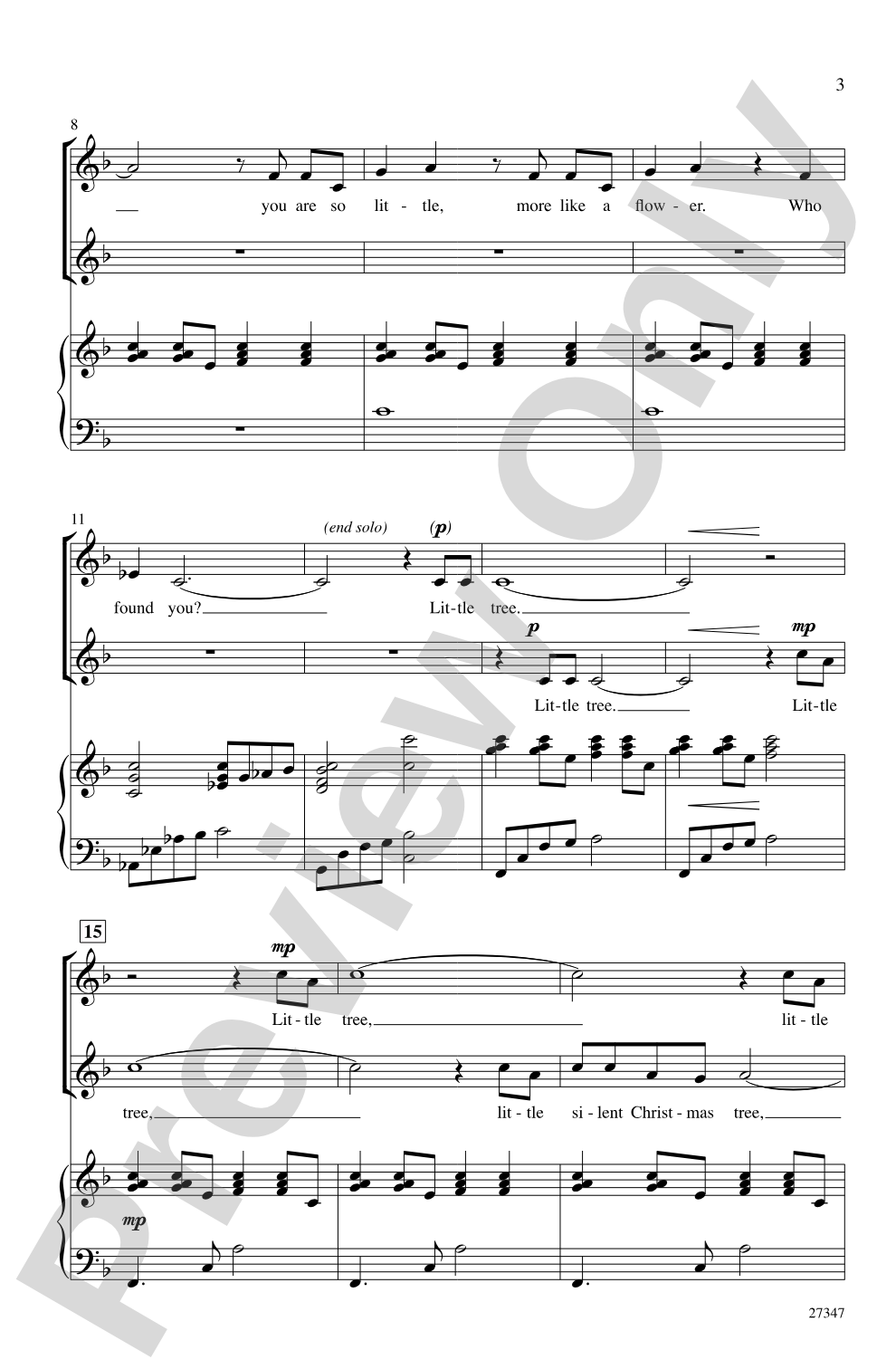
A charming and unique Christmas piece with lyrics inspired by a famous e. e. cummings poem. "Little silent Christmas tree, were you sorry to leave the forest?" The music, taking its cue from the text, is beautiful in its simplicity. An elegant change of pace for your holiday concerts. Features an optional solo or small group section.


Little Tree: 2-Part Choral Octavo isn't in MakeMusic Cloud just yet...but it could be. Let us know you'd like to see it, and you'll help shape what comes next. In the meantime, start a free trial and dive into thousands of interactive titles your students can play along with today.
Request This Title
Tell us you want it.
Start Your Free Trial
Explore everything that's ready to play right now.
Sample Audio
1
Audio File
--:--
0:00
0:00
Sample Video
No sample videos found.
Additional Details
Series:
Alfred Choral Designs
Publisher:
Alfred Music
Page Count:
8
SKU:
00-PO-0000383
More about this title
About the Composer: Sally K. Albrecht
Sally K. Albrecht has shaped choral music education for over thirty years, first as Director of School Choral, Vocal, and Elementary Publications at Alfred Music and other major publishers, and continuously as a composer, conductor, and clinician. Since 1987, she has been a recipient of the ASCAP Special Music Award annually, with more than 600 choral publications and 75 larger works in print. She has conducted honor choirs at prestigious venues including Lincoln Center, Carnegie Hall, and The Kennedy Center, and has taught at Oakland University, Jersey City State College, and Meredith College.
Albrecht holds a B.A. in Music and Theater from Rollins College (1976), an M.A. in Drama from the University of Miami (1977), and an M.M. in Accompanying from the University of Miami (1979). She served as Chair of the Board of Trustees for Omicron Delta Kappa National Leadership Honor Society and received their Pillar of Leadership award. In 2021, both the University of Miami Frost School of Music and Rollins College honored her with Distinguished Alumna Awards. She lives in Wake Forest, North Carolina, with her husband, composer and arranger Jay Althouse.
Why we love this
Albrecht and Althouse crafted this piece around the contemplative voice of e. e. cummings, letting the poem's gentle questioning shape every musical phrase. The 2-part texture keeps it accessible while the optional solo or small group passage adds an intimate moment that contrasts beautifully with the full ensemble sound, giving you programming flexibility without complexity. This is the kind of repertoire that makes singers want to listen to their own performance again.
What to expect
The music mirrors the poem's quiet wonder with elegant simplicity. There's a tenderness throughout that comes from genuine melodic writing rather than harmonic complexity, creating the feeling of a moment frozen in time. Singers experience the text as introspective and sincere, with the optional solo passage offering a chance for genuine musical storytelling.
Who it's for
This piece fits perfectly in choirs working toward festival or contest repertoire at the developing level, where singers benefit from clear melodic writing and manageable ranges. It also serves directors looking to add a secular Christmas work that doesn't depend on traditional carols or heavy arrangements.
How to get the most out of it
- Emphasize the stillness in the vocal writing; resist the urge to over-phrase. The simplicity is the strength.
- Shape the optional solo section with care so it lands as a true moment of reflection rather than just a technical feature.
- Consider how the piece sits in your concert order; its quiet dignity makes it an excellent closer or a powerful contrast after more energetic selections.
How to use it
Program this as a refreshing alternative to standard Christmas repertoire, using its reflective quality to create a mood shift in your holiday concert. It pairs well with more robust seasonal pieces and works equally well as a closing number that leaves audiences in a thoughtful space. The optional solo arrangement also makes it suitable for small choral festival or competition settings.
Skills your students will build
- Reading and singing independent 2-part voicing
- Interpreting poetry-driven text through musical phrasing
- Managing dynamics in music built on simplicity rather than range extremes
- Performing as part of a small ensemble within a larger choral context (optional solo section)