
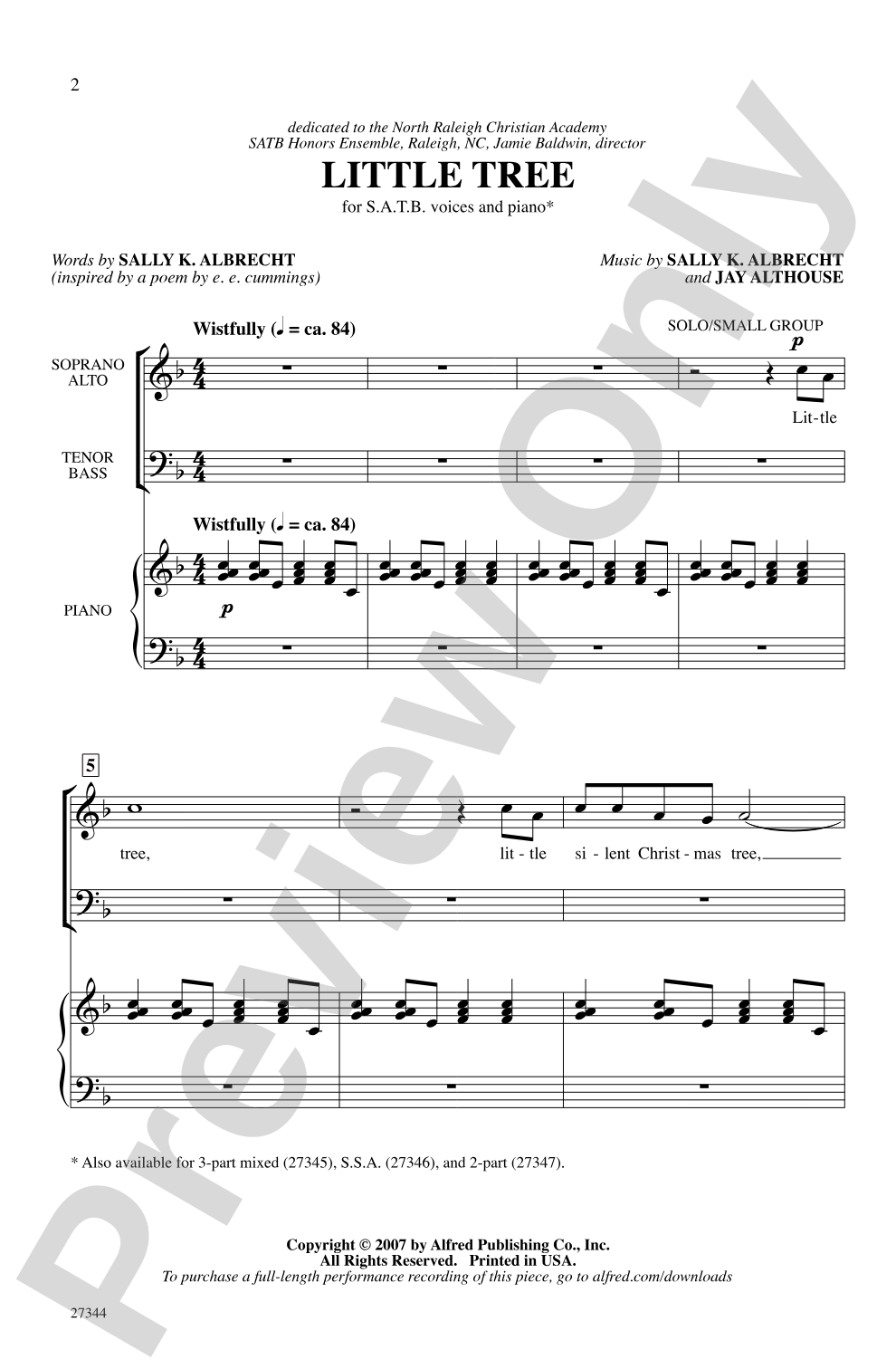

Little Tree: SATB Choral Octavo
Inspired by a poem by e. e. cummings. Words by Sally K. Albrecht, music by Sally K. Albrecht and Jay Althouse
Item: 00-PO-0000380
$1.75
Minimum order quantity: 20 copies
Pickup currently not available
Related Items
Little Tree: 3-Part Mixed Choral Octavo |
$1.75
|
View | |
Little Tree: SSA Choral Octavo |
$1.75
|
View | |
Little Tree: 2-Part Choral Octavo |
$1.75
|
View | |
Little Tree: SATB Choral Octavo |
$1.75
|
View | |
Little Tree: 3-Part Mixed Choral Octavo |
$1.75
|
View | |
Little Tree: SSA Choral Octavo |
$1.75
|
View | |
Little Tree: 2-Part Choral Octavo |
$1.75
|
View |
Description
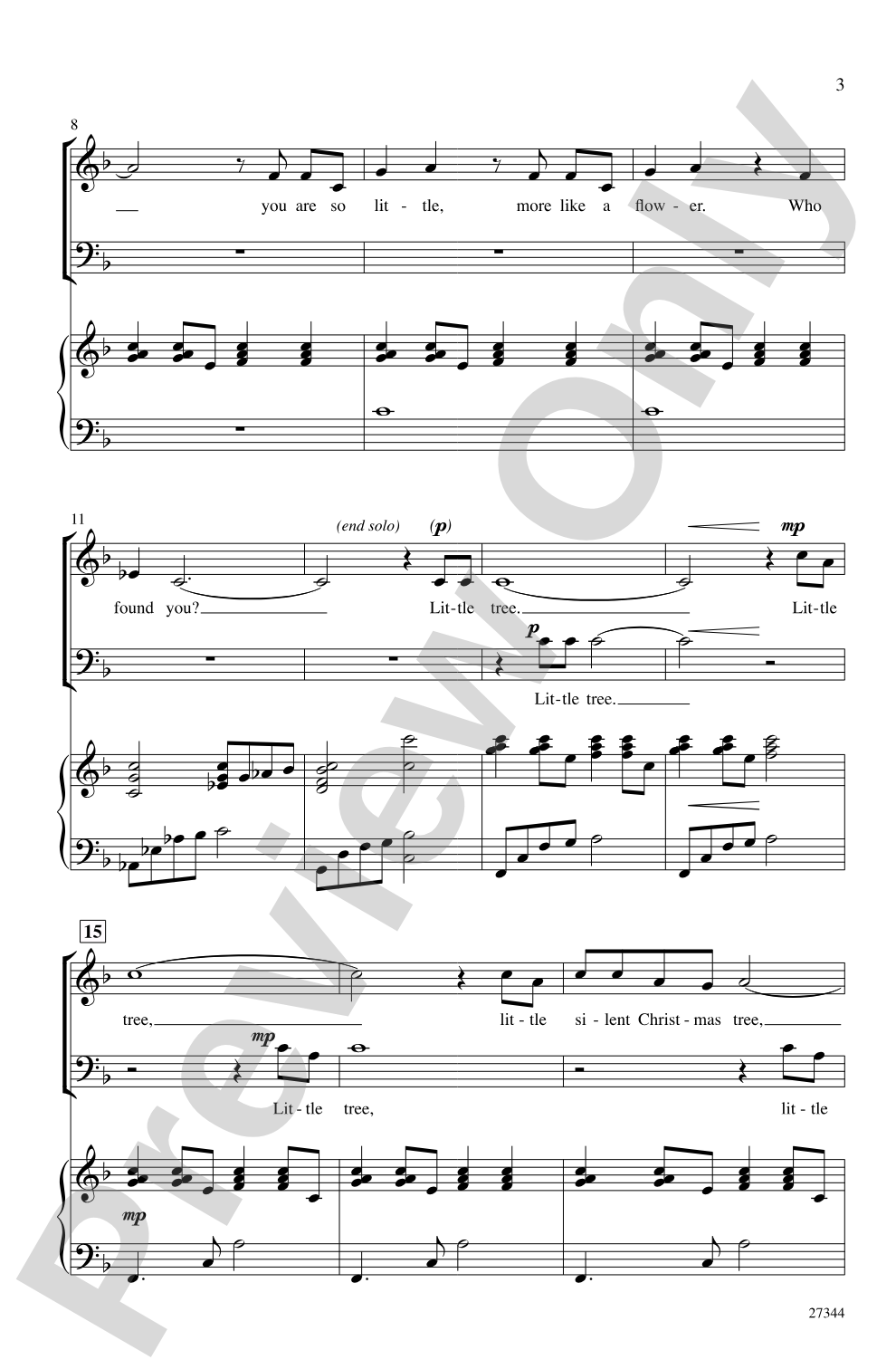
A charming and unique Christmas piece with lyrics inspired by a famous e. e. cummings poem. "Little silent Christmas tree, were you sorry to leave the forest?" The music, taking its cue from the text, is beautiful in its simplicity. An elegant change of pace for your holiday concerts. Features an optional solo or small group section.


Little Tree: SATB Choral Octavo isn't in MakeMusic Cloud just yet...but it could be. Let us know you'd like to see it, and you'll help shape what comes next. In the meantime, start a free trial and dive into thousands of interactive titles your students can play along with today.
Request This Title
Tell us you want it.
Start Your Free Trial
Explore everything that's ready to play right now.
Sample Audio
1
Audio File
--:--
0:00
0:00
Sample Video
No sample videos found.
Additional Details
Series:
Alfred Choral Designs
Publisher:
Alfred Music
Page Count:
8
SKU:
00-PO-0000380
More about this title
About the Composer: Sally K. Albrecht

Sally K. Albrecht has spent more than thirty years shaping choral music education as a composer, conductor, and clinician. Her catalog exceeds 600 published choral works alongside 75 full-length musicals and songbooks; she has been recognized annually by ASCAP for her contributions since 1987. She has guest-conducted honor choirs at major venues including Lincoln Center, Carnegie Hall, and The Kennedy Center, and served as Director of School Choral, Vocal, and Elementary Publications at Alfred Music for three decades.
Educationally rooted at Oakland University, Jersey City State College, and Meredith College, Albrecht holds degrees from Rollins College (B.A., 1976) and the University of Miami (M.A. in Drama, M.M. in Accompanying). She has received the Distinguished Alumna Award from both institutions and serves on Rollins' Board of Trustees. In 2021, she was honored as a "Pillar of Leadership" by the Omicron Delta Kappa National Leadership Honor Society. She lives in Wake Forest, North Carolina, with her husband and frequent collaborator, composer and arranger Jay Althouse.
Why we love this
The text drawn from e. e. cummings lends genuine literary weight to what could have been a standard holiday selection. Albrecht and Althouse honor the poem's quiet meditation with equally restrained music, creating a moment of genuine reflection in a season often filled with volume and spectacle. The optional solo section gives you flexibility in casting while maintaining the piece's intimate character.
What to expect
Quiet and spacious, with the gentle melancholy of winter reflected in natural daylight rather than stage lighting. The harmonic language is transparent and unpretentious, allowing the borrowed poetry to carry the emotional weight. There's an understated beauty here that accumulates through restraint rather than crescendo.
Who it's for
Choirs looking for a secular Christmas piece that respects both their singers' artistry and their audience's intelligence will find this especially valuable. It works equally well for high school and adult ensembles, community choirs, and contest or festival settings where musical substance matters as much as seasonal appeal.
How to get the most out of it
- Resist the urge to add dynamic excess. The simplicity of the harmonic palette rewards clarity and stillness rather than theatrical phrasing.
- If using the solo or small group section, choose singers comfortable with vulnerability. This moment asks for directness, not display.
- Balance the upper and lower voices evenly throughout. The piece relies on blend rather than sectional dominance to achieve its elegance.
- Shape phrases thoughtfully across the bar lines. Let the text's contemplative rhythm guide your tempo decisions rather than rushing toward resolution.
How to use it
Program this as a turning point in your holiday concert, perhaps between higher-energy selections or as the final offering before a closing carol. Its brevity and contemplative mood make it an excellent choice for a mixed program that needs textural and emotional contrast. Consider pairing it with other secular or contemporary holiday works rather than relegating it to a traditional carol section.
Skills your students will build
- Singing sustained, unadorned lines with precision and emotional commitment
- Balancing blend across four parts in intimate, close-voiced textures
- Interpreting poetry and matching phrasing to literary rather than purely musical phrases
- Performing with restraint and subtlety as an artistic choice