

Kuna Karamu (Let's Celebrate - Swahili): 3-Part Mixed Choral Octavo
(Let's Celebrate --Swahili)
By Sally K. Albrecht
Item: 00-PO-0000099
$1.65
Minimum order quantity: 20 copies
Pickup currently not available
Related Items
Kuna Karamu: SoundTrax Digital Audio Download |
$22.95
|
View | |
Kuna Karamu (Let's Celebrate - Swahili): SATB Choral Octavo |
$1.65
|
View | |
Kuna Karamu (Let's Celebrate - Swahili): 2-Part Choral Octavo |
$1.65
|
View | |
Kuna Karamu: SATB Choral Octavo |
$1.65
|
View | |
Kuna Karamu: 3-Part Mixed Choral Octavo |
$1.65
|
View | |
Kuna Karamu: Choral Octavo SoundTrax CD |
$22.95
|
View |
Description
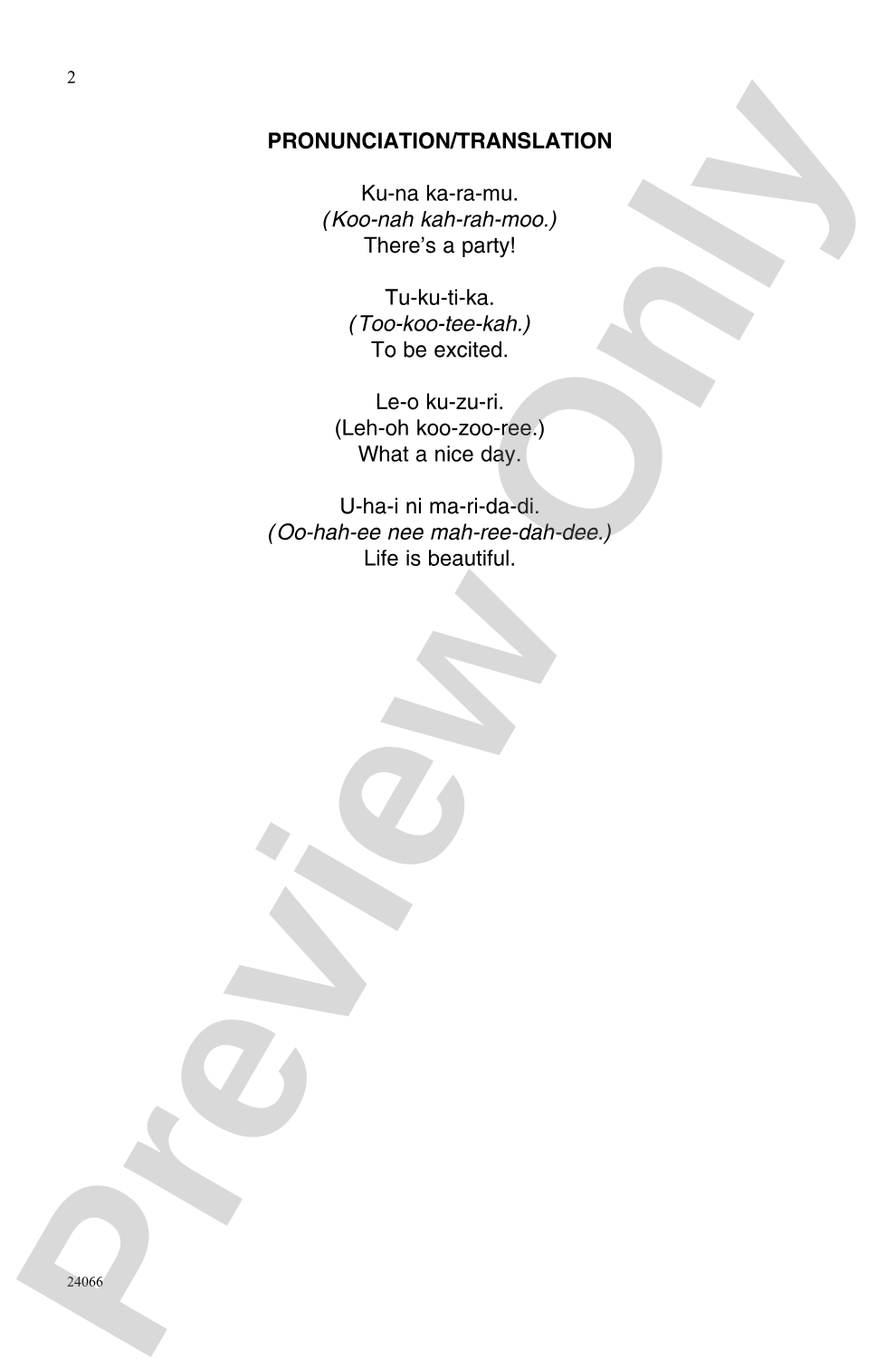
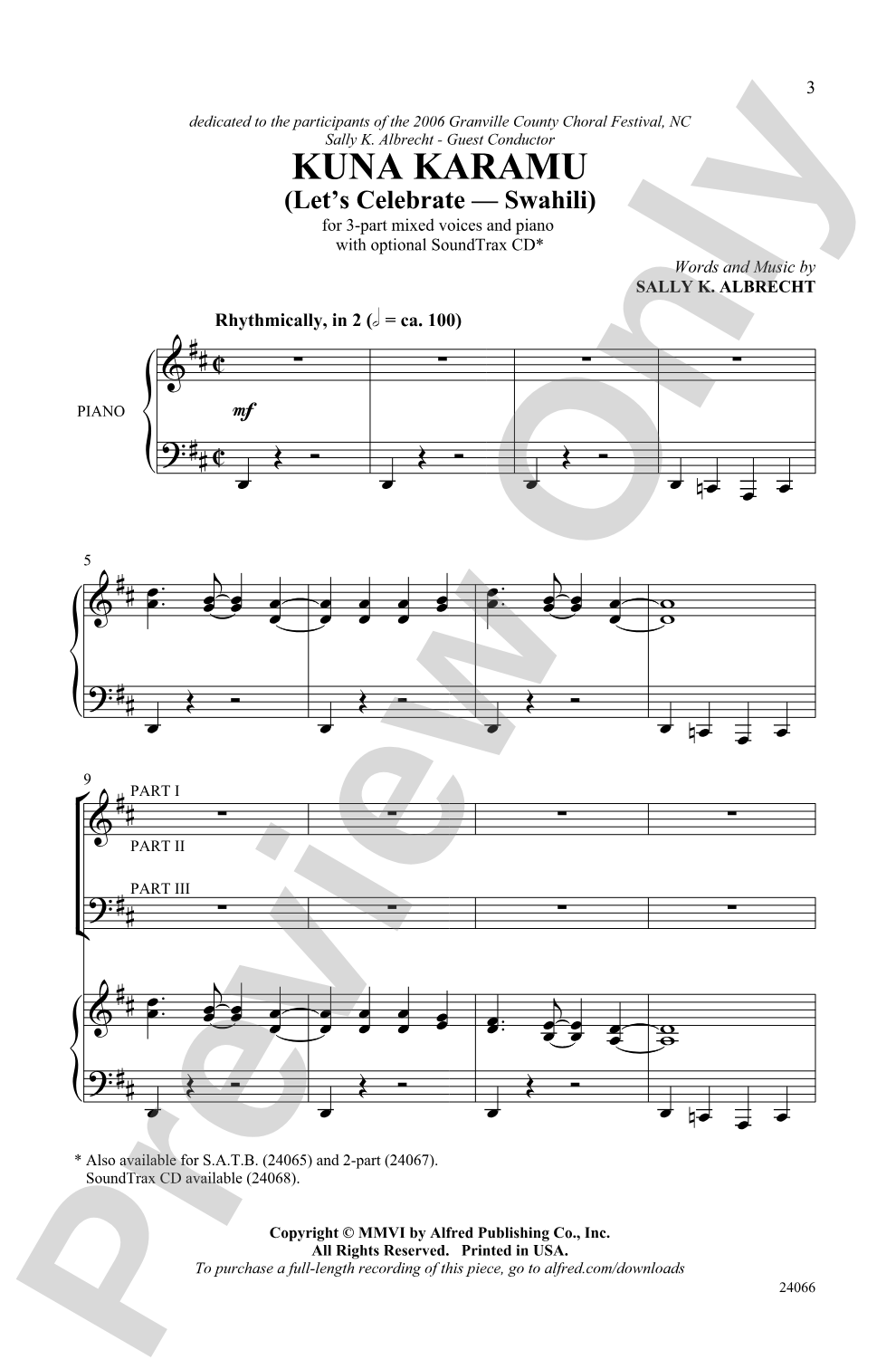
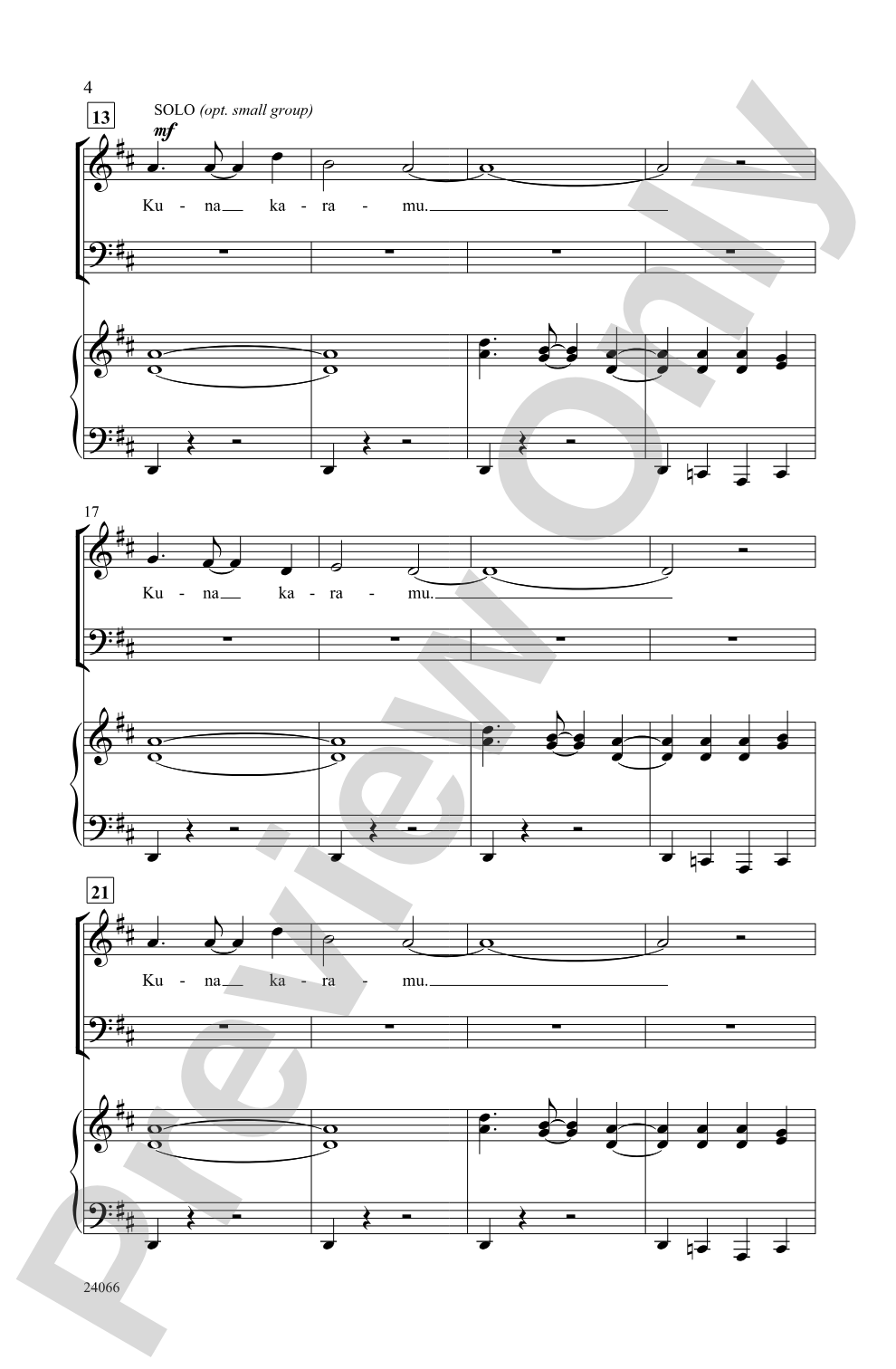
"Kuna Karamu" means "let's celebrate" in Swahili. The African rhythms add excitement, and the combination English/Swahili text is a celebration of the beauty of life. Add your choice of rhythm instruments, or use the lively SoundTrax CD.


Kuna Karamu (Let's Celebrate - Swahili): 3-Part Mixed Choral Octavo isn't in MakeMusic Cloud just yet...but it could be. Let us know you'd like to see it, and you'll help shape what comes next. In the meantime, start a free trial and dive into thousands of interactive titles your students can play along with today.
Request This Title
Tell us you want it.
Start Your Free Trial
Explore everything that's ready to play right now.
Sample Audio
1
Audio File
--:--
0:00
0:00
Sample Video
No sample videos found.
Additional Details
Series:
Alfred Choral Designs
Publisher:
Alfred Music
Page Count:
12
SKU:
00-PO-0000099
More about this title
About the Composer: Sally K. Albrecht

Sally K. Albrecht has shaped choral education for over thirty years, first as Director of School Choral, Vocal, and Elementary Publications at major educational publishers, most recently Alfred Music, and continuing as a prolific composer with more than 600 published choral works in print. Her compositions span octavos, songbooks, and full musicals, and she has conducted honor choirs at prestigious venues including Lincoln Center, Carnegie Hall, and The Kennedy Center. Since 1987, she has received the ASCAP Special Music Award annually, recognizing her consistent contributions to American choral music.
Albrecht's dual training in music and the performing arts (B.A. from Rollins College in Music and Theater; M.A. in Drama and M.M. in Accompanying from the University of Miami) informs her distinctive approach to choral writing, which integrates movement and theatrical elements. She has taught at Oakland University, Jersey City State College, and Meredith College, and currently resides in North Carolina. In 2021, she received the Distinguished Alumna Award from both the University of Miami Frost School of Music and Rollins College.
Why we love this
Albrecht captures genuine celebration without resorting to saccharine arrangements. The fusion of English and Swahili text feels natural rather than tacked on, and the African rhythms pulse through the SAB voicing in ways that invite students to move and feel the music rather than simply sing it. This is exactly the kind of secular multicultural piece that builds cultural awareness and energizes a concert.
What to expect
Infectious and joyful, with a rhythmic vitality that makes standing still difficult. The combination of English and Swahili creates an inclusive invitation to celebration, while the harmonic simplicity of SAB voicing ensures that the focus stays on the energy and spirit rather than technical complexity.
Who it's for
This octavo works for mixed choirs at the middle school and early high school level seeking accessible yet culturally rich repertoire. Directors who value movement, world music, and a straightforward narrative arc for concert programming will find this especially useful.
How to get the most out of it
- Layer in rhythm instruments gradually during rehearsals. Start with hand percussion on the main pulse, then add pitched or unpitched instruments as students lock the harmonic foundation.
- Encourage singers to emphasize the Swahili text with crisp articulation and forward energy; these syllables should cut through the rhythmic texture.
- If using the recorded accompaniment, rehearse to it early and often so students internalizes the groove and can respond to the rhythmic momentum.
- Let the piece breathe: resist the urge to rush the celebratory moments. African rhythms thrive on precision and space, not hurried tempo.
How to use it
Program this as a concert opener or closing piece to set or sustain an upbeat, celebratory mood. It pairs well with other multicultural or world music selections and serves as an excellent vehicle for introducing students to non-Western rhythmic patterns and languages in a performance context.
Skills your students will build
- Reading and performing rhythms in African musical styles
- Pronunciation and musicality in a non-English language (Swahili)
- Ensemble precision in three-part mixed voicing with independent rhythmic lines
- Physical response and movement integration with harmonic singing