
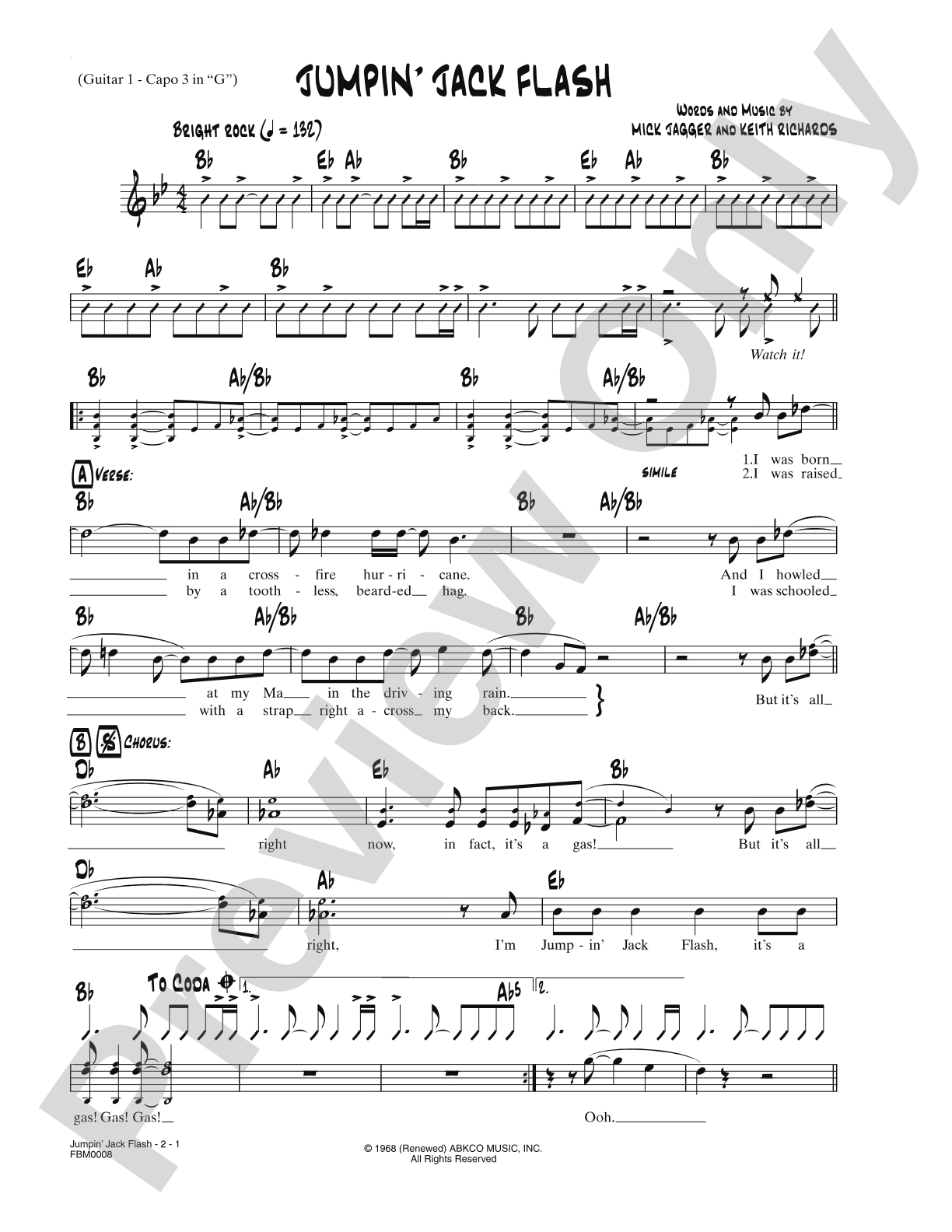

Jumpin' Jack Flash: Lead Sheet
The Rolling Stones
Item: 00-PS-0012232
$4.99
Pickup currently not available
Related Items
(Get Your Kicks On) Route 66: Lead Sheet |
$4.99
|
View | |
Time is on My Side: Lead Sheet |
$4.99
|
View | |
You Better Move On: Lead Sheet |
$4.99
|
View | |
I'm Movin' On: Lead Sheet |
$4.99
|
View | |
Mercy, Mercy: Lead Sheet |
$4.99
|
View | |
If You Need Me: Lead Sheet |
$4.99
|
View | |
Fortune Teller: Lead Sheet |
$4.99
|
View | |
19th Nervous Breakdown: Lead Sheet |
$4.99
|
View | |
2000 Light Years From Home: Lead Sheet |
$4.99
|
View | |
2000 Man: Lead Sheet |
$4.99
|
View | |
2120 South Michigan Avenue: Lead Sheet |
$4.99
|
View | |
All Sold Out: Lead Sheet |
$4.99
|
View | |
All Down the Line: Lead Sheet |
$4.99
|
View | |
As Tears Go By: Lead Sheet |
$4.99
|
View | |
Backstreet Girl: Lead Sheet |
$4.99
|
View | |
Bitch: Lead Sheet |
$4.99
|
View | |
Brown Sugar: Lead Sheet |
$4.99
|
View | |
Blue Turns to Grey: Lead Sheet |
$4.99
|
View | |
Citadel: Lead Sheet |
$4.99
|
View | |
Can't You Hear Me Knocking: Lead Sheet |
$4.99
|
View | |
Child of the Moon: Lead Sheet |
$4.99
|
View | |
Connection: Lead Sheet |
$4.99
|
View | |
Complicated: Lead Sheet |
$4.99
|
View | |
Congratulations: Lead Sheet |
$4.99
|
View | |
Country Honk: Lead Sheet |
$4.99
|
View | |
Dead Flowers: Lead Sheet |
$4.99
|
View | |
Cool, Calm and Collected: Lead Sheet |
$4.99
|
View | |
Dandelion: Lead Sheet |
$4.99
|
View | |
Dear Doctor: Lead Sheet |
$4.99
|
View | |
Don't Lie to Me: Lead Sheet |
$4.99
|
View | |
Doncha Bother Me: Lead Sheet |
$4.99
|
View | |
Downtown Suzie: Lead Sheet |
$4.99
|
View | |
Empty Heart: Lead Sheet |
$4.99
|
View | |
Each and Every Day of the Year: Lead Sheet |
$4.99
|
View | |
Factory Girl: Lead Sheet |
$4.99
|
View | |
Family: Lead Sheet |
$4.99
|
View | |
Gimme Shelter: Lead Sheet |
$4.99
|
View | |
Good Times, Bad Times: Lead Sheet |
$4.99
|
View | |
Flight 505: Lead Sheet |
$4.99
|
View | |
Get Off of My Cloud: Lead Sheet |
$4.99
|
View | |
Goin' Home: Lead Sheet |
$4.99
|
View | |
Gomper: Lead Sheet |
$4.99
|
View | |
Good Times: Lead Sheet |
$4.99
|
View | |
Grown Up Wrong: Lead Sheet |
$4.99
|
View | |
Gotta Get Away: Lead Sheet |
$4.99
|
View | |
Have You Seen Your Mother, Baby, Standing in the Shadow?: Lead Sheet |
$4.99
|
View | |
Heart of Stone: Lead Sheet |
$4.99
|
View | |
Honky Tonk Women: Lead Sheet |
$4.99
|
View | |
High and Dry: Lead Sheet |
$4.99
|
View | |
I Am Waiting: Lead Sheet |
$4.99
|
View |
Description
The Rolling Stones Fake Book includes 167 classic Stones songs recorded between 1963 and 1971 -- from early blues covers (Chuck Berry and Buddy Holly songs) to the psychedelia of Their Satanic Majesties Request. All songs are in complete, professional-style lead sheets with fundamental instrumental riffs and figures included. There is also a special guitar TAB section, featuring the pivotal guitar riffs and solos from 29 of their most legendary songs, an introductory essay, a full-color ABKCO years discography (with album art), and 40 pages of classic early sheet music covers reproduced in full color. The comb binding creates a lay-flat book that is perfect for study and performance. The ultimate Rolling Stones songbook!


Jumpin' Jack Flash: Lead Sheet isn't in MakeMusic Cloud just yet...but it could be. Let us know you'd like to see it, and you'll help shape what comes next. In the meantime, start a free trial and dive into thousands of interactive titles your students can play along with today.
Request This Title
Tell us you want it.
Start Your Free Trial
Explore everything that's ready to play right now.
Sample Audio
No sample audio found.
Sample Video
No sample videos found.
Additional Details
Series:
Just Real Books Series
Publisher:
Alfred Music
Page Count:
432
SKU:
00-PS-0012232
More about this title
About the Composer: Mick Jagger
Mick Jagger emerged as one of rock and roll's most commanding frontmen, defining the Rolling Stones' sound through his distinctive vocal phrasing and songwriting partnership with Keith Richards. Their collaborative output between the mid-1960s and early 1970s established the blueprint for modern rock composition, blending American blues traditions with British sensibility and an edge that made their music feel dangerous and alive.
Jagger's approach to melody and lyrical content pushed rock beyond novelty, creating songs that worked equally well as radio hits and deeper album tracks. His understanding of song structure, rhythm, and the interplay between voice and instrument shaped an entire generation of musicians and continues to influence how songwriters approach the genre today.
Why we love this
This collection captures the Stones at their most inventive and diverse, spanning everything from straight blues-based rockers to studio experimentation. The inclusion of fundamental instrumental riffs alongside complete lead sheets means guitarists see exactly how the songs are constructed, and the 29-song TAB section for pivotal riffs gives players a direct entry point into the band's most recognizable moments. Having a 432-page resource that bridges study and performance, with full discography and vintage sheet music reproductions, makes this the kind of reference that justifies itself immediately.
What to expect
Raw, swaggering energy tempered by genuine musicianship. These are songs that sound simple until you sit down to learn them and realize how much craft went into making them feel effortless. The mix of blues-based rock and studio experimentation means you're shifting between straightforward grooves and textures that required real creative thinking to execute.
Who it's for
Guitarists from intermediate to advanced levels who want to understand how the Stones built their songs and want the reference material to back up serious study. This works equally well for players preparing for jazz or rock ensemble contexts and for those mining the catalog for solo repertoire or band covers.
How to get the most out of it
- Study the recorded versions before diving into the lead sheet; these songs often hinge on specific rhythmic feels and articulations that notation can only approximate.
- Pay attention to the included instrumental riffs. They're not decoration. They're the DNA of how these songs breathe, and learning them teaches you the difference between playing the right notes and playing the song right.
- Use the TAB section strategically. Rather than learning all 29 riffs at once, pick the ones that align with your current repertoire or skill level, then add others as you develop.
- Dig into the early discography. Understanding which album a song comes from and what surrounded it gives context to arrangement choices you might otherwise miss.
How to use it
This is ideal for a guitar elective or rock history unit where students explore songwriting and arrangement across decades. Pull individual songs for ensemble contexts, use the TAB section in a technique-focused curriculum, or assign it as a reference for students building an understanding of how classic rock songs were structured. The discography and historical context make it valuable for music history courses too.
Skills your students will build
- Reading lead sheets with embedded riffs and figures
- Understanding blues-based harmonic progressions in rock contexts
- Translating standard notation and TAB interchangeably
- Recognizing structural patterns in classic rock songwriting
- Historical context for rock composition between 1963 and 1971