
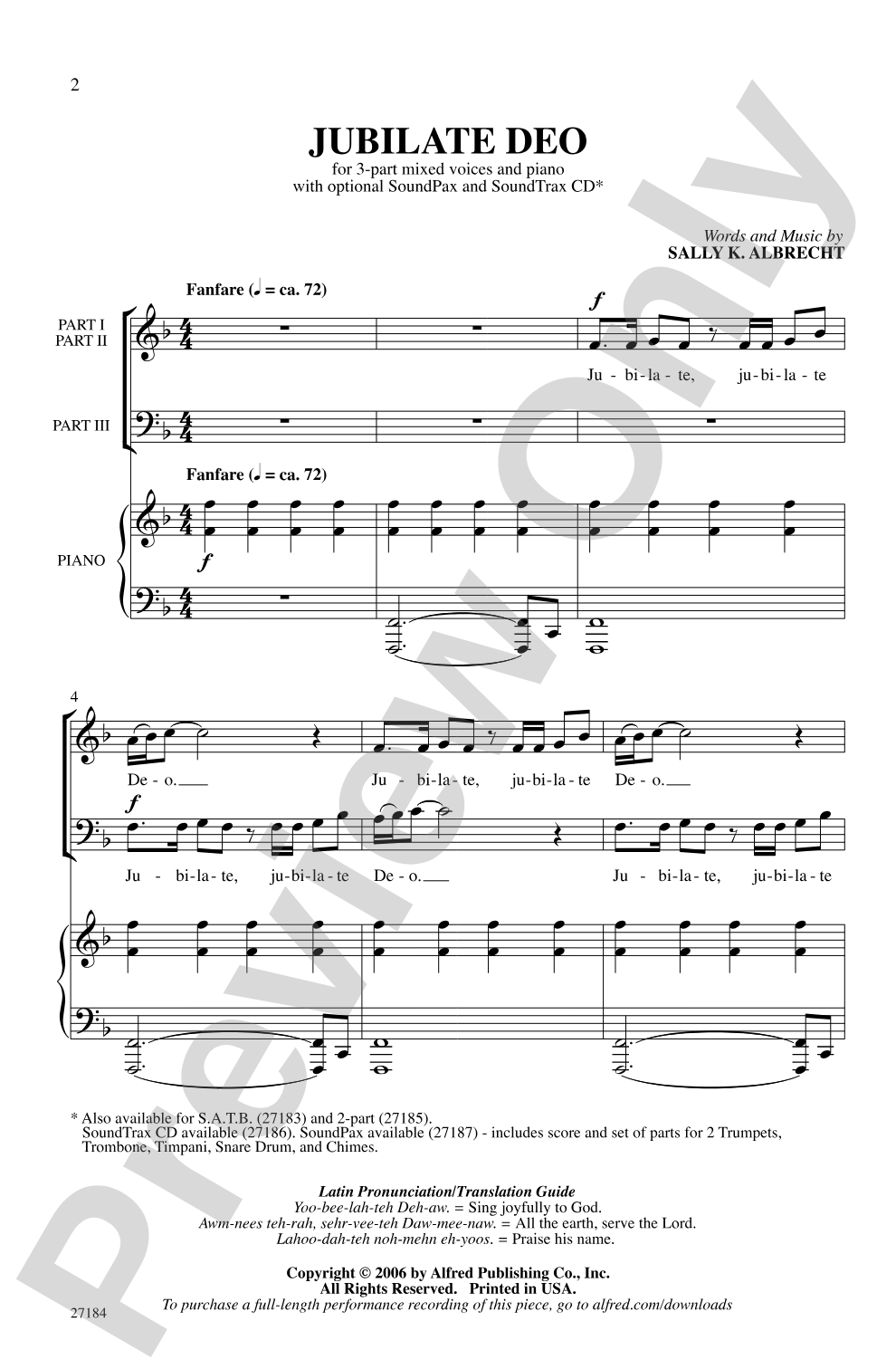

Jubilate Deo: 3-Part Mixed Choral Octavo
Words and music by Sally K. Albrecht
Item: 00-PO-0000318
$1.75
Minimum order quantity: 20 copies
Pickup currently not available
Related Items
Jubilate Deo: SoundTrax Digital Audio Download |
$22.95
|
View | |
Jubilate Deo: SATB Choral Octavo |
$1.75
|
View | |
Jubilate Deo: 2-Part Choral Octavo |
$1.65
|
View | |
Jubilate Deo: Choral SoundPax |
$25.00
|
View | |
Jubilate Deo: SATB Choral Octavo |
$1.75
|
View | |
Jubilate Deo: 3-Part Mixed Choral Octavo |
$1.75
|
View | |
Jubilate Deo: 2-Part Choral Octavo |
$1.65
|
View | |
Jubilate Deo: Choral Octavo SoundTrax CD |
$22.95
|
View | |
Jubilate Deo: Choral SoundPax |
$25.00
|
View |
Description
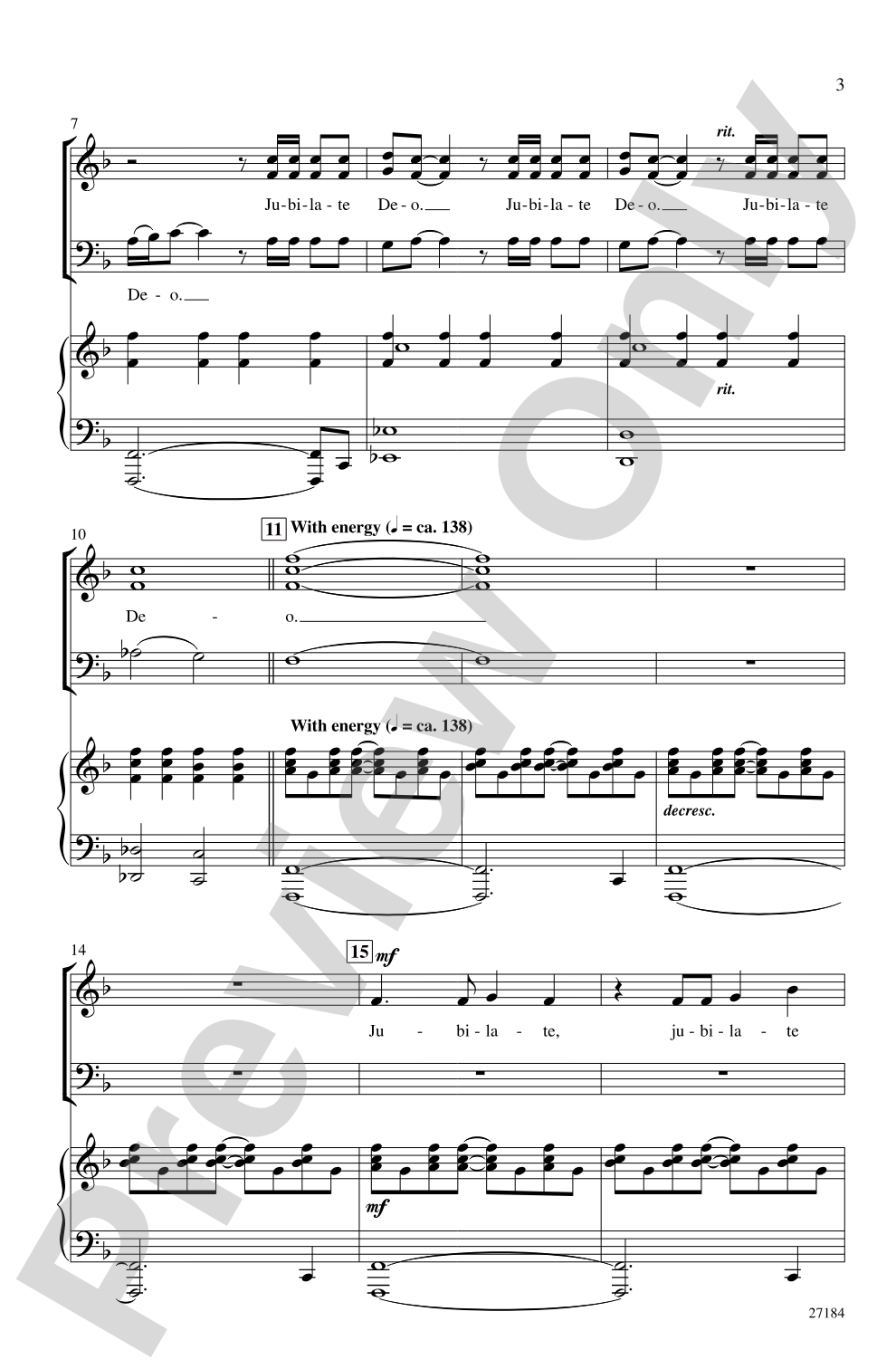
Expertly written by Sally K. Albrecht for today's choirs, this Latin-text piece opens with a fanfare and evolves into an energetic work. The choral writing is traditional and powerful, and the piano accompaniment adds excitement. An impressive work for any choir at contests, festivals, and concerts. Latin pronunciation guide/translation included in the publication.


Jubilate Deo: 3-Part Mixed Choral Octavo isn't in MakeMusic Cloud just yet...but it could be. Let us know you'd like to see it, and you'll help shape what comes next. In the meantime, start a free trial and dive into thousands of interactive titles your students can play along with today.
Request This Title
Tell us you want it.
Start Your Free Trial
Explore everything that's ready to play right now.
Sample Audio
1
Audio File
--:--
0:00
0:00
Sample Video
No sample videos found.
Additional Details
Series:
Alfred Choral Designs
Publisher:
Alfred Music
Page Count:
12
SKU:
00-PO-0000318
More about this title
About the Composer: Sally K. Albrecht

Sally K. Albrecht has shaped American choral music for decades as a composer, conductor, and clinician with deep expertise in choral movement and vocal performance. Since 1987, she has received the ASCAP Special Music Award annually, and her catalog includes over 600 published choral works alongside 75 larger musicals and songbooks. She spent more than thirty years directing school choral and vocal publications at major educational publishers, most recently Alfred Music, and has conducted honor choirs at prestigious venues including Lincoln Center, Carnegie Hall, and The Kennedy Center.
Her musical training spans multiple disciplines. Albrecht earned a B.A. in Music and Theater from Rollins College (Florida) in 1976, then continued at the University of Miami, completing an M.A. in Drama (1977) and an M.M. in Accompanying (1979). She has taught at Oakland University (Michigan), Jersey City State College (New Jersey), and Meredith College (North Carolina). In recent years, Albrecht received the Distinguished Alumna Award from both the University of Miami Frost School of Music and Rollins College, where she serves on the Board of Trustees. She resides in Wake Forest, North Carolina, with her husband, composer and arranger Jay Althouse.
Why we love this
Albrecht's approach to 3-part writing strikes an ideal balance: the choral writing remains strong and singable without sacrificing musical substance, while the piano accompaniment gives the piece theatrical energy that elevates it beyond typical octavo fare. The fanfare opening immediately signals to an audience that something special is about to unfold, making this a natural showstopper for competitions and formal concert settings.
What to expect
The opening fanfare delivers an immediate spark of joy and ceremony, drawing listeners in with its radiant energy. As the piece unfolds, it maintains that celebratory character while weaving in sophisticated harmonic moments that keep singers engaged and audiences impressed.
Who it's for
This octavo works for choirs at the intermediate level and above who are ready for Latin repertoire and energetic, stylistically confident writing. It suits school and community choirs preparing for festival competitions, invitational concerts, and special liturgical or secular celebrations that call for a bright, festive statement.
How to get the most out of it
- Shape the opening fanfare with clear articulation and rhythmic precision; this moment sets the tone for everything that follows, so invest in unified vowel formation and crisp consonant attacks.
- Balance the Latin text carefully against the piano part. The accompaniment should support without overwhelming the voices, especially during sections where the text carries the emotional weight.
- Lock in the harmonic rhythm internally before adding movement or gesture. With a 3-part texture, intonation clarity becomes even more critical since there are fewer voices to cover missteps.
How to use it
Position this as a concert centerpiece or grand finale, especially when you want to showcase your choir's ability to handle Latin text with confidence and style. It pairs well on a program with either devotional works or contrasting secular pieces, since its formal energy and polished presentation make it a natural anchor for mixed-voice concerts.
Skills your students will build
- Singing in Latin with accurate pronunciation and legible diction
- Reading and performing in 3-part SAB texture
- Balancing independent vocal lines while maintaining harmonic blend
- Interpreting text and musical character in a fanfare-based structural form
- Responding to accompaniment while maintaining choral independence