
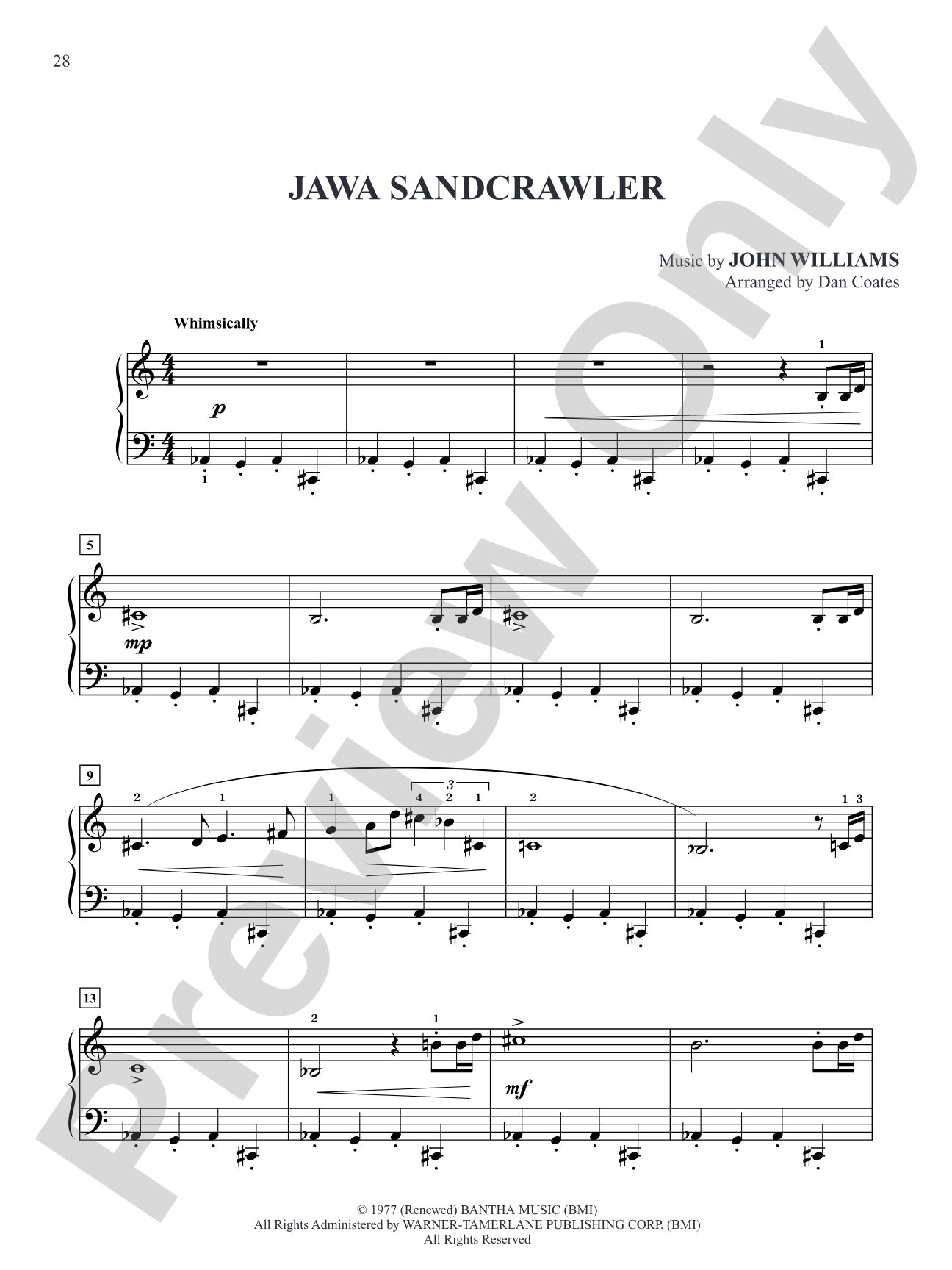

Jawa Sandcrawler (from "Star Wars Episode IV: A New Hope"): Easy Piano
By John Williams / arr. Dan Coates
Level: Easy Piano
Item: 00-PS-0012776
$4.99
One moment…
Related Items
Cantina Band (from "Star Wars Episode IV: A New Hope"): Easy Piano |
$4.99
|
View | |
Princess Leia's Theme (from "Star Wars"): Easy Piano |
$4.99
|
View | |
The Throne Room (from "Star Wars"): Easy Piano |
$4.99
|
View | |
Yoda's Theme (from "Star Wars Episode V: The Empire Strikes Back"): Easy Piano |
$4.99
|
View | |
May the Force Be With You (from "Star Wars Episode V: The Empire Strikes Back"): Easy Piano |
$4.99
|
View | |
Imperial March ("Darth Vader's Theme") (from "Star Wars Episode V: The Empire Strikes Back"): Easy Piano |
$4.99
|
View | |
Binary Sunset (from "Star Wars Episode IV: A New Hope"): Easy Piano |
$4.99
|
View | |
Star Wars Main Theme (from "Star Wars"): Easy Piano |
$4.99
|
View |
Description
For the first time, this piano sheet music collection encompasses the entire Star Wars saga! Set amid stunning imagery from the films, these easy piano arrangements bring the magic of Star Wars to life as they masterfully invoke the grand romanticism of John Williams's epic, award-winning scores. This collection includes several all-new arrangements by Dan Coates. The most definitive and memorable pieces from each of the six Star Wars episodes are included.
Titles: Twentieth Century Fox Trademark * Anakin's Theme * Across the Stars * Battle of the Heroes * Binary Sunset * Cantina Band * Duel of the Fates * The Force Theme * The Imperial March * Jawa Sandcrawler * Luke and Leia * May the Force Be with You * Princess Leia's Theme * Star Wars (Main Title) * The Throne Room * Yoda's Theme.


Titles: Twentieth Century Fox Trademark * Anakin's Theme * Across the Stars * Battle of the Heroes * Binary Sunset * Cantina Band * Duel of the Fates * The Force Theme * The Imperial March * Jawa Sandcrawler * Luke and Leia * May the Force Be with You * Princess Leia's Theme * Star Wars (Main Title) * The Throne Room * Yoda's Theme.
Jawa Sandcrawler (from "Star Wars Episode IV: A New Hope"): Easy Piano isn't in MakeMusic Cloud just yet...but it could be. Let us know you'd like to see it, and you'll help shape what comes next. In the meantime, start a free trial and dive into thousands of interactive titles your students can play along with today.
Request This Title
Tell us you want it.
Start Your Free Trial
Explore everything that's ready to play right now.
Sample Audio
No sample audio found.
Sample Video
No sample videos found.
Additional Details
Publisher:
Alfred Music
Page Count:
56
SKU:
00-PS-0012776
More about this title
About the Composer: John Williams
John Williams stands as one of the most prolific and celebrated film composers of our time. His scores for the Star Wars saga, Indiana Jones films, Jaws, E.T., Schindler's List, and countless other blockbusters have defined the sound of modern cinema and earned him five Academy Awards, four Golden Globes, and 52 Grammy nominations. Williams studied composition at UCLA and has spent over six decades crafting orchestral music that balances accessibility with profound emotional depth.
For music educators, Williams represents something vital: proof that serious compositional craft and popular appeal are not opposites. His melodies are instantly singable, his harmonies are rich but logical, and his orchestration principles transfer directly to student ensembles. Teachers turn to his film scores because they demonstrate how memorable themes, clear harmonic progressions, and dramatic pacing work in real music.
Why we love this
These arrangements unlock music your students already love. Choosing to include "Jawa Sandcrawler" alongside the obvious "Main Title" and "Imperial March" shows thoughtful programming, offering variety in character and texture across the collection. Dan Coates's easy piano writing respects Williams's original harmonic language while removing technical obstacles, so pianists can focus on tone production, phrasing, and capturing each piece's distinct personality.
What to expect
Opening this collection feels like stepping into a theater. Each piece carries the cinematic sweep of Williams's orchestrations translated to a single keyboard, from the somber desert introspection of "Jawa Sandcrawler" to the triumphant energy of "The Force Theme." You'll find yourself drawn into different worlds: the danger and mystique of the Imperial March, the warmth of family themes, the alien charm of the Cantina. The piano becomes a gateway to the emotional geography of the entire saga.
Who it's for
Young pianists (typically ages 8-12) who are drawn to familiar, beloved film music and need accessible arrangements that still capture the grandeur of Williams's original conceptions. Students preparing for recitals often gravitate toward these pieces because they combine recognition value with the satisfaction of playing recognizable melodies without advanced technical demands.
How to get the most out of it
- Approach the rhythmic ostinatos (particularly in "Jawa Sandcrawler") with steady precision rather than mechanical rigidity. A gentle sway in the accompaniment patterns brings the music alive without disrupting the pulse.
- Treat each piece as having its own emotional temperature. "Binary Sunset" asks for space and reflection, while "Cantina Band" thrives on rhythmic energy and character. Read the arc of the entire collection before drilling individual selections.
- Let the melody sing through thick textures. In busier passages, the right hand should always have sonic priority so the Williams themes cut through clearly and listeners hear exactly why these melodies matter.
- Use the dynamic range available even within easy arrangements. Williams's scores live on contrast between intimate moments and grand sweeps. Commit to soft passages as fully as you commit to powerful ones.
How to use it
Use individual selections from this collection as filler pieces between more demanding repertoire in student recitals, since recognition carries momentum and audience engagement. Program a thematic pairing (e.g., "Binary Sunset" and "Luke and Leia" back-to-back) to highlight how Williams uses melody to deepen emotional storytelling. This collection also works well in spring showcases where younger students need motivating performance opportunities alongside advancing pianists.
Skills your students will build
- Sustaining legato phrasing across phrase boundaries despite hand position changes
- Balancing melody and accompaniment texture with clear part independence
- Reading and executing straightforward but varied rhythmic patterns (swinging eighths, syncopation, steady ostinatos)
- Projecting character and mood through articulation, tempo control, and dynamic shaping
- Sight-reading film music with clear harmonic structures and predictable melodic contours