
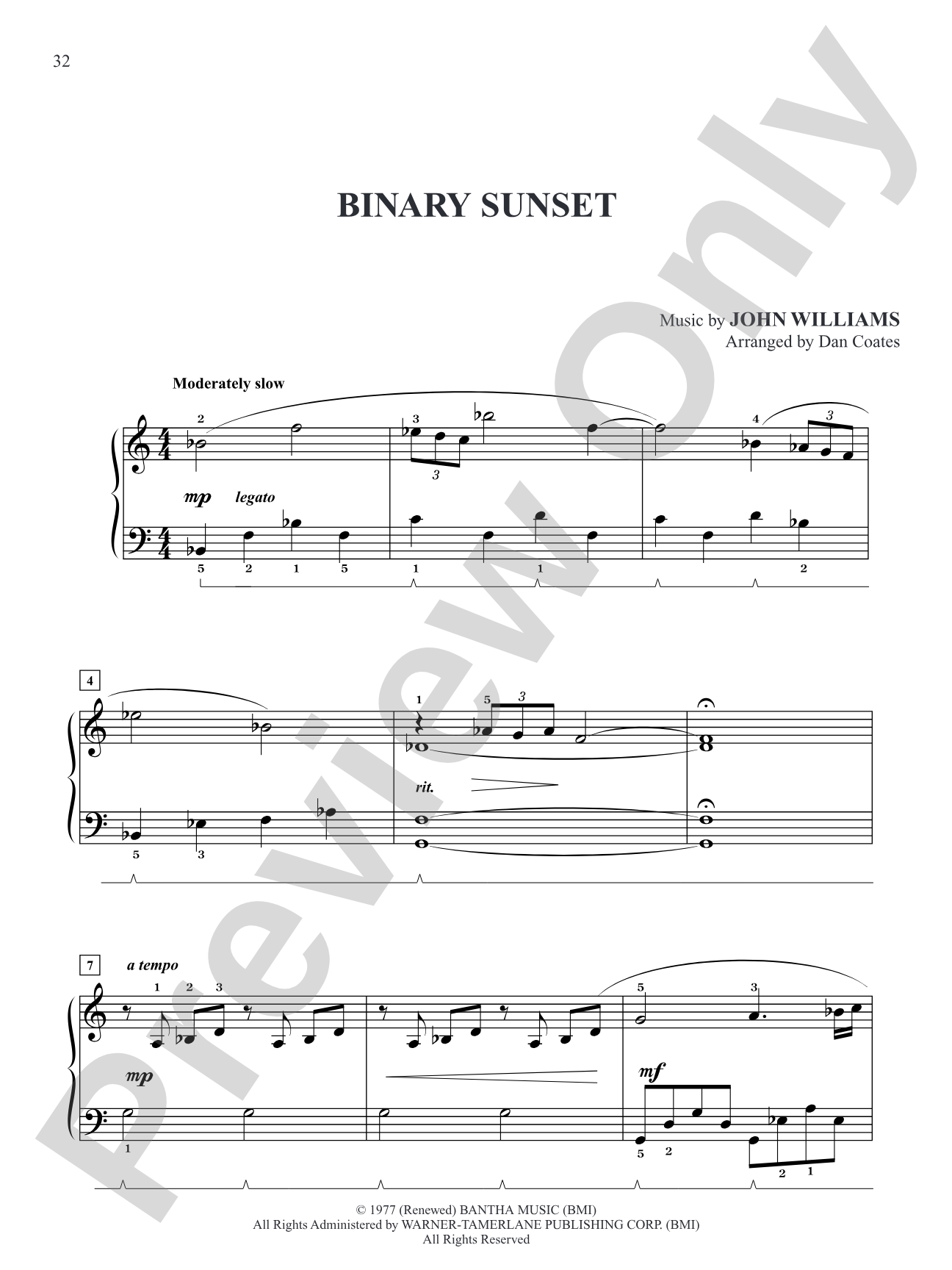

Binary Sunset (from "Star Wars Episode IV: A New Hope"): Easy Piano
By John Williams / arr. Dan Coates
Level: Easy Piano
Item: 00-PS-0012777
$4.99
One moment…
Related Items
Cantina Band (from "Star Wars Episode IV: A New Hope"): Easy Piano |
$4.99
|
View | |
Princess Leia's Theme (from "Star Wars"): Easy Piano |
$4.99
|
View | |
The Throne Room (from "Star Wars"): Easy Piano |
$4.99
|
View | |
Yoda's Theme (from "Star Wars Episode V: The Empire Strikes Back"): Easy Piano |
$4.99
|
View | |
May the Force Be With You (from "Star Wars Episode V: The Empire Strikes Back"): Easy Piano |
$4.99
|
View | |
Imperial March ("Darth Vader's Theme") (from "Star Wars Episode V: The Empire Strikes Back"): Easy Piano |
$4.99
|
View | |
Jawa Sandcrawler (from "Star Wars Episode IV: A New Hope"): Easy Piano |
$4.99
|
View | |
Star Wars Main Theme (from "Star Wars"): Easy Piano |
$4.99
|
View |
Description
For the first time, this piano sheet music collection encompasses the entire Star Wars saga! Set amid stunning imagery from the films, these easy piano arrangements bring the magic of Star Wars to life as they masterfully invoke the grand romanticism of John Williams's epic, award-winning scores. This collection includes several all-new arrangements by Dan Coates. The most definitive and memorable pieces from each of the six Star Wars episodes are included.
Titles: Twentieth Century Fox Trademark * Anakin's Theme * Across the Stars * Battle of the Heroes * Binary Sunset * Cantina Band * Duel of the Fates * The Force Theme * The Imperial March * Jawa Sandcrawler * Luke and Leia * May the Force Be with You * Princess Leia's Theme * Star Wars (Main Title) * The Throne Room * Yoda's Theme.


Titles: Twentieth Century Fox Trademark * Anakin's Theme * Across the Stars * Battle of the Heroes * Binary Sunset * Cantina Band * Duel of the Fates * The Force Theme * The Imperial March * Jawa Sandcrawler * Luke and Leia * May the Force Be with You * Princess Leia's Theme * Star Wars (Main Title) * The Throne Room * Yoda's Theme.
Binary Sunset (from "Star Wars Episode IV: A New Hope"): Easy Piano isn't in MakeMusic Cloud just yet...but it could be. Let us know you'd like to see it, and you'll help shape what comes next. In the meantime, start a free trial and dive into thousands of interactive titles your students can play along with today.
Request This Title
Tell us you want it.
Start Your Free Trial
Explore everything that's ready to play right now.
Sample Audio
No sample audio found.
Sample Video
No sample videos found.
Additional Details
Publisher:
Alfred Music
Page Count:
56
SKU:
00-PS-0012777
More about this title
About the Composer: John Williams
John Williams has shaped the sound of modern cinema for nearly five decades. His orchestral scores for Star Wars, Indiana Jones, Jaws, E.T., Schindler's List, and Harry Potter set the gold standard for film composition, earning him five Academy Awards and a Grammy Award. Williams studied composition at UCLA and has conducted major orchestras worldwide; his influence on contemporary music education is profound, as his themes have become the gateway through which millions of students first encounter sophisticated harmonic language and orchestral color.
Why we love this
Dan Coates has distilled Williams's sweeping orchestral writing into genuinely playable piano arrangements that preserve the emotional core of each theme. Young pianists encounter real harmonic substance here, not simplifications that rob the music of its power. Programming a recital around Star Wars music shifts the entire energy of a student showcase and gives reluctant young players a reason to practice.
What to expect
Heroic, wistful, and grand all at once. These arrangements channel the emotional sweep of Williams's original scores, transporting you from a desert planet at sunset to the throne room of an imperial palace, all within the span of a recital.
Who it's for
Young pianists who connect with film music and need motivation to develop their technique. Teachers seeking repertoire that draws reluctant students into serious practice without sacrificing musical substance.
How to get the most out of it
- Lean into the melodic phrasing rather than rushing the harmonic changes. These arrangements reward singers who think like string players.
- Resist the urge to add tempo; Williams's themes work best when given space to breathe, especially in slower pieces like Binary Sunset.
- Use the left hand to anchor the harmonic foundation without overwhelming the right hand melody. Balance between hands matters more at this level than technical flourish.
- Return to the film recordings occasionally. Hearing Williams's orchestral voicing will clarify what the piano arrangement is trying to capture in fewer notes.
How to use it
Build a thematic recital around different Star Wars episodes, pairing these pieces with classical precedents they echo. Alternatively, use individual arrangements as encores or as bridging pieces between classical and contemporary sections of a concert. A student performing Binary Sunset followed by a traditional Romantic-era nocturne creates a natural conversation about melodic writing across musical eras.
Skills your students will build
- Shaping long melodic phrases across harmonic changes
- Reading and executing dotted rhythms and syncopation in the accompaniment
- Balancing melody with independent harmonic movement in the left hand
- Sustaining musical momentum through key changes and modulations
- Interpreting orchestral color through keyboard dynamics and touch