
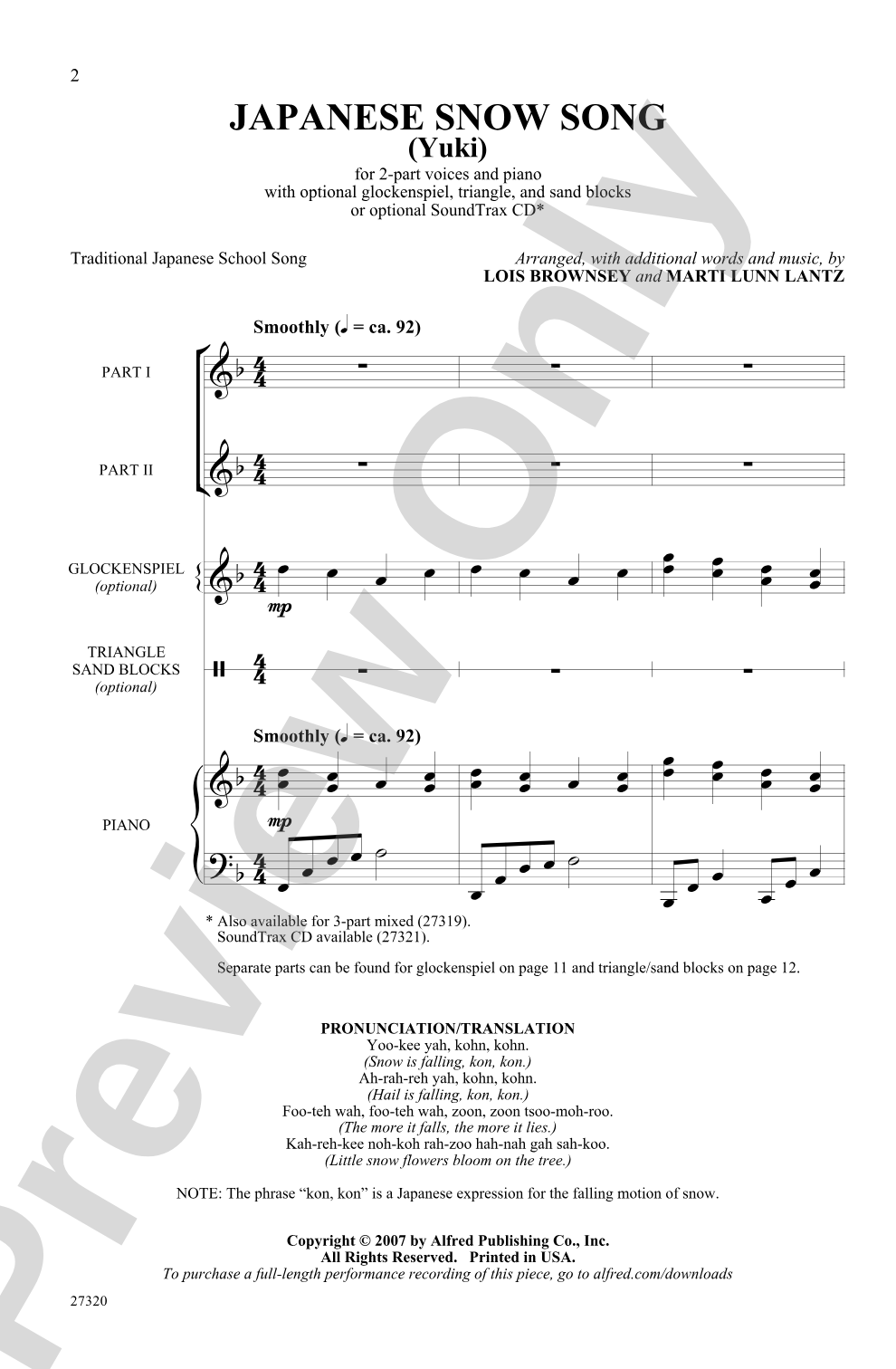

Japanese Snow Song (Yuki): 2-Part Choral Octavo
Arr., with additional words, by Lois Brownsey and Marti Lunn Lantz
Item: 00-PO-0000379

$2.25
Minimum order quantity: 20 copies
Pickup currently not available
Related Items
Japanese Snow Song (Yuki): SoundTrax Digital Audio Download |
$27.99
|
View | |
Japanese Snow Song (Yuki): 3-Part Mixed Choral Octavo |
$2.25
|
View | |
Japanese Snow Song (Yuki): 3-Part Mixed Choral Octavo |
$2.25
|
View | |
Japanese Snow Song (Yuki): 2-Part Choral Octavo |
$2.25
|
View | |
Japanese Snow Song (Yuki): Choral Octavo SoundTrax CD |
$27.99
|
View |
Description
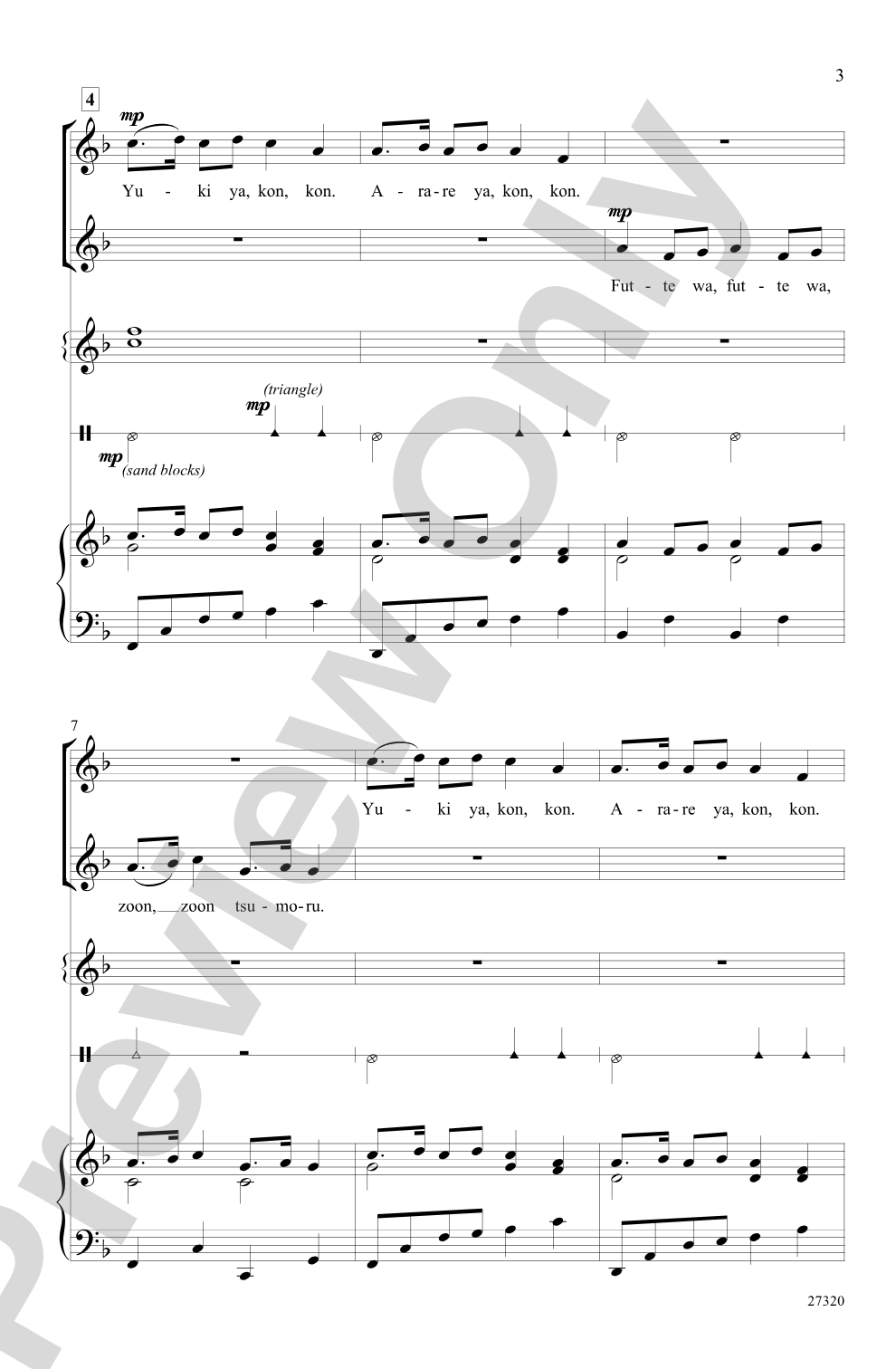
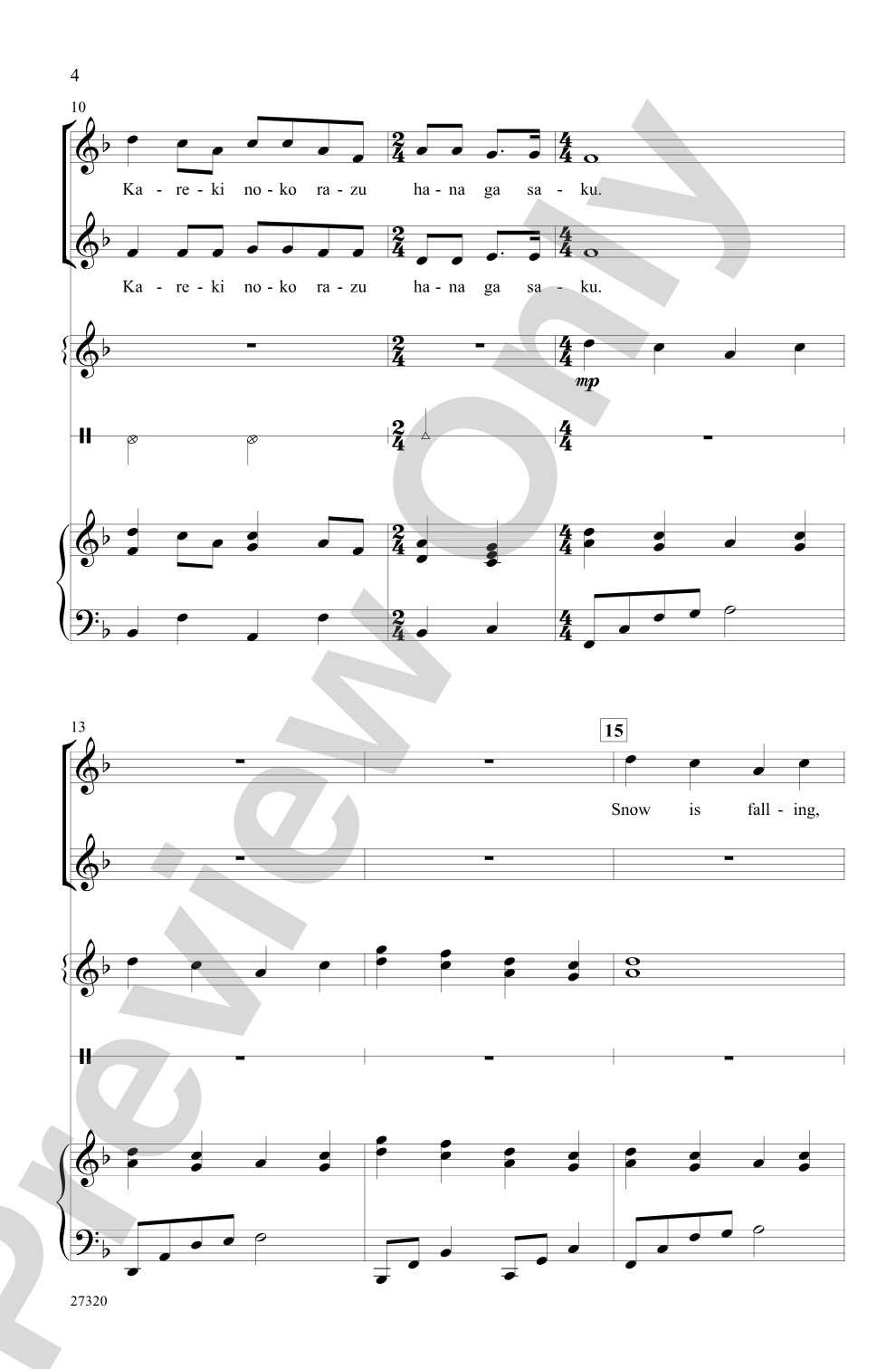
A delicate melody swirls and twirls like drifting snow in this tasteful arrangement of a traditional Japanese school song. The three short Japanese phrases (and several English words) are easy-to-learn and bring to mind icy images of wintertime. Simple parts for glockenspiel, triangle, and sand blocks can be heard on the Asian-inspired SoundTrax CD and are also included in the publication.


Don't just read it, hear it, play along with it, and watch your students grow with it. In MakeMusic Cloud, Japanese Snow Song (Yuki): 2-Part Choral Octavo comes alive with professional accompaniment, adjustable tempo, and built-in practice tools that turn solo practice into real progress.
Open in the Player
Jump straight in and assign it today.
Start Your Free Trial
Open this title and explore the full library in minutes.
Sample Audio
1
Audio File
--:--
0:00
0:00
Sample Video
No sample videos found.
Additional Details
Series:
Alfred Archive Edition: Alfred Choral Designs
Publisher:
Alfred Music
Page Count:
12
SKU:
00-PO-0000379
Instrumentation:
Opt. Percussion
More about this title
About the Arranger: Lois Brownsey

Lois Brownsey and Marti Lunn Lantz have built a catalog of choral works rooted in cultural traditions and seasonal themes published with Alfred. Their collaborations span "Winter's Frost," "The Colors of Winter," and "Deedle Deedle Dai," alongside song collections like Celebrations around the World and The Wonders of the Earth. Brownsey's musical foundation stretches back to her Philadelphia years studying at Temple University and the Guitar Workshop, where she performed extensively in musical theatre, pop, rock, and blues ensembles across the United States and internationally before retiring from live performance in 1997.
Today, Brownsey and her husband Kent operate Red Rock recording Studios in the Pocono Mountains of Pennsylvania, where numerous Alfred choral projects are produced. Her professional background includes commercial songwriting for major clients and collaborative arrangements with other composers like Sally K. Albrecht. Brownsey remains active in her community as a Celebrant and advocate for the arts.
Why we love this
This arrangement captures the visual and emotional essence of falling snow through a gentle melodic line that feels genuinely poetic rather than sugary. The inclusion of Japanese phrases alongside English text honors the song's origin while remaining accessible to young singers, and the optional percussion parts (glockenspiel, triangle, sand blocks) add authentic textural color without overwhelming a developing choir.
What to expect
The melody unfolds with the quiet, hypnotic quality of snow falling through still air; there is a sense of beauty tinged with coolness, never saccharine or overwrought. The combination of Japanese school song tradition and English text creates an intimate, almost meditative atmosphere that feels both timeless and contemporary.
Who it's for
This octavo works well for middle school and early high school choirs seeking winter repertoire that is musically substantive without excessive difficulty. It suits ensembles with developing musicianship and limited rehearsal time, since the two-part voicing and modest range make it approachable for singers still building confidence.
How to get the most out of it
- Treat the Japanese phrases as lyrical melody rather than foreign language obstacles; have singers listen to the recorded accompaniment multiple times to absorb the natural rhythm and inflection.
- Balance the two parts so neither dominates; the arrangement's delicacy depends on both voices maintaining an ethereal, floating quality.
- If using the optional percussion parts, rehearse them separately first, then layer them in gradually so they enhance rather than distract from the vocal line.
- Keep the overall tempo unhurried and allow slight space between phrases to mirror the slow drift of snow.
How to use it
Feature this during a winter concert segment focused on cultural celebrations or seasonal reflections, where its gentle character can stand alone or pair elegantly with other world music selections. The piece also works as a concert opener, setting a contemplative tone before shifting to livelier repertoire.
Skills your students will build
- Singing in a second language (Japanese phrases) with proper pronunciation and musicality
- Maintaining independent melodic lines while blending with another voice part
- Achieving balance and blend in lighter, more ethereal textures
- Following and responding to optional instrumental accompaniment cues
- Understanding cultural context and respectful interpretation of non-Western musical traditions