
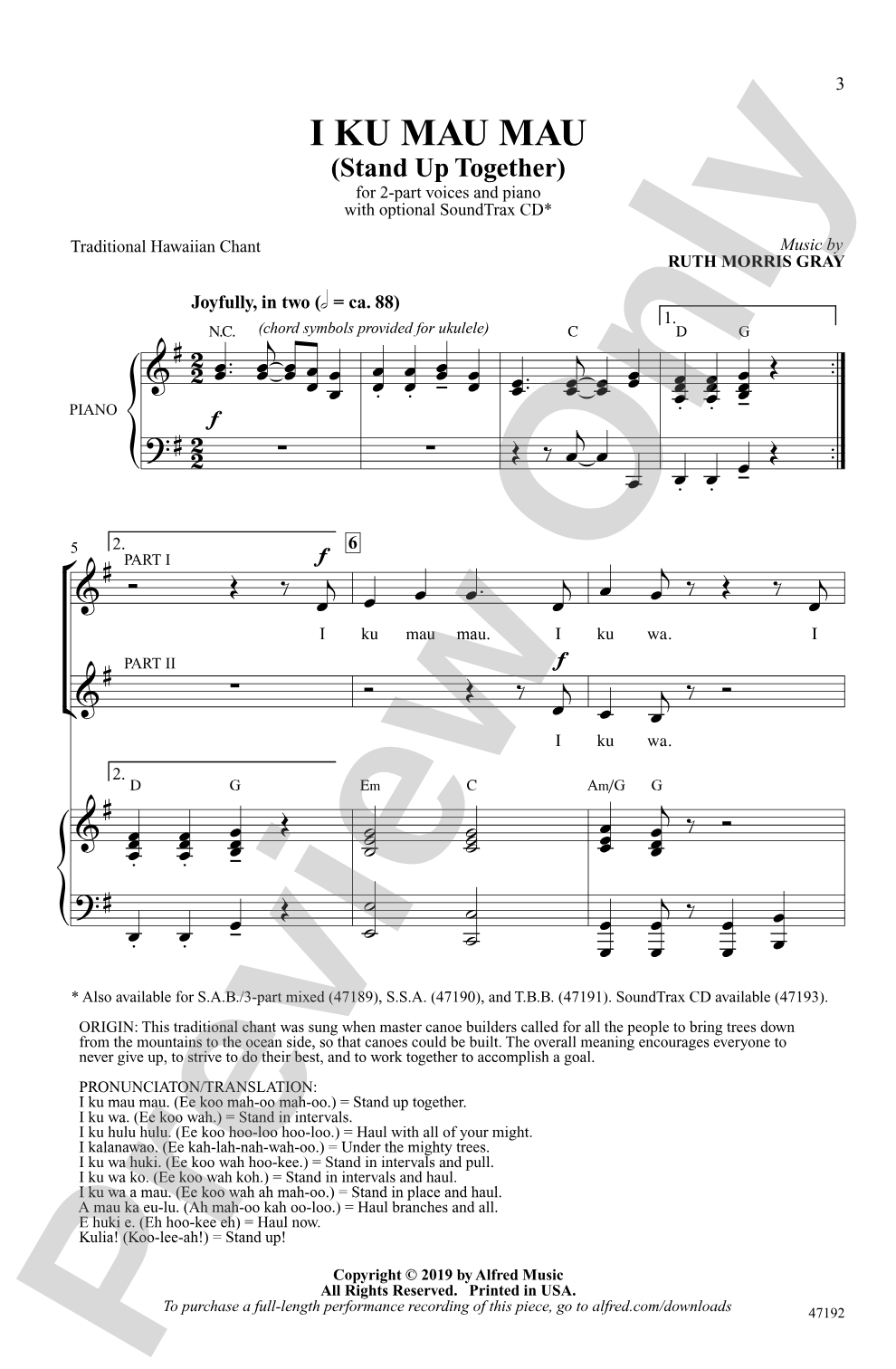
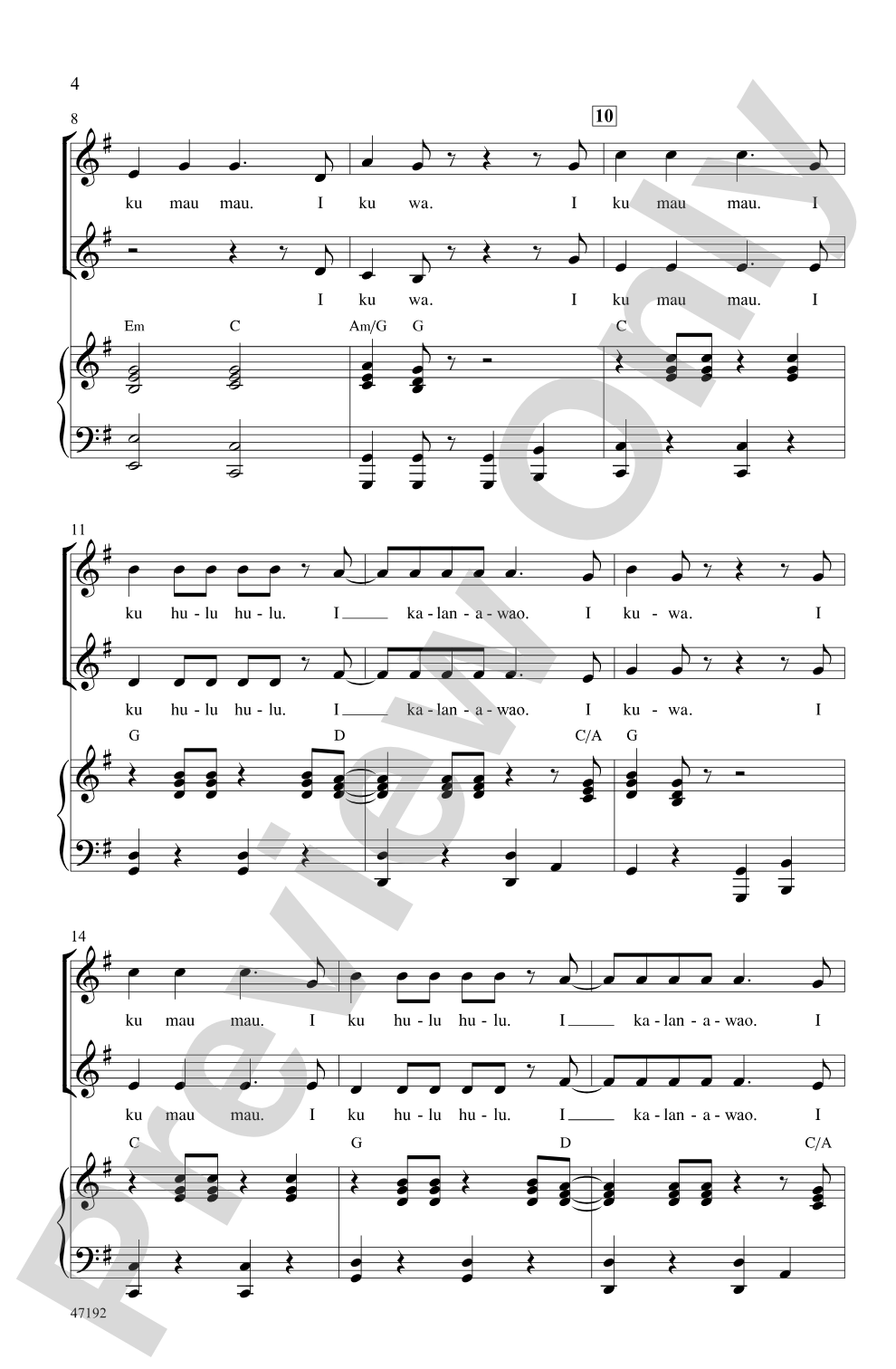

I Ku Mau Mau: 2-Part Choral Octavo
(Stand Up Together)
Words from a Traditional Hawaiian Chant, music by Ruth Morris Gray
Item: 00-PO-0005906
$2.05
Minimum order quantity: 20 copies
Pickup currently not available
Related Items
I Ku Mau Mau: SoundTrax Digital Audio Download |
$27.99
|
View | |
I Ku Mau Mau: 3-Part Mixed/SAB Choral Octavo |
$2.05
|
View | |
I Ku Mau Mau: SSA Choral Octavo |
$2.05
|
View | |
I Ku Mau Mau: TBB Choral Octavo |
$2.05
|
View | |
I Ku Mau Mau: 3-Part Mixed/SAB Choral Octavo |
$2.05
|
View | |
I Ku Mau Mau: SSA Choral Octavo |
$2.05
|
View | |
I Ku Mau Mau: TBB Choral Octavo |
$2.05
|
View | |
I Ku Mau Mau: 2-Part Choral Octavo |
$2.05
|
View | |
I Ku Mau Mau: Choral Octavo SoundTrax CD |
$27.99
|
View |
Description
This traditional Hawaiian chant was used when master canoe builders called for people to bring trees down from the mountains to the ocean side so that canoes could be built. Now set to music, the words teach us to stand up together and work as a team. An upbeat hook, a spoken word section, and a contrasting countermelody combine at the end to create the ultimate multicultural experience. Download the digital ChoreoTrax for even more fun!


I Ku Mau Mau: 2-Part Choral Octavo isn't in MakeMusic Cloud just yet...but it could be. Let us know you'd like to see it, and you'll help shape what comes next. In the meantime, start a free trial and dive into thousands of interactive titles your students can play along with today.
Request This Title
Tell us you want it.
Start Your Free Trial
Explore everything that's ready to play right now.
Sample Audio
1
Audio File
--:--
0:00
0:00
Sample Video
Additional Details
Series:
Alfred Choral Designs
Publisher:
Alfred Music
Page Count:
12
SKU:
00-PO-0005906
More about this title
About the Composer: Ruth Morris Gray

Ruth Morris Gray has served as Director of Choirs at Rosemead High School in California since 2004, where she also teaches piano. She holds a Bachelor of Music in Piano Performance and Composition from Biola University, a Master of Arts in Music Composition from UC Santa Barbara, and a California Single Subject Music Credential from Cal State Northridge.
With over 100 published choral compositions to her name, Gray has established herself as a prolific voice in multicultural and contemporary choral writing. Her work reflects deep engagement with diverse musical traditions and a commitment to repertoire that speaks to ensemble collaboration and cultural understanding.
Why we love this
Gray taps into the genuine energy of a working chant, transforming historical purpose into immediate, embodied learning. The layering of spoken word, countermelody, and rhythmic hooks creates natural opportunities for choreography and physical engagement, which means your students stay invested from the first read through performance night.
What to expect
Energy builds from the opening hook as voices layer in, creating forward momentum that mirrors the historical urgency of the chant itself. The contrasting sections give singers breath and variety, while the interplay between spoken word and melody creates a modern, engaging texture that feels both respectful and alive.
Who it's for
Two-part choirs at the middle school, high school, or community level will find this piece accessible without being simplistic. It works especially well for groups looking to expand their multicultural repertoire and for singers who respond to music with clear cultural roots and collaborative purpose.
How to get the most out of it
- Treat the spoken section with intention. The clarity of the text matters as much as the melody, so work articulation and projection alongside pitch accuracy.
- Balance the two voice parts so that neither drowns out the other when the countermelody enters. Light sectional rehearsals early on prevent the blend from becoming muddy.
- Use the recorded accompaniment to establish the groove and rhythmic confidence, then gradually reduce dependence on it so singers own the pulse.
- Explore the ChoreoTrax resource during a separate rehearsal devoted entirely to staging. Movement should feel organic to the text and the cultural context, not grafted on.
How to use it
This piece anchors a multicultural concert theme or celebration of Pacific Islander heritage. Its rhythmic clarity and ensemble focus also make it an ideal opener for a concert designed around themes of community and teamwork, or a natural fit alongside other spirituals and work songs that explore collective action.
Skills your students will build
- Rhythmic precision in syncopated passages
- Blending two independent melodic lines
- Projection and clarity in spoken text within a musical context
- Interpretation of music rooted in cultural tradition
- Coordination of singing with movement and staging