
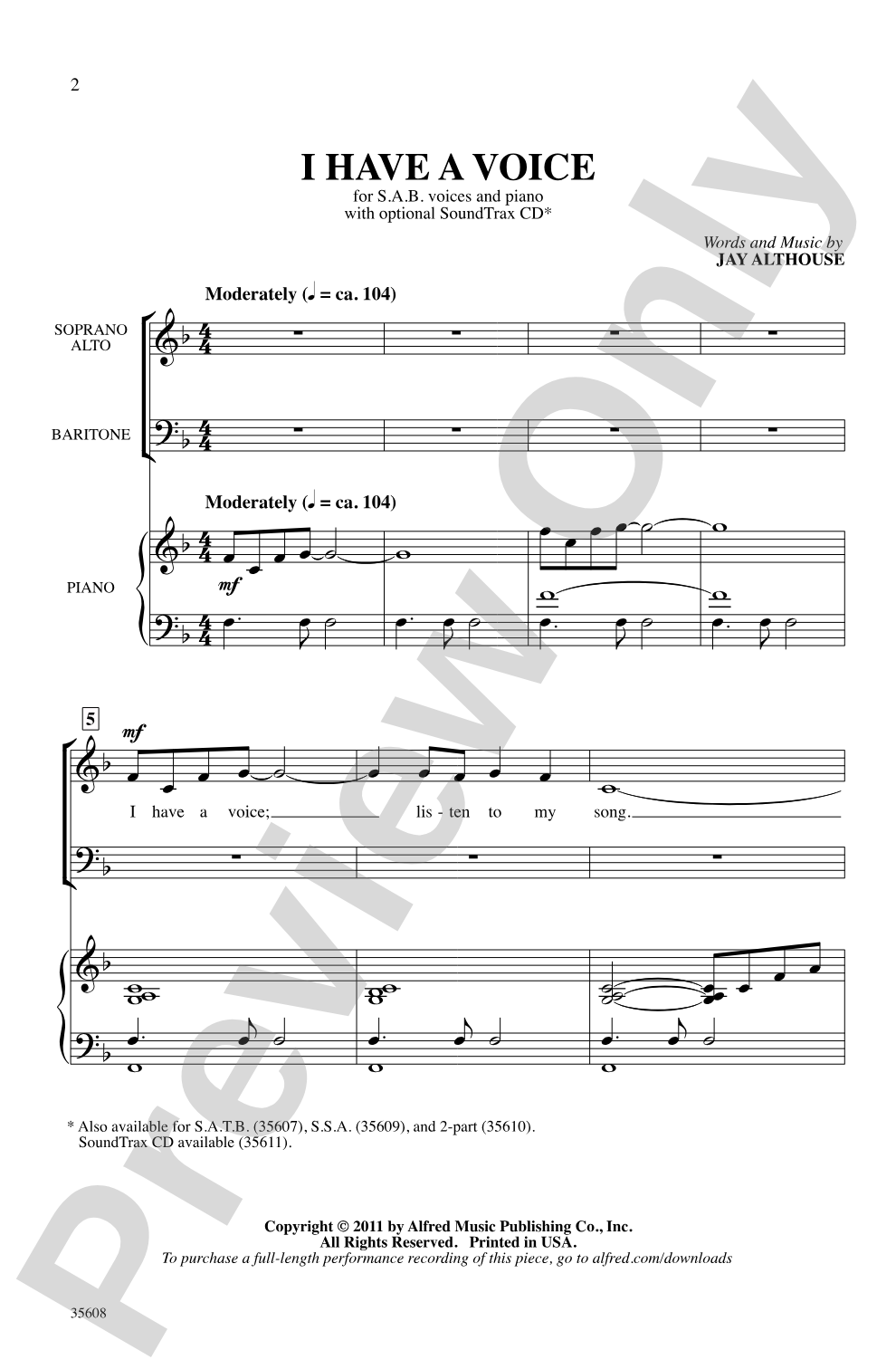
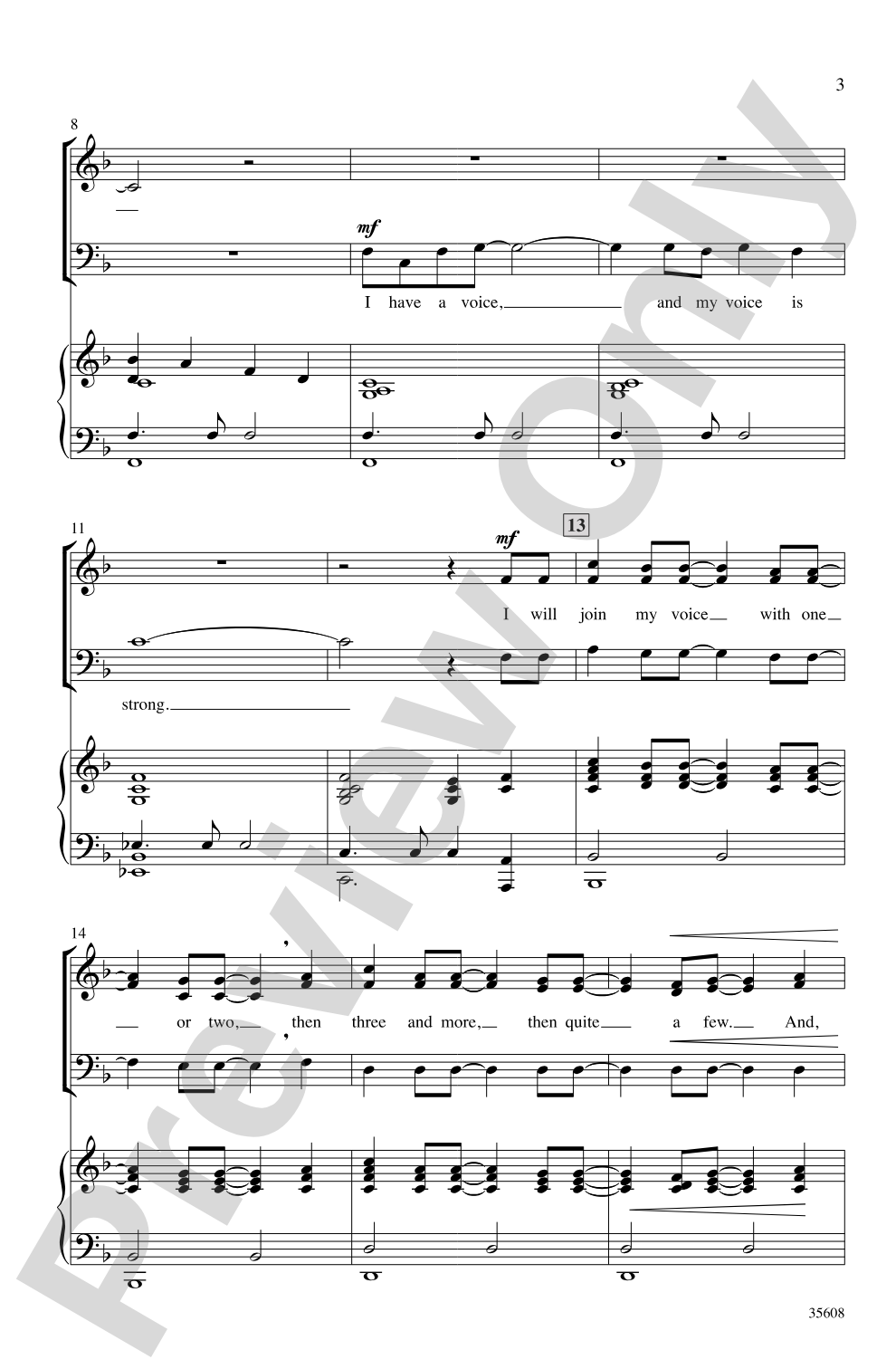

I Have a Voice: SAB Choral Octavo
Words and music by Jay Althouse
Item: 00-PO-0000921
$1.80
Minimum order quantity: 20 copies
Pickup currently not available
Related Items
I Have a Voice: SoundTrax Digital Audio Download |
$26.99
|
View | |
I Have a Voice: SATB Choral Octavo |
$1.80
|
View | |
I Have a Voice: SSA Choral Octavo |
$1.80
|
View | |
I Have a Voice: 2-Part Choral Octavo |
$1.80
|
View | |
I Have a Voice: SATB Choral Octavo |
$1.80
|
View | |
I Have a Voice: SAB Choral Octavo |
$1.80
|
View | |
I Have a Voice: SSA Choral Octavo |
$1.80
|
View | |
I Have a Voice: 2-Part Choral Octavo |
$1.80
|
View | |
I Have a Voice: Choral Octavo SoundTrax CD |
$26.99
|
View |
Description
No matter where we go or who we are, we should feel free to sing our own song---and others are welcome to join in. "And I'll be there to guide you through." A joyous and uplifting choral for all ages. Featured on Showbiz! choral movement DVD (00-35858).


I Have a Voice: SAB Choral Octavo isn't in MakeMusic Cloud just yet...but it could be. Let us know you'd like to see it, and you'll help shape what comes next. In the meantime, start a free trial and dive into thousands of interactive titles your students can play along with today.
Request This Title
Tell us you want it.
Start Your Free Trial
Explore everything that's ready to play right now.
Sample Audio
1
Audio File
--:--
0:00
0:00
Sample Video
No sample videos found.
Additional Details
Series:
Alfred Choral Designs
Publisher:
Alfred Music
Page Count:
12
SKU:
00-PO-0000921
More about this title
About the Composer: Jay Althouse

Jay Althouse earned degrees in Music Education and Music from Indiana University of Pennsylvania, where he was later honored as a Distinguished Alumnus. Early in his career, he spent eight years managing rights and licenses for a major educational publisher and served on the Executive Board of the Music Publishers Association of America.
As a composer, Althouse has over 800 choral works in print across all levels, performed widely throughout the English-speaking world. He holds ASCAP membership and is a regular recipient of the ASCAP Special Award. Beyond composition, he has co-written children's musicals with his wife Sally K. Albrecht, compiled respected vocal collections, co-authored The Complete Choral Warm-up Book and Accent on Composers, and created classroom resources including Ready to Read Music and Sixty Music Quizzes. He co-wrote I Hear America Singing, performed by the San Francisco Girls and Boys Choirs at President Obama's 2009 Inauguration. Althouse has served on boards for the North Carolina Master Chorale and the Folk Art Society of America.
Why we love this
Althouse writes with genuine warmth and accessibility, crafting melodies that singers of all abilities can feel immediately. The text about claiming your own voice paired with the simple, memorable music makes this a celebration rather than a sermon, which audiences genuinely respond to. The built-in staging suggestions mean you can make this special without needing to reinvent the wheel.
What to expect
Warm, hopeful, and genuinely inviting. The music feels like someone is extending their hand and saying, "Your voice matters." There's joy in the simplicity and uplift in the harmonies that builds without ever feeling forced or saccharine.
Who it's for
Any choir seeking a piece that works equally well with middle school singers, community choirs, or intergenerational groups. This piece reaches people regardless of vocal background because the message and music feel genuinely inclusive. It's ideal for directors who want to include movement and staging without complexity.
How to get the most out of it
- Lean into the dialogue between parts. The SAB voicing creates natural conversation; resist the urge to homogenize the sound and let each section's line shine through.
- The recorded accompaniment provides solid support, but consider dropping it for one verse to let voices anchor the texture themselves and build independence.
- Think of the overall arc as a journey rather than a single statement. Start with genuine vulnerability in the opening, building confidence toward the climax.
- Encourage singers to connect personally with the text about finding and sharing their voice. This emotional buy-in makes the staging feel authentic, not staged.
How to use it
Open a concert with this piece to set a welcoming, joyful tone from the start. It also works beautifully as a finale that sends audiences out feeling seen and encouraged. Consider pairing it with spirituals or folk arrangements that reinforce themes of individual voice and community.
Skills your students will build
- Balancing SAB voicing across three independent lines
- Connecting text and music emotionally rather than mechanically
- Stage movement and blocking within a choral piece
- Sustaining melodic line through phrase arcs
- Ensemble blend while maintaining individual voice clarity