
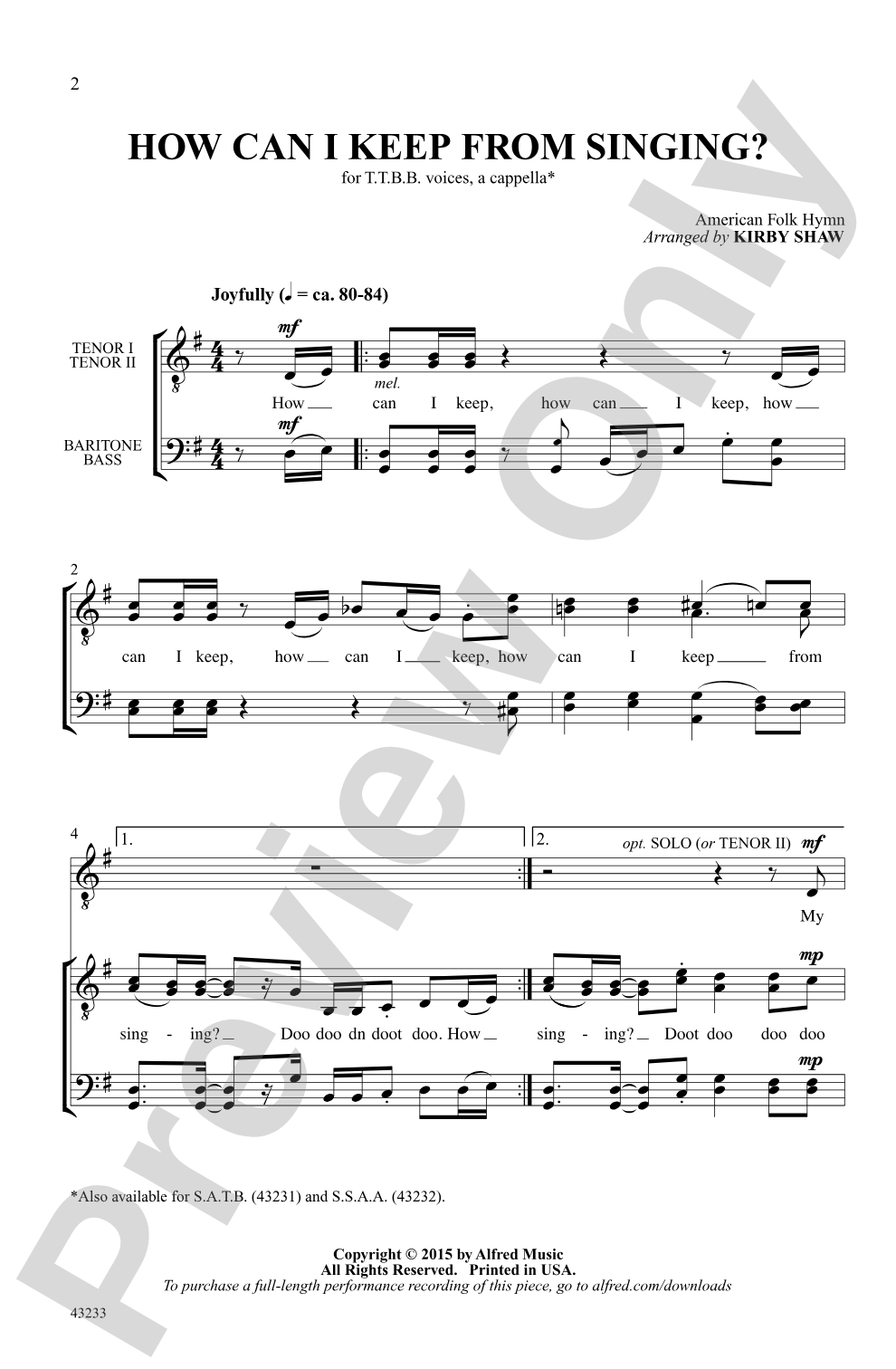
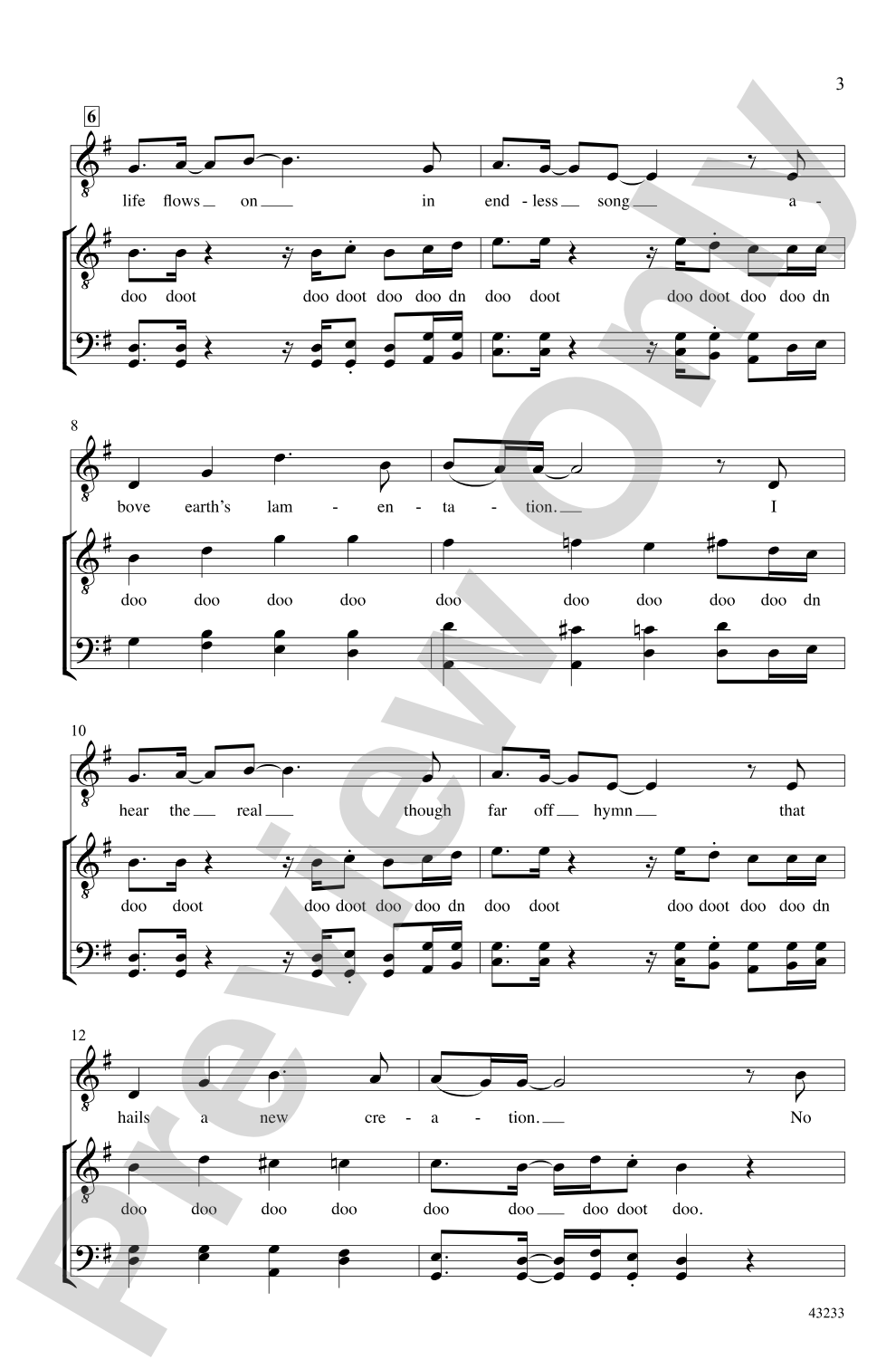

How Can I Keep from Singing?: TTBB, a cappella Choral Octavo
American Folk Hymn / arr. Kirby Shaw
Item: 00-PO-0003221
$1.90
Minimum order quantity: 20 copies
Pickup currently not available
Description
You've heard many arrangements of this beautiful American folk hymn, but none quite like this. Kirby Shaw's unique style brings out the inherent joy of the traditional text. Throughout the piece, contemporary a cappella techniques use sections of the choir as accompaniment, and a bright chord structure yields a current sound.


How Can I Keep from Singing?: TTBB, a cappella Choral Octavo isn't in MakeMusic Cloud just yet...but it could be. Let us know you'd like to see it, and you'll help shape what comes next. In the meantime, start a free trial and dive into thousands of interactive titles your students can play along with today.
Request This Title
Tell us you want it.
Start Your Free Trial
Explore everything that's ready to play right now.
Sample Audio
1
Audio File
--:--
0:00
0:00
Sample Video
No sample videos found.
Additional Details
Series:
Alfred Choral Designs
Publisher:
Alfred Music
Page Count:
8
SKU:
00-PO-0003221
More about this title
About the Arranger: Kirby Shaw
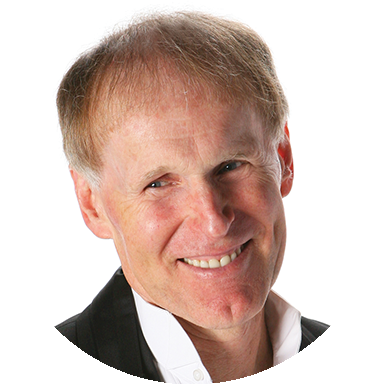
Kirby Shaw's reputation as a choral educator spans five decades and six continents. After earning degrees in Music Education and Choral Composition from San Jose State University and a DMA in Choral Conducting from the University of Washington, he built his career developing innovative vocal programs at institutions including College of the Siskiyous, Colorado State University, University of Missouri at Kansas City, and Southern Oregon University. His teaching style combines rigorous musicianship with infectious humor and deep pedagogical insight.
As a composer and arranger, Shaw has created over 2,500 works for choir that have sold nearly 20 million copies worldwide. His prolific output reflects both technical mastery and genuine connection to singers at every level. He has collaborated with vocal legends including Bobby McFerrin, Al Jarreau, and Jon Hendricks, and continues to receive commissions from major ensembles. Shaw is also a founding member of Just 4 Kicks, a professional a cappella quartet specializing in jazz.
Why we love this
Shaw's arrangement strips away the baggage of overly familiar settings and reveals why this hymn has endured. Rather than relying on organ harmonies or traditional four-part hymnal writing, he builds accompaniment from the voices themselves, creating a contemporary sound that feels fresh without ever losing the spiritual core of the text. TTBB choirs rarely find material this singable and this engaging.
What to expect
Singing this feels like discovering a familiar hymn through a new lens. The contemporary harmonic language and voice-as-accompaniment technique create unexpected color and movement while the text remains spiritually grounded. There's joy in the singing itself, from the opening phrases through to the final cadence.
Who it's for
This arrangement suits TTBB choirs with solid vocal blend and rhythmic confidence. It works equally well for men's college or church choirs seeking repertoire that honors a traditional text while sounding distinctly modern. Directors looking to expand their a cappella catalog without retreating into barbershop or doo-wop conventions will find this particularly valuable.
How to get the most out of it
- Balance the accompanying sections carefully so they support rather than overpower the melody line. The brightness of Shaw's chord structure depends on clarity across all four parts.
- Shape the text expressively throughout. The joy in 'How can I keep from singing' comes through phrasing and dynamic control, not just note accuracy.
- Lock in rhythmic precision between sections since the a cappella texture has no external reference. Rehearse the transitions between different voice groupings with particular attention.
- Experiment with slight tempo flexibility in phrases that feel especially lyrical. Shaw's contemporary approach allows for tasteful rubato without disrupting the overall forward motion.
How to use it
Pair this with other folk hymn arrangements or a cappella sacred works to build a set that shows musical range within the choral repertoire. It functions beautifully as a concert closer or as part of a service music program where a brief, uplifting piece provides both spiritual content and musical sophistication. The 8-page length makes it manageable for rehearsal schedules while demanding enough to justify performance time.
Skills your students will build
- Blend and balance in a cappella texture with multiple accompanying voice lines
- Rhythmic independence and precision in a cappella singing without instrumental reference
- Sensitivity to contemporary harmonic language and modern chord structures
- Phrasing and text expression within a folk hymn tradition
- Sectional awareness and coordination when voices function as both melody and accompaniment