
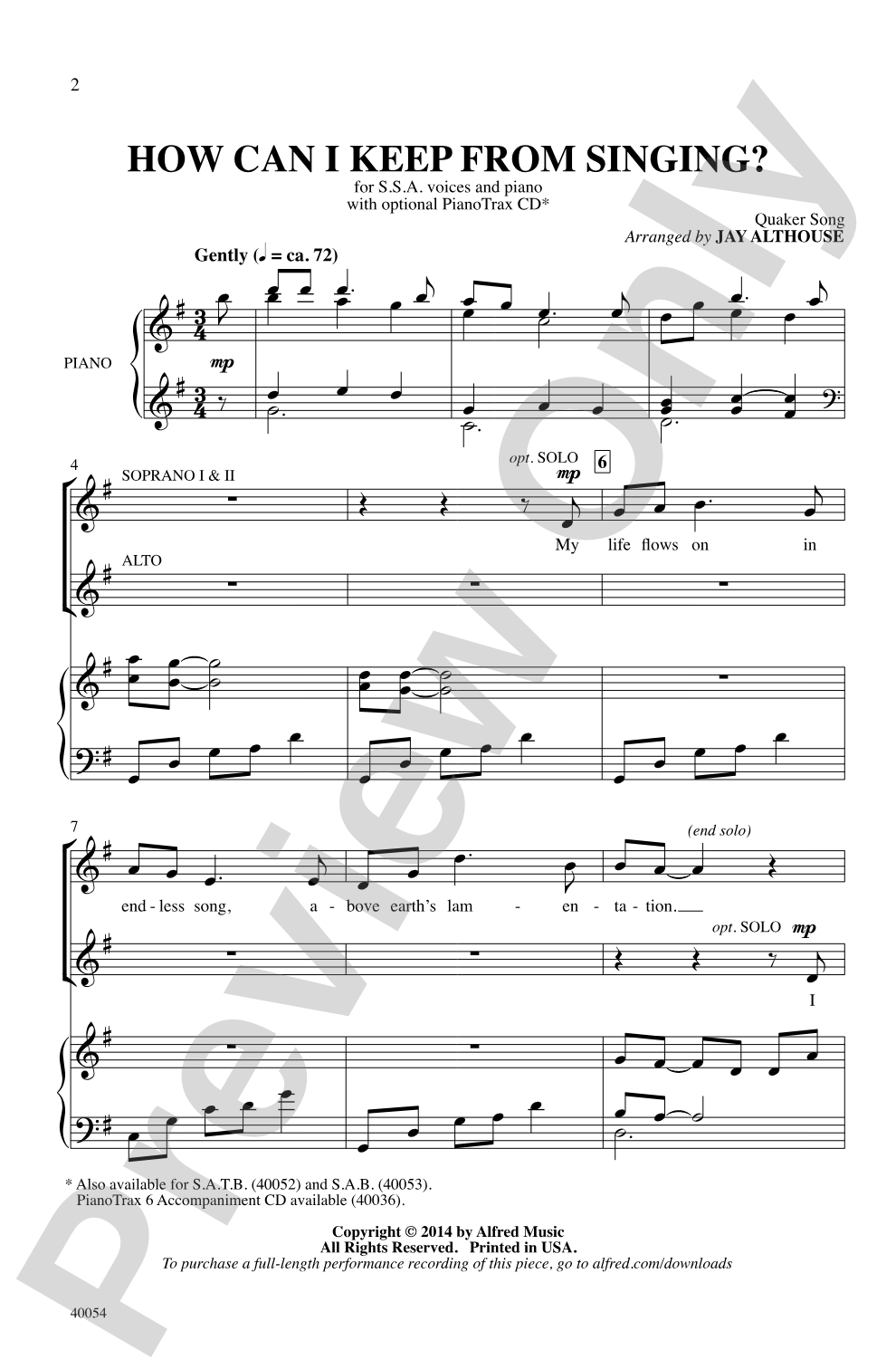
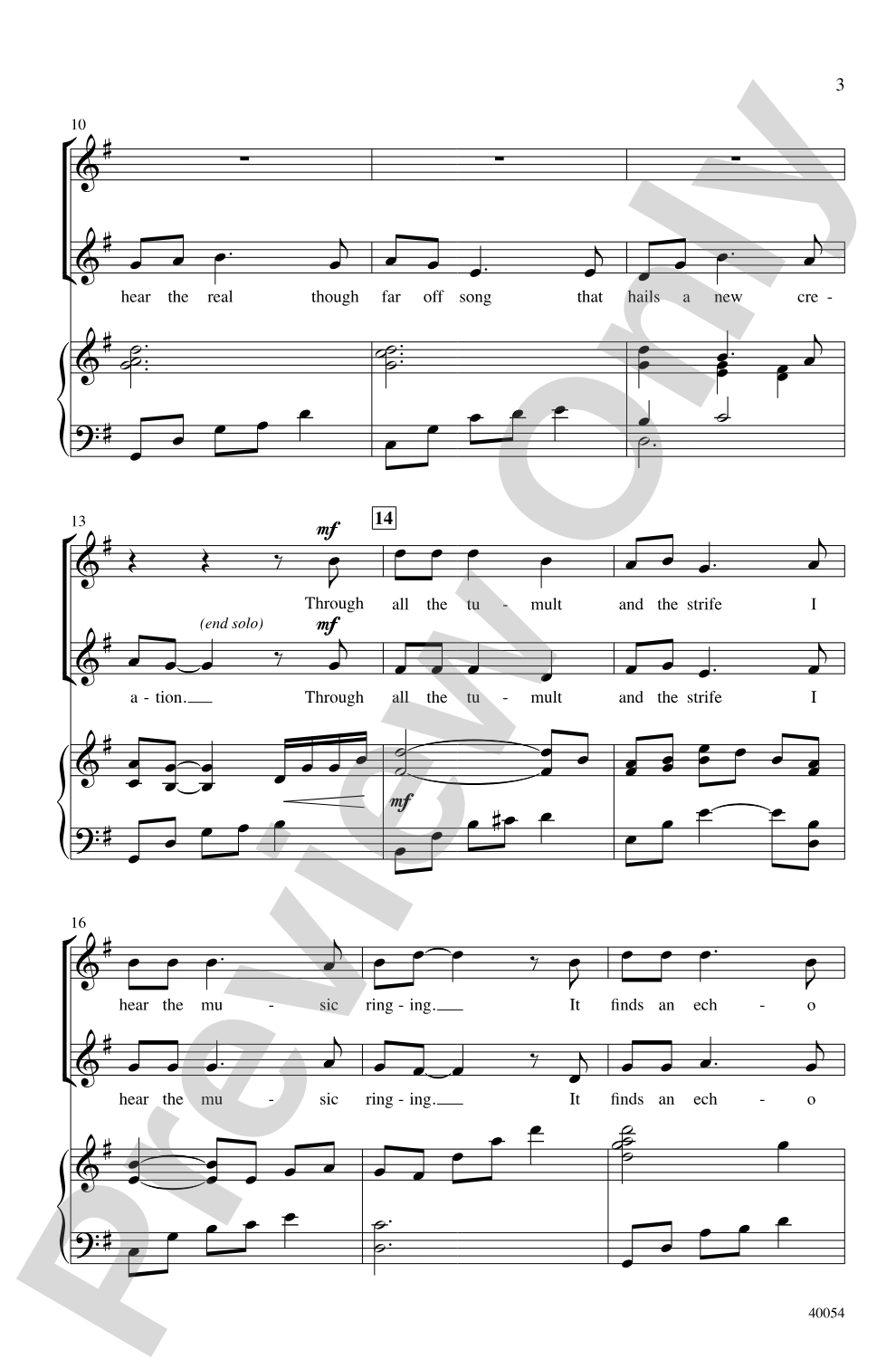

How Can I Keep from Singing?: SSA Choral Octavo
Quaker Song
Arr. Jay Althouse
Item: 00-PO-0001768
$2.05
Minimum order quantity: 20 copies
Pickup currently not available
Related Items
How Can I Keep from Singing?: PianoTrax Digital Download |
$9.99
|
View | |
How Can I Keep from Singing?: SATB Choral Octavo |
$2.05
|
View | |
How Can I Keep from Singing?: SAB Choral Octavo |
$2.05
|
View | |
How Can I Keep from Singing?: SATB Choral Octavo |
$2.05
|
View | |
How Can I Keep from Singing?: SAB Choral Octavo |
$2.05
|
View | |
How Can I Keep from Singing?: SSA Choral Octavo |
$2.05
|
View |
Description
Singers will cherish this sublime Quaker song, taken from our rich heritage of American folk music. As experienced conductors have come to expect from the gifted arranger, Jay's setting is artful in its simplicity, elegant in its effect.


How Can I Keep from Singing?: SSA Choral Octavo isn't in MakeMusic Cloud just yet...but it could be. Let us know you'd like to see it, and you'll help shape what comes next. In the meantime, start a free trial and dive into thousands of interactive titles your students can play along with today.
Request This Title
Tell us you want it.
Start Your Free Trial
Explore everything that's ready to play right now.
Sample Audio
1
Audio File
--:--
0:00
0:00
Sample Video
No sample videos found.
Additional Details
Series:
Alfred Choral Designs
Publisher:
Alfred Music
Page Count:
8
SKU:
00-PO-0001768
More about this title
About the Arranger: Jay Althouse

Jay Althouse holds degrees in Music Education and Music from Indiana University of Pennsylvania, where he was honored as a Distinguished Alumnus. His career in music spans composition, publishing, and education; he spent eight years working in rights and licensing for a major educational music publisher and served on the Executive Board of the Music Publishers Association of America. As a composer, he has over 800 choral works in print, performed widely across English-speaking countries, and is a writer member of ASCAP with multiple Special Awards for his compositions.
Beyond composition, Althouse has collaborated with his wife Sally K. Albrecht on children's musicals and co-authored influential books including The Complete Choral Warm-up Book and Accent on Composers. He has compiled and arranged respected vocal collections, authored reproducible classroom resources, and co-wrote I Hear America Singing, performed by the San Francisco Girls and Boys Choirs at President Obama's inauguration in 2009. Currently based in North Carolina, he serves on the National Advisory Board of the Folk Art Society of America and contributes articles to its quarterly periodical.
Why we love this
Althouse strips this Quaker hymn to its emotional core without sacrificing depth. The SSA voicing sits naturally in the treble range, the counterpoint unfolds organically rather than drawing attention to itself, and the harmonic language honors the tune's spiritual legacy while feeling entirely fresh. Singers discover why this folk hymn endures through singing it, not through arrangement flourishes.
What to expect
The piece settles into an intimate, reflective space from its opening measures. There is resilience beneath the calm surface, as though singers are affirming something hard-won rather than celebrating something easy. The arrangement creates space for voices to blend and breath to matter, making every phrase feel both simple and weighted with meaning.
Who it's for
This arrangement reaches choirs seeking repertoire that moves audiences without technical display. SSA groups at intermediate levels and above will find the voicing lies comfortably in range while still offering musical substance. Any choir drawn to American sacred folk music will connect to this piece's quiet power.
How to get the most out of it
- Allow the simplicity of the writing to become your greatest asset. Clarity of text and pure vowels matter more here than interpretive ornamentation.
- Shape the gentle phrases without rushing; let the spiritual character emerge from sustained, unhurried singing rather than driving forward.
- Balance the three voices so the melody sings out naturally while the supporting parts provide warmth without overshadowing.
- Consider the piece's context as a song of conviction and resilience. The understatement of the arrangement asks singers to invest emotional authenticity into every phrase.
How to use it
This arrangement works as a spiritual anchor in a concert, grounding programming in American roots and offering audiences a moment of genuine quietness. Pair it with other folk-inspired pieces or use it to contrast with more complex contemporary choral works. It also fits beautifully in services or community gatherings where shared singing matters more than technical display.
Skills your students will build
- Singing with independence while maintaining ensemble blend in three-part harmony
- Shaping long melodic lines with breath and phrasing rather than dynamic changes
- Understanding the relationship between folk melody and artistic arrangement
- Developing sensitivity to text expression in sacred American music