
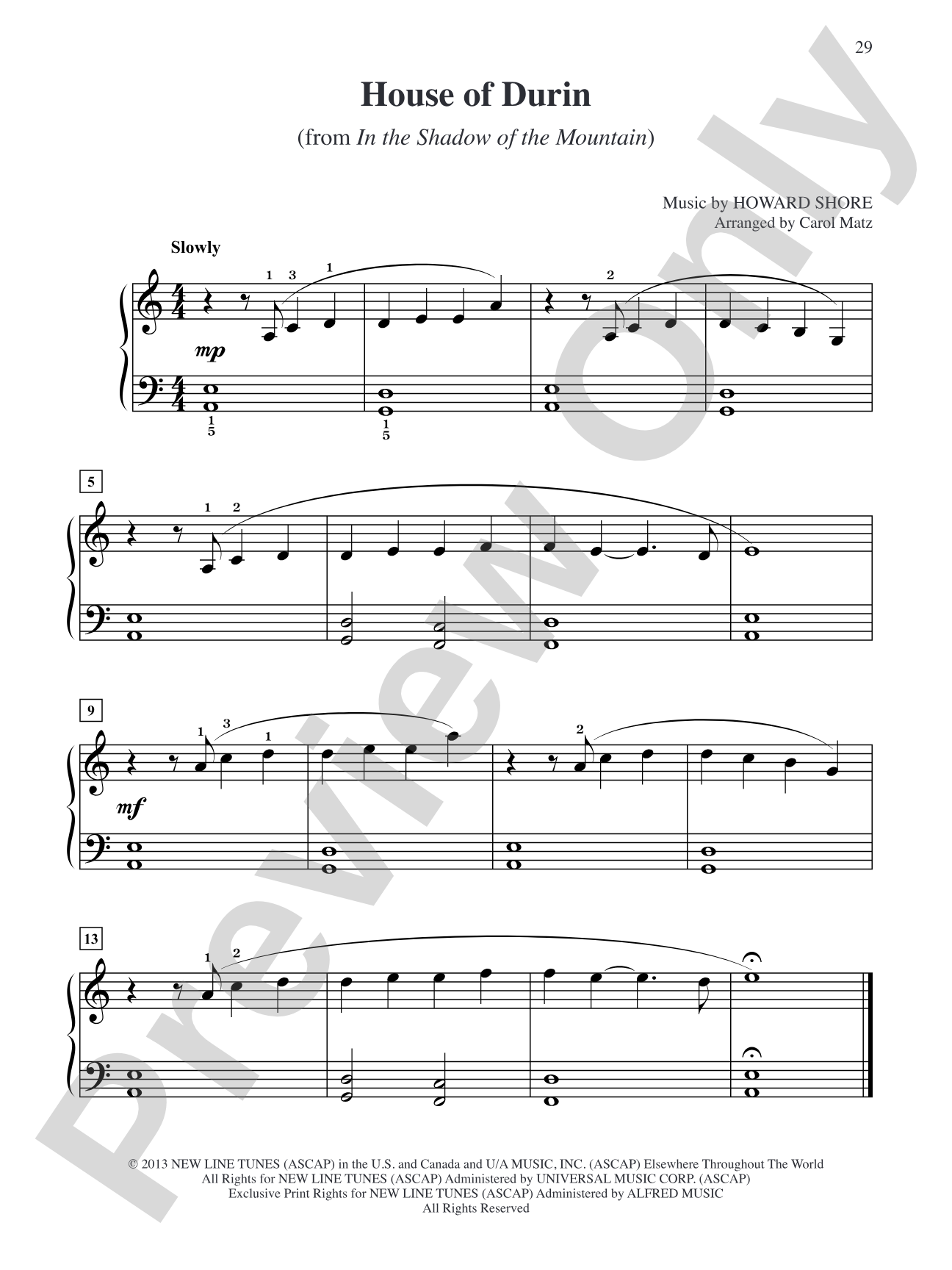

House of Durin (from The Hobbit: The Desolation of Smaug): Big Note Piano
Big Note Piano Selections from the Original Motion Picture Soundtrack
By Howard Shore / arr. Carol Matz
Level: Big Note
Item: 00-PS-0015949
$4.99
One moment…
Related Items
Beyond the Forest (from The Hobbit: The Desolation of Smaug): Big Note Piano |
$4.99
|
View | |
The Quest for Erebor (from The Hobbit: The Desolation of Smaug): Big Note Piano |
$4.99
|
View | |
Erebor (from The Hobbit: The Desolation of Smaug): Big Note Piano |
$4.99
|
View | |
Bree (from The Hobbit: The Desolation of Smaug): Big Note Piano |
$4.99
|
View | |
Beorn (from The Hobbit: The Desolation of Smaug): Big Note Piano |
$4.99
|
View | |
The Woodland Realm (from The Hobbit: The Desolation of Smaug): Big Note Piano |
$4.99
|
View | |
Bard A Man of Lake-town (from The Hobbit: The Desolation of Smaug): Big Note Piano |
$4.99
|
View | |
Bard and Family (from The Hobbit: The Desolation of Smaug): Big Note Piano |
$4.99
|
View | |
Girion Lord of Dale (from The Hobbit: The Desolation of Smaug): Big Note Piano |
$4.99
|
View | |
Girion and Bard (from The Hobbit: The Desolation of Smaug): Big Note Piano |
$4.99
|
View | |
Lake-town Bard (from The Hobbit: The Desolation of Smaug): Big Note Piano |
$4.99
|
View | |
Smaug (from The Hobbit: The Desolation of Smaug): Big Note Piano |
$4.99
|
View | |
I See Fire (from The Hobbit: The Desolation of Smaug): Big Note Piano |
$4.99
|
View | |
The Hobbit: The Desolation of Smaug: Piano Book |
$14.99
|
View |
Description
With The Hobbit: The Desolation of Smaug, audiences worldwide were transported back to Middle-earth for more thrills and adventure. 14 pieces from Howard Shore's brilliant score have been arranged for Big Note Piano. Pianists will have both classic and new themes from the epic journey right at their fingertips as they play. In addition to the piano arrangements, this beautifully produced souvenir folio features an array of colorful photos from the film. Titles: The Quest for Erebor * Erebor * Bree * Beorn * Woodland Realm * Bard, A Man of Lake-town * Bard and Family * Girion, Lord of Dale * Girion and Bard * Lake-town Bard * House of Durin * Smaug * I See Fire * Beyond the Forest.


House of Durin (from The Hobbit: The Desolation of Smaug): Big Note Piano isn't in MakeMusic Cloud just yet...but it could be. Let us know you'd like to see it, and you'll help shape what comes next. In the meantime, start a free trial and dive into thousands of interactive titles your students can play along with today.
Request This Title
Tell us you want it.
Start Your Free Trial
Explore everything that's ready to play right now.
Sample Audio
No sample audio found.
Sample Video
No sample videos found.
Additional Details
Publisher:
Alfred Music
Page Count:
40
SKU:
00-PS-0015949
More about this title
About the Composer: Howard Shore
Howard Shore is a film composer whose orchestral scores have defined modern cinema across multiple genres and decades. His work on Peter Jackson's The Lord of the Rings trilogy established him as a master of epic, thematically rich composition, and he brought that same architectural approach to The Hobbit films, crafting leitmotifs that carry emotional weight across the narrative.
Why we love this
Carol Matz's Big Note arrangement captures the grandeur of Shore's themes while keeping the technical demands manageable for early intermediate pianists. Young players encounter real film music here, not simplified pastiches, and the collection's breadth means you can program selections from different scenes to tell a story across a recital.
What to expect
These themes shimmer with adventure and epic grandeur. You'll find moments of dark mystery alongside passages that soar with heroic swagger, and the harmonic language occasionally shifts into unexpected territory that makes you sit up and listen more carefully. The music never rushes you; it trusts you to inhabit the landscape it creates.
Who it's for
Big Note pianists ready to engage with film music that doesn't condescend to their level. This collection works for students in their first or second year of lessons who love The Hobbit and want to play recognizable, emotionally satisfying material that still requires genuine musical decision-making.
How to get the most out of it
- Honor the thematic integrity by maintaining steady tempos through longer passages; Shore's orchestrations rely on rhythmic momentum to build dramatic tension.
- Balance the bass line with melody to preserve the orchestral texture; many of these arrangements distribute the harmonic foundation across the left hand.
- Use the film stills throughout the folio as visual references before you play; connecting the music to its dramatic moment deepens your interpretation.
- Mark phrase endings clearly so you know where to breathe and reset; thematic material often spans multiple systems in these big-note transcriptions.
How to use it
Sequence selections thematically rather than chronologically through your recital. Pair "House of Durin" with "Erebor" to explore the dwarves' storyline, or isolate "I See Fire" as a standalone recital piece for a student seeking something with genuine emotional gravity. The film stills make these pieces conversation starters for parents and audience members unfamiliar with classical piano repertoire.
Skills your students will build
- Reading chord-based harmony across both hands simultaneously
- Maintaining phrasing and shape across extended single-note passages
- Managing dynamic contrast within a smaller technical range
- Interpreting thematic material with stylistic consistency
- Navigating film music's characteristic rhythmic patterns and orchestral textures