
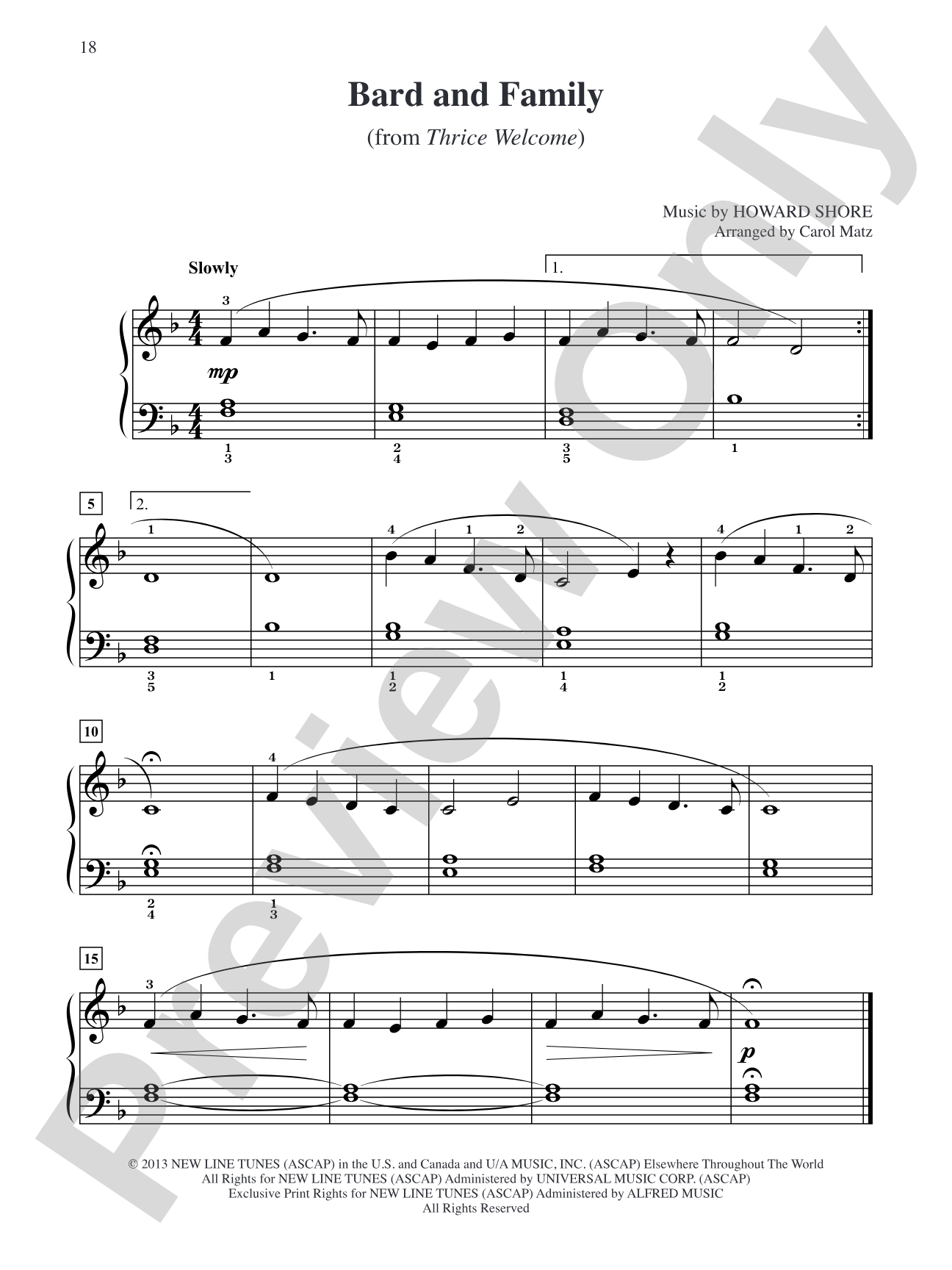

Bard and Family (from The Hobbit: The Desolation of Smaug): Big Note Piano
Big Note Piano Selections from the Original Motion Picture Soundtrack
By Howard Shore / arr. Carol Matz
Level: Big Note
Item: 00-PS-0015945
$4.99
One moment…
Related Items
Beyond the Forest (from The Hobbit: The Desolation of Smaug): Big Note Piano |
$4.99
|
View | |
The Quest for Erebor (from The Hobbit: The Desolation of Smaug): Big Note Piano |
$4.99
|
View | |
Erebor (from The Hobbit: The Desolation of Smaug): Big Note Piano |
$4.99
|
View | |
Bree (from The Hobbit: The Desolation of Smaug): Big Note Piano |
$4.99
|
View | |
Beorn (from The Hobbit: The Desolation of Smaug): Big Note Piano |
$4.99
|
View | |
The Woodland Realm (from The Hobbit: The Desolation of Smaug): Big Note Piano |
$4.99
|
View | |
Bard A Man of Lake-town (from The Hobbit: The Desolation of Smaug): Big Note Piano |
$4.99
|
View | |
Girion Lord of Dale (from The Hobbit: The Desolation of Smaug): Big Note Piano |
$4.99
|
View | |
Girion and Bard (from The Hobbit: The Desolation of Smaug): Big Note Piano |
$4.99
|
View | |
Lake-town Bard (from The Hobbit: The Desolation of Smaug): Big Note Piano |
$4.99
|
View | |
House of Durin (from The Hobbit: The Desolation of Smaug): Big Note Piano |
$4.99
|
View | |
Smaug (from The Hobbit: The Desolation of Smaug): Big Note Piano |
$4.99
|
View | |
I See Fire (from The Hobbit: The Desolation of Smaug): Big Note Piano |
$4.99
|
View | |
The Hobbit: The Desolation of Smaug: Piano Book |
$14.99
|
View |
Description
With The Hobbit: The Desolation of Smaug, audiences worldwide were transported back to Middle-earth for more thrills and adventure. 14 pieces from Howard Shore's brilliant score have been arranged for Big Note Piano. Pianists will have both classic and new themes from the epic journey right at their fingertips as they play. In addition to the piano arrangements, this beautifully produced souvenir folio features an array of colorful photos from the film. Titles: The Quest for Erebor * Erebor * Bree * Beorn * Woodland Realm * Bard, A Man of Lake-town * Bard and Family * Girion, Lord of Dale * Girion and Bard * Lake-town Bard * House of Durin * Smaug * I See Fire * Beyond the Forest.


Bard and Family (from The Hobbit: The Desolation of Smaug): Big Note Piano isn't in MakeMusic Cloud just yet...but it could be. Let us know you'd like to see it, and you'll help shape what comes next. In the meantime, start a free trial and dive into thousands of interactive titles your students can play along with today.
Request This Title
Tell us you want it.
Start Your Free Trial
Explore everything that's ready to play right now.
Sample Audio
No sample audio found.
Sample Video
No sample videos found.
Additional Details
Publisher:
Alfred Music
Page Count:
40
SKU:
00-PS-0015945
More about this title
About the Composer: Howard Shore
Howard Shore is a film composer whose work has shaped the sound of modern cinema. His scores for Peter Jackson's Lord of the Rings and Hobbit trilogies stand as monuments of orchestral storytelling, earning him three Academy Awards and demonstrating how thematic composition can drive narrative across multiple films. Shore's ability to write memorable, singable themes that work across different instrumental arrangements makes his music ideal for music education contexts.
Why we love this
These arrangements preserve Shore's melodic gifts while keeping the technical demands accessible. Young pianists get to play themes of real dramatic weight and cultural familiarity, which means they're motivated to practice and genuinely invested in bringing the music to life. The collection spans many moods across its 14 pieces, giving students a diverse toolkit for building musicality and interpretive confidence.
What to expect
Sweeping and heroic, yet intimate in moments. These themes evoke adventure and danger, but also quiet moments of reflection and home. Playing through the collection feels like scoring your own journey through the films.
Who it's for
Young pianists in their first years of study who love film music and the world of Middle-earth. This collection gives students aged 8 and up a reason to sit down at the piano daily while building fundamental skills on repertoire they actually want to play.
How to get the most out of it
- Shape the longer melodic lines with clear phrase breathing. Even at Big Note level, these themes deserve legato playing that honors Shore's original orchestral voicing.
- Listen to the film recordings to internalize the character and tempo of each piece. This helps you communicate the story through your playing, not just the notes.
- Balance the melody with a warm but uncluttered accompaniment. Big Note arranging often simplifies left-hand figures; resist the urge to rush through them.
- Pay attention to the opening notes of each piece. Many of Shore's themes are identified by their first few measures, so nail those moments with confidence.
How to use it
Feature individual pieces in student recitals throughout the year, building toward a complete performance or medley as a program finale. The variety of moods and tempos makes these works flexible for spring concerts, holiday performances, or themed studio events celebrating film music.
Skills your students will build
- Legato phrasing across larger intervallic leaps
- Maintaining steady tempo through rhythmically simple but longer melodic statements
- Balancing melody and accompaniment in simplified two-hand textures
- Recognizing and executing repeated thematic material with consistent interpretation
- Reading across wider keyboard range with clear left-hand anchoring