
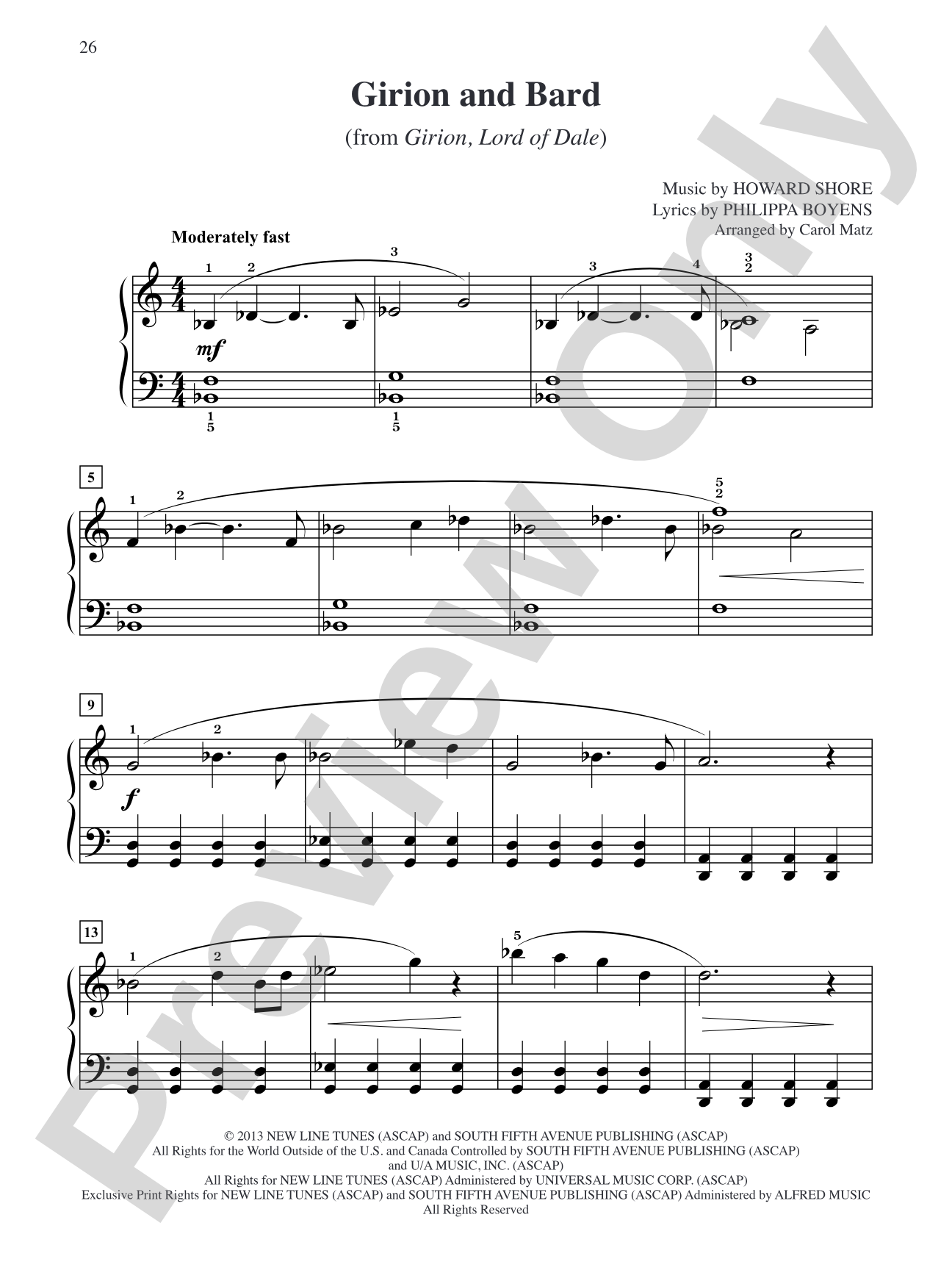

Girion and Bard (from The Hobbit: The Desolation of Smaug): Big Note Piano
Big Note Piano Selections from the Original Motion Picture Soundtrack
By Howard Shore / arr. Carol Matz
Level: Big Note
Item: 00-PS-0015947
$4.99
Pickup currently not available
Related Items
Beyond the Forest (from The Hobbit: The Desolation of Smaug): Big Note Piano |
$4.99
|
View | |
The Quest for Erebor (from The Hobbit: The Desolation of Smaug): Big Note Piano |
$4.99
|
View | |
Erebor (from The Hobbit: The Desolation of Smaug): Big Note Piano |
$4.99
|
View | |
Bree (from The Hobbit: The Desolation of Smaug): Big Note Piano |
$4.99
|
View | |
Beorn (from The Hobbit: The Desolation of Smaug): Big Note Piano |
$4.99
|
View | |
The Woodland Realm (from The Hobbit: The Desolation of Smaug): Big Note Piano |
$4.99
|
View | |
Bard A Man of Lake-town (from The Hobbit: The Desolation of Smaug): Big Note Piano |
$4.99
|
View | |
Bard and Family (from The Hobbit: The Desolation of Smaug): Big Note Piano |
$4.99
|
View | |
Girion Lord of Dale (from The Hobbit: The Desolation of Smaug): Big Note Piano |
$4.99
|
View | |
Lake-town Bard (from The Hobbit: The Desolation of Smaug): Big Note Piano |
$4.99
|
View | |
House of Durin (from The Hobbit: The Desolation of Smaug): Big Note Piano |
$4.99
|
View | |
Smaug (from The Hobbit: The Desolation of Smaug): Big Note Piano |
$4.99
|
View | |
I See Fire (from The Hobbit: The Desolation of Smaug): Big Note Piano |
$4.99
|
View | |
The Hobbit: The Desolation of Smaug: Piano Book |
$14.99
|
View |
Description
With The Hobbit: The Desolation of Smaug, audiences worldwide were transported back to Middle-earth for more thrills and adventure. 14 pieces from Howard Shore's brilliant score have been arranged for Big Note Piano. Pianists will have both classic and new themes from the epic journey right at their fingertips as they play. In addition to the piano arrangements, this beautifully produced souvenir folio features an array of colorful photos from the film. Titles: The Quest for Erebor * Erebor * Bree * Beorn * Woodland Realm * Bard, A Man of Lake-town * Bard and Family * Girion, Lord of Dale * Girion and Bard * Lake-town Bard * House of Durin * Smaug * I See Fire * Beyond the Forest.


Girion and Bard (from The Hobbit: The Desolation of Smaug): Big Note Piano isn't in MakeMusic Cloud just yet...but it could be. Let us know you'd like to see it, and you'll help shape what comes next. In the meantime, start a free trial and dive into thousands of interactive titles your students can play along with today.
Request This Title
Tell us you want it.
Start Your Free Trial
Explore everything that's ready to play right now.
Sample Audio
No sample audio found.
Sample Video
No sample videos found.
Additional Details
Publisher:
Alfred Music
Page Count:
40
SKU:
00-PS-0015947
More about this title
About the Composer: Howard Shore
Howard Shore has spent decades crafting immersive orchestral scores for some of cinema's most beloved fantasy epics. His work on Peter Jackson's Middle-earth films earned him three Academy Awards and established him as a master of thematic storytelling through instrumental music. Shore's ability to weave leitmotifs that carry emotional weight and narrative clarity makes his scores exceptionally effective when adapted for student musicians.
Why we love this
This collection captures the sweep and heroism of Shore's score in arrangements that stay true to his melodic gift without overwhelming young pianists. The mix of action-driven pieces and quieter character themes gives students access to genuinely memorable music from a world-class film score. Big Note format keeps technical demands reasonable while the included film photography creates an engaging visual connection to the music they're playing.
What to expect
Majestic and purposeful. These arrangements channel the grandeur of Middle-earth through accessible piano writing, creating moments of quiet reflection alongside passages that pulse with forward momentum. The music invites pianists to discover how Shore uses melody and harmony to bring characters and kingdoms to life.
Who it's for
Young pianists who want to tackle recognizable, cinematically rich material without navigating complex rhythms or dense voicings. Students preparing for recitals or informal performances will find that these themes are instantly familiar and dramatically satisfying to play.
How to get the most out of it
- Pay attention to Shore's use of rising and falling melodic contours to suggest adventure and peril; these shapes carry the emotional story even in simplified arrangements.
- Balance the melody with steady accompaniment patterns so the thematic material remains clear and doesn't get rushed by the harmonic foundation.
- Use tempo and dynamics to delineate different characters and locations; Bard's themes benefit from a grounded, deliberate approach compared to the more soaring Erebor music.
How to use it
Feature a single piece at a winter or spring recital to give students a taste of film score arranging, or select two or three contrasting titles for a short suite that showcases the range of Shore's thematic work. The colorful photographs make this an excellent choice for community events or school showcases where visual elements enhance student engagement.
Skills your students will build
- Reading and sustaining thematic material across multiple phrases
- Balancing melody and accompaniment textures
- Interpreting tempo and dynamic choices to convey character and mood
- Managing moderate hand spans and basic left-hand patterns
- Maintaining musical coherence across extended pieces