
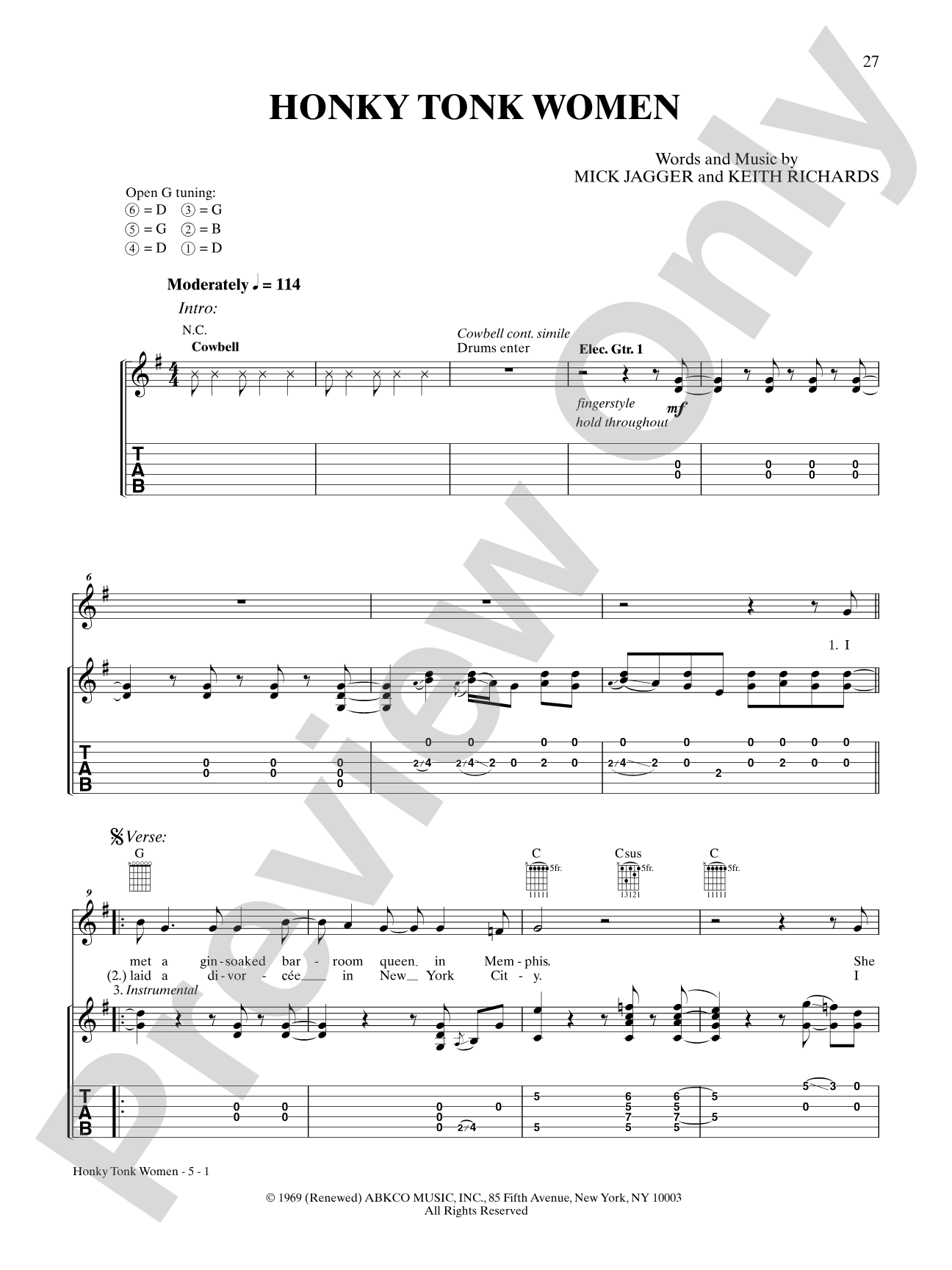

Honky Tonk Women: Guitar TAB
20 Classic Hits
The Rolling Stones
Item: 00-PS-0013706
$4.99
Pickup currently not available
Related Items
Paint It, Black: Guitar TAB |
$4.99
|
View | |
(I Can't Get No) Satisfaction: Guitar TAB |
$4.99
|
View | |
The Last Time: Guitar TAB |
$4.99
|
View | |
Get Off of My Cloud: Guitar TAB |
$4.99
|
View | |
19th Nervous Breakdown: Guitar TAB |
$5.99
|
View | |
Play with Fire: Guitar TAB |
$4.99
|
View | |
Mother's Little Helper: Guitar TAB |
$4.99
|
View | |
You Can't Always Get What You Want: Guitar TAB |
$5.99
|
View | |
As Tears Go By: Guitar TAB |
$4.99
|
View | |
Ruby Tuesday: Guitar TAB |
$4.99
|
View | |
Sympathy for the Devil: Guitar TAB |
$5.99
|
View | |
Brown Sugar: Guitar TAB |
$5.99
|
View | |
Let's Spend the Night Together: Guitar TAB |
$4.99
|
View | |
Under My Thumb: Guitar TAB |
$4.99
|
View | |
Gimme Shelter: Guitar TAB |
$4.99
|
View | |
Let It Bleed: Guitar TAB |
$4.99
|
View | |
No Expectations: Guitar TAB |
$4.99
|
View | |
Jumpin' Jack Flash: Guitar TAB |
$5.99
|
View | |
Wild Horses: Guitar TAB |
$4.99
|
View | |
The Rolling Stones: Easy Guitar TAB Anthology: Easy Guitar TAB Book |
$26.99
|
View |
Description
Featuring 20 of The Rolling Stones greatest hits, each guitar part is carefully arranged in full notation and TAB to be easily playable yet still accurately reflect all of Keith Richard's classic guitar parts with correct fingerings and tunings. Titles: 19th Nervous Breakdown * As Tears Go By * Brown Sugar * Get Off of My Cloud * Gimme Shelter * Honky Tonk Women * Jumpin' Jack Flash * Let it Bleed * Let's Spend The Night Together * Mother's Little Helper * No Expectations * Paint It, Black * Play With Fire * Ruby Tuesday * (I Can't Get No) Satisfaction * Sympathy for the Devil * The Last Time * Under My Thumb * Wild Horses * You Can't Always Get What You Want.


Honky Tonk Women: Guitar TAB isn't in MakeMusic Cloud just yet...but it could be. Let us know you'd like to see it, and you'll help shape what comes next. In the meantime, start a free trial and dive into thousands of interactive titles your students can play along with today.
Request This Title
Tell us you want it.
Start Your Free Trial
Explore everything that's ready to play right now.
Sample Audio
No sample audio found.
Sample Video
No sample videos found.
Additional Details
Series:
Guitar TAB Anthology
Publisher:
Alfred Music
Page Count:
88
SKU:
00-PS-0013706
More about this title
About the Composer: Mick Jagger
Mick Jagger's songwriting partnership with Keith Richards transformed popular music across five decades, establishing the template for rock composition that blended blues traditions with modern sensibility. His melodies and lyrical voice shaped some of the most covered and studied rock songs in music education, offering guitarists direct access to the harmonic and rhythmic vocabulary that defined an era.
Why we love this
These 20 tracks capture the essential Stones repertoire in a format that respects Keith Richards' original voicings while making them genuinely playable for intermediate guitarists. The accurate fingerings and tuning notations transform what could be frustrating detective work into focused practice on articulation, dynamics, and that unmistakable Stones swagger.
What to expect
Swagger, restraint, and blues-soaked innovation. These arrangements capture the tension between raw rock energy and precise musical craft that defined the Stones' output, with open strings ringing against bent notes and sparse, deliberate phrasing that sounds effortless until you try to replicate it.
Who it's for
Intermediate guitarists ready to move beyond simplified tabs into arrangements that preserve the actual character of iconic recordings. Players who want to understand how Richards built his signature sound through careful tuning, voicing, and fingering choices rather than learning simplified approximations.
How to get the most out of it
- Pay close attention to the tuning notations at the start of each song. Open and alternate tunings are central to the Stones' sound, and nailing them is half the battle.
- Prioritize the rhythmic pocket over perfect speed. These songs live in their groove, not in tempo races. Lock the timing before you increase speed.
- Use the TAB fingerings as written, especially on the classic riffs. Richards' choices reveal efficient voicing and natural hand position that make sustain and bending work.
- Differentiate between rhythm and lead sections through dynamics and tone control. The TAB shows both, but your touch shapes whether they land as accompaniment or statement.
How to use it
Build a rock history masterclass by programming selections across a semester or year, using each song to explore a specific element of Richards' approach (open tunings, call-and-response phrasing, blues vocabulary). These transcriptions work equally well as solo recital repertoire or as reference materials for ensemble arrangements.
Skills your students will build
- Reading and applying alternate and open tunings
- Executing blues-based bends and vibrato with control
- Balancing rhythmic pocket awareness with melodic accuracy
- Analyzing and recreating signature riffs through notation and TAB
- Understanding voicing choices and their relationship to tone