
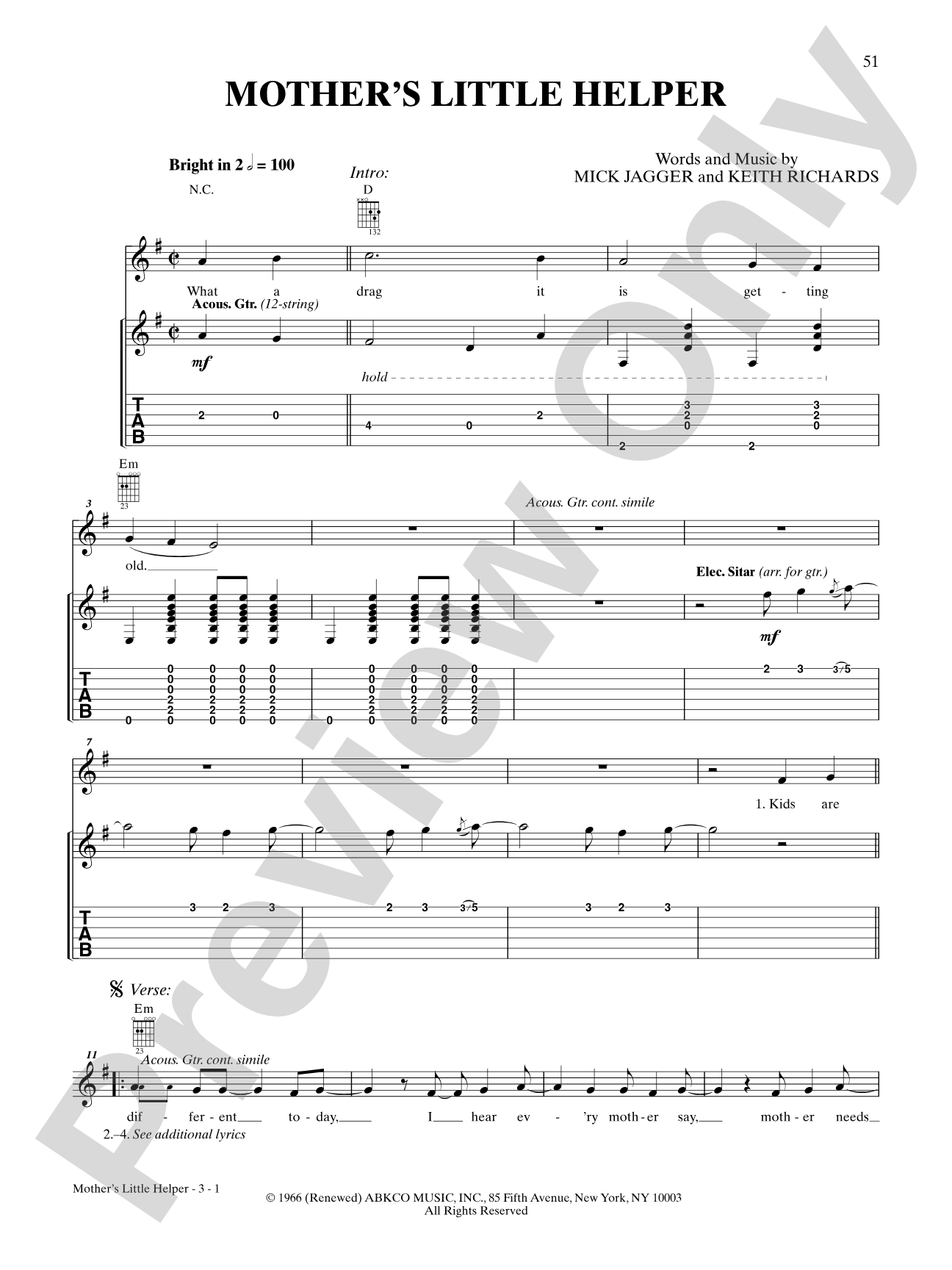

Mother's Little Helper: Guitar TAB
20 Classic Hits
The Rolling Stones
Item: 00-PS-0013705
$4.99
Pickup currently not available
Related Items
Paint It, Black: Guitar TAB |
$4.99
|
View | |
(I Can't Get No) Satisfaction: Guitar TAB |
$4.99
|
View | |
The Last Time: Guitar TAB |
$4.99
|
View | |
Get Off of My Cloud: Guitar TAB |
$4.99
|
View | |
19th Nervous Breakdown: Guitar TAB |
$5.99
|
View | |
Play with Fire: Guitar TAB |
$4.99
|
View | |
Honky Tonk Women: Guitar TAB |
$4.99
|
View | |
You Can't Always Get What You Want: Guitar TAB |
$5.99
|
View | |
As Tears Go By: Guitar TAB |
$4.99
|
View | |
Ruby Tuesday: Guitar TAB |
$4.99
|
View | |
Sympathy for the Devil: Guitar TAB |
$5.99
|
View | |
Brown Sugar: Guitar TAB |
$5.99
|
View | |
Let's Spend the Night Together: Guitar TAB |
$4.99
|
View | |
Under My Thumb: Guitar TAB |
$4.99
|
View | |
Gimme Shelter: Guitar TAB |
$4.99
|
View | |
Let It Bleed: Guitar TAB |
$4.99
|
View | |
No Expectations: Guitar TAB |
$4.99
|
View | |
Jumpin' Jack Flash: Guitar TAB |
$5.99
|
View | |
Wild Horses: Guitar TAB |
$4.99
|
View | |
The Rolling Stones: Easy Guitar TAB Anthology: Easy Guitar TAB Book |
$26.99
|
View |
Description
Featuring 20 of The Rolling Stones greatest hits, each guitar part is carefully arranged in full notation and TAB to be easily playable yet still accurately reflect all of Keith Richard's classic guitar parts with correct fingerings and tunings. Titles: 19th Nervous Breakdown * As Tears Go By * Brown Sugar * Get Off of My Cloud * Gimme Shelter * Honky Tonk Women * Jumpin' Jack Flash * Let it Bleed * Let's Spend The Night Together * Mother's Little Helper * No Expectations * Paint It, Black * Play With Fire * Ruby Tuesday * (I Can't Get No) Satisfaction * Sympathy for the Devil * The Last Time * Under My Thumb * Wild Horses * You Can't Always Get What You Want.


Mother's Little Helper: Guitar TAB isn't in MakeMusic Cloud just yet...but it could be. Let us know you'd like to see it, and you'll help shape what comes next. In the meantime, start a free trial and dive into thousands of interactive titles your students can play along with today.
Request This Title
Tell us you want it.
Start Your Free Trial
Explore everything that's ready to play right now.
Sample Audio
No sample audio found.
Sample Video
No sample videos found.
Additional Details
Series:
Guitar TAB Anthology
Publisher:
Alfred Music
Page Count:
88
SKU:
00-PS-0013705
More about this title
About the Composer: Mick Jagger
Mick Jagger stands as one of rock music's most distinctive lyricists and frontmen, known for his ability to capture social observation, desire, and humor within deceptively simple melodic frameworks. His partnership with Keith Richards produced some of the most enduring rock compositions of the 20th century, songs that balance blues-influenced structures with sharp, often ironic commentary on contemporary life.
Why we love this
This collection lets guitarists step directly into Keith Richards' creative voice during the band's most fertile period. The arrangements preserve the signature riffs and textural details that made these songs iconic while remaining accessible to intermediate players, so students can experience the satisfaction of playing authentic parts rather than simplified versions.
What to expect
Raw, bluesy, confident. These are songs built on lean riffs that cut through the mix, played with a swagger that comes from understanding the relationship between rhythm and lead. There's swagger without pretension here; the guitar work serves the song's storytelling.
Who it's for
Intermediate guitarists who want to learn the actual parts from recordings rather than generic rock covers. This works equally well for students in a guitar class, ensemble, or private studio, and for players building a repertoire of touchstone rock songs.
How to get the most out of it
- Focus on the rhythmic pocket before chasing speed. These songs thrive on feel and timing; lock into the groove first, then build tempo gradually.
- Pay close attention to tuning notations for each song. Open tunings and alternate tunings are core to Richards' sound and won't translate correctly in standard tuning.
- Use the fingering suggestions as guides for hand position and efficiency. They're designed to help you move between chords and passages the way they were originally played.
- Emphasize the percussive quality of muted or partially muted strings where indicated. The attack and dynamics matter as much as pitch in classic Stones riffs.
How to use it
Use individual songs as showcases for a student recital or ensemble performance, or assign them as part of a rock history unit that explores how blues-based songwriting shaped popular music. They also work well as motivation for technique practice, since studying them reveals why hand position, fingering logic, and rhythmic precision matter.
Skills your students will build
- Reading TAB and standard notation simultaneously
- Playing in alternate and open tunings
- Identifying and executing rhythm guitar textures (muting, dynamics, touch)
- Transferring recorded performances to the fingerboard with accuracy
- Understanding blues-based chord progressions and riff construction
- Developing fingerpicking and strumming patterns across multiple songs