
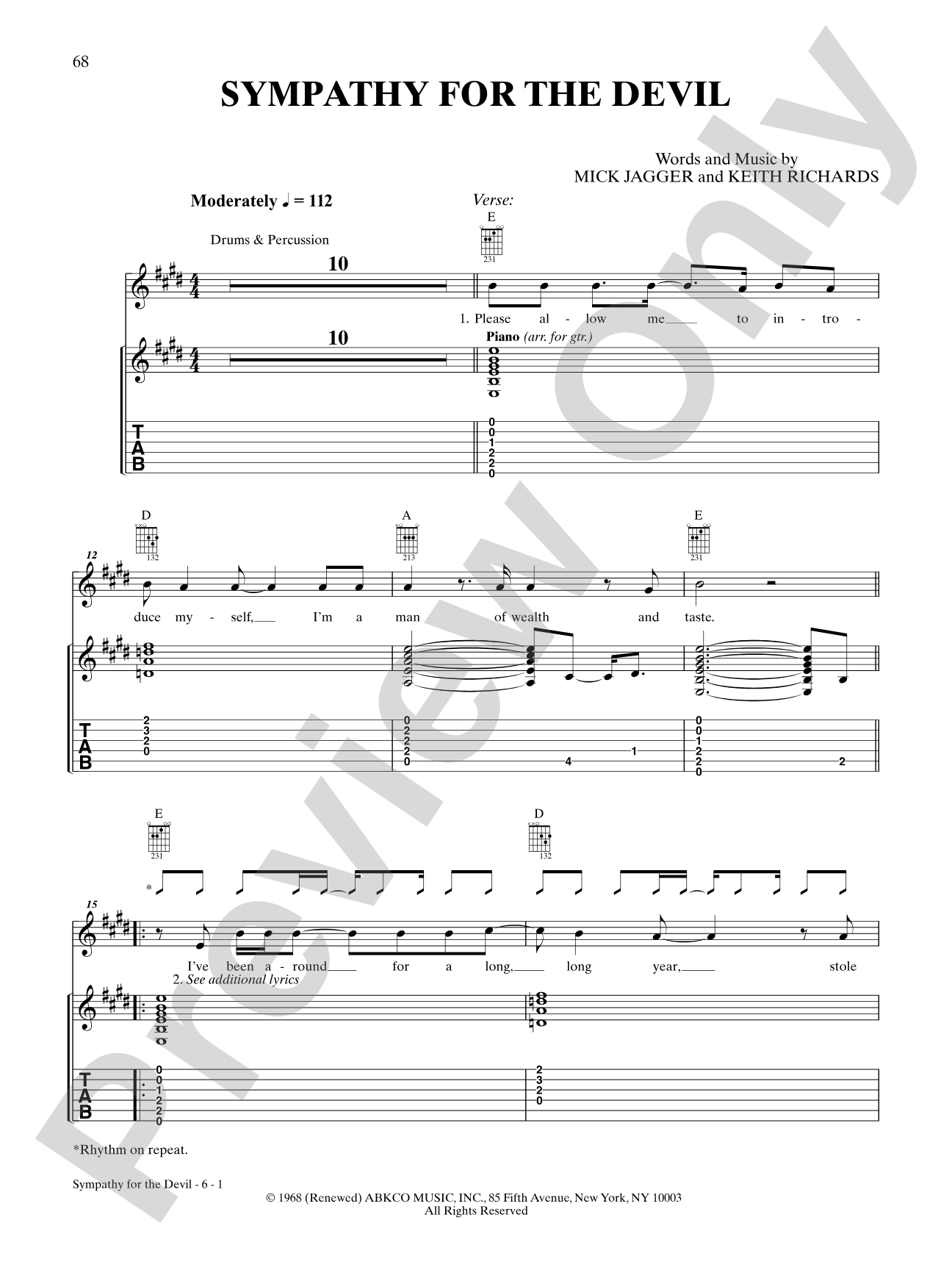
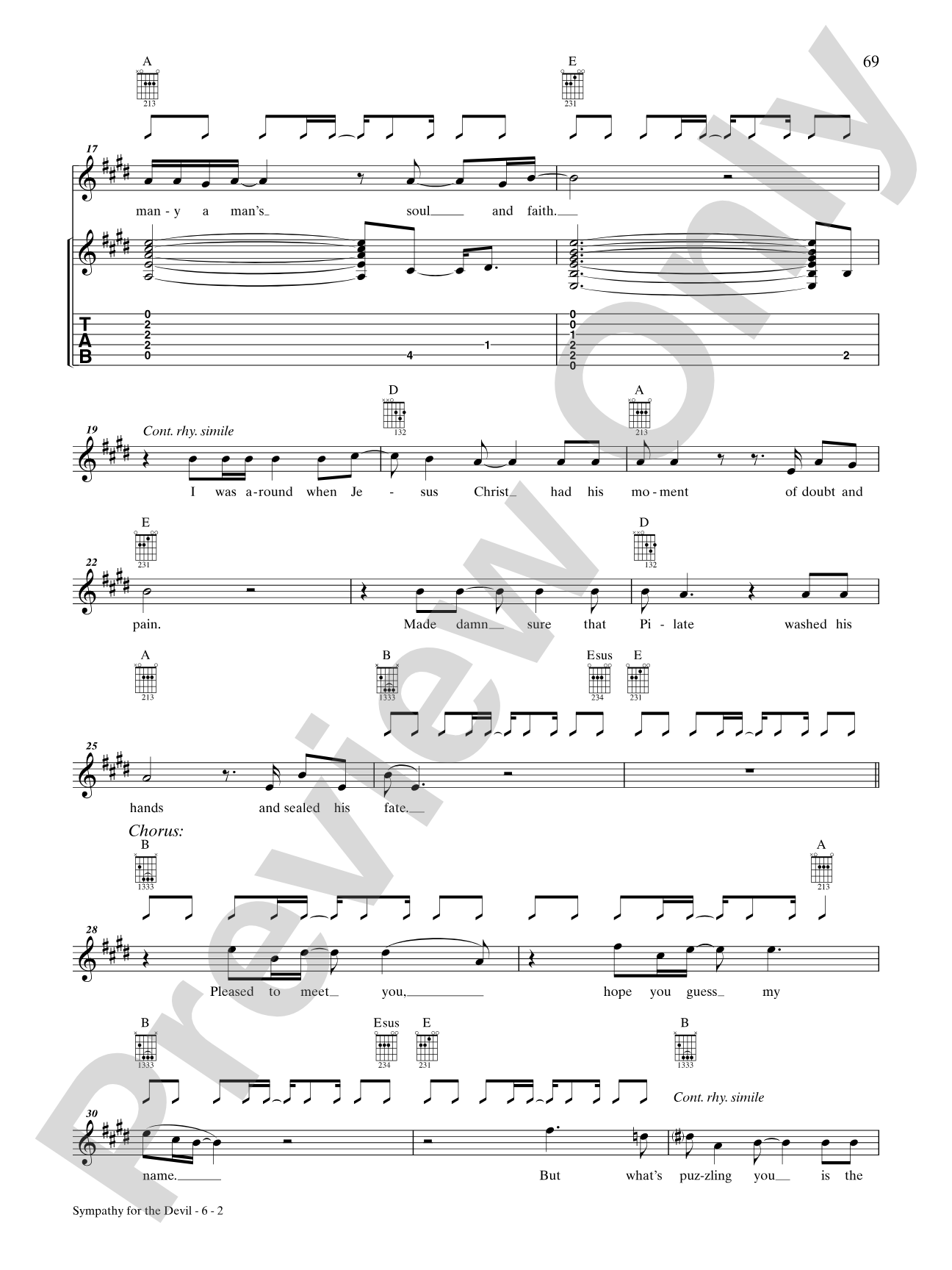

Sympathy for the Devil: Guitar TAB
20 Classic Hits
The Rolling Stones
Item: 00-PS-0013710
$5.99
Pickup currently not available
Related Items
Paint It, Black: Guitar TAB |
$4.99
|
View | |
(I Can't Get No) Satisfaction: Guitar TAB |
$4.99
|
View | |
The Last Time: Guitar TAB |
$4.99
|
View | |
Get Off of My Cloud: Guitar TAB |
$4.99
|
View | |
19th Nervous Breakdown: Guitar TAB |
$5.99
|
View | |
Play with Fire: Guitar TAB |
$4.99
|
View | |
Mother's Little Helper: Guitar TAB |
$4.99
|
View | |
Honky Tonk Women: Guitar TAB |
$4.99
|
View | |
You Can't Always Get What You Want: Guitar TAB |
$5.99
|
View | |
As Tears Go By: Guitar TAB |
$4.99
|
View | |
Ruby Tuesday: Guitar TAB |
$4.99
|
View | |
Brown Sugar: Guitar TAB |
$5.99
|
View | |
Let's Spend the Night Together: Guitar TAB |
$4.99
|
View | |
Under My Thumb: Guitar TAB |
$4.99
|
View | |
Gimme Shelter: Guitar TAB |
$4.99
|
View | |
Let It Bleed: Guitar TAB |
$4.99
|
View | |
No Expectations: Guitar TAB |
$4.99
|
View | |
Jumpin' Jack Flash: Guitar TAB |
$5.99
|
View | |
Wild Horses: Guitar TAB |
$4.99
|
View | |
The Rolling Stones: Easy Guitar TAB Anthology: Easy Guitar TAB Book |
$26.99
|
View |
Description
Featuring 20 of The Rolling Stones greatest hits, each guitar part is carefully arranged in full notation and TAB to be easily playable yet still accurately reflect all of Keith Richard's classic guitar parts with correct fingerings and tunings. Titles: 19th Nervous Breakdown * As Tears Go By * Brown Sugar * Get Off of My Cloud * Gimme Shelter * Honky Tonk Women * Jumpin' Jack Flash * Let it Bleed * Let's Spend The Night Together * Mother's Little Helper * No Expectations * Paint It, Black * Play With Fire * Ruby Tuesday * (I Can't Get No) Satisfaction * Sympathy for the Devil * The Last Time * Under My Thumb * Wild Horses * You Can't Always Get What You Want.


Sympathy for the Devil: Guitar TAB isn't in MakeMusic Cloud just yet...but it could be. Let us know you'd like to see it, and you'll help shape what comes next. In the meantime, start a free trial and dive into thousands of interactive titles your students can play along with today.
Request This Title
Tell us you want it.
Start Your Free Trial
Explore everything that's ready to play right now.
Sample Audio
No sample audio found.
Sample Video
No sample videos found.
Additional Details
Series:
Guitar TAB Anthology
Publisher:
Alfred Music
Page Count:
88
SKU:
00-PS-0013710
More about this title
About the Composer: Mick Jagger
Mick Jagger stands as one of rock's most distinctive lyricists and frontmen, bringing theatrical intensity and sharp social observation to The Rolling Stones' catalog since the 1960s. His songwriting partnership with Keith Richards produced some of the era's most enduring rock compositions, songs that balanced commercial appeal with genuine artistic ambition and often addressed class, desire, and cultural commentary with wit and edge.
Why we love this
This collection captures Keith Richards' fingerprint guitar work across two decades of Stones classics in arrangements that preserve the character of each riff without overwhelming intermediate players. The TAB includes proper tunings and fingerings for each song, so players aren't reverse-engineering the parts or guessing at alternative voicings. It's a masterclass in how iconic rock guitar can be both recognizable and learnable.
What to expect
Swaggering, bluesy, and immediately recognizable, these arrangements deliver the attitude and swagger of the Stones in playable form. Each riff carries the weight of its era while remaining fresh, balancing the rawness of rock with moments of genuine sophistication in tone and phrasing.
Who it's for
Intermediate guitarists ready to tackle iconic rock parts with historical depth and guitarists who want to understand how these songs actually sit under the fingers. This is ideal for players building a repertoire of recognizable material for recitals, ensemble projects, or simply the satisfaction of playing the exact parts that shaped modern rock guitar.
How to get the most out of it
- Pay attention to the tuning notation for each song; several pieces use open tunings that dramatically change the feel and available voicings, so switching between standard and alternate tunings is part of mastering these arrangements.
- Use the fingering suggestions as written rather than substituting your own; they're designed to position your hand efficiently for the transitions and ornaments that define each riff.
- Listen to the original recordings while learning, focusing on tone and sustain choices as much as note placement. Richards' approach to dynamics and attack shape the character of these parts.
- Work through the arrangement at a slower tempo first, particularly on pieces with rapid fingerpicking or complex rhythm figures, to lock in the articulation before building to performance speed.
How to use it
Feature individual songs as solo performance pieces in a recital or guitar showcase, or build a thematic concert around the evolution of rock guitar across the 1960s and 1970s by combining selections from this collection. These pieces also work well as performance incentives or curriculum touchstones for intermediate students learning how classic rock riffs translate from ear to notation.
Skills your students will build
- Reading full notation and TAB simultaneously
- Transitioning between standard and open tunings
- Executing classic rock phrasing and dynamics
- Interpreting fingering suggestions for efficiency and musicality
- Understanding chord voicings and inversions in rock contexts
- Building finger independence for rhythmic figures and ornaments