
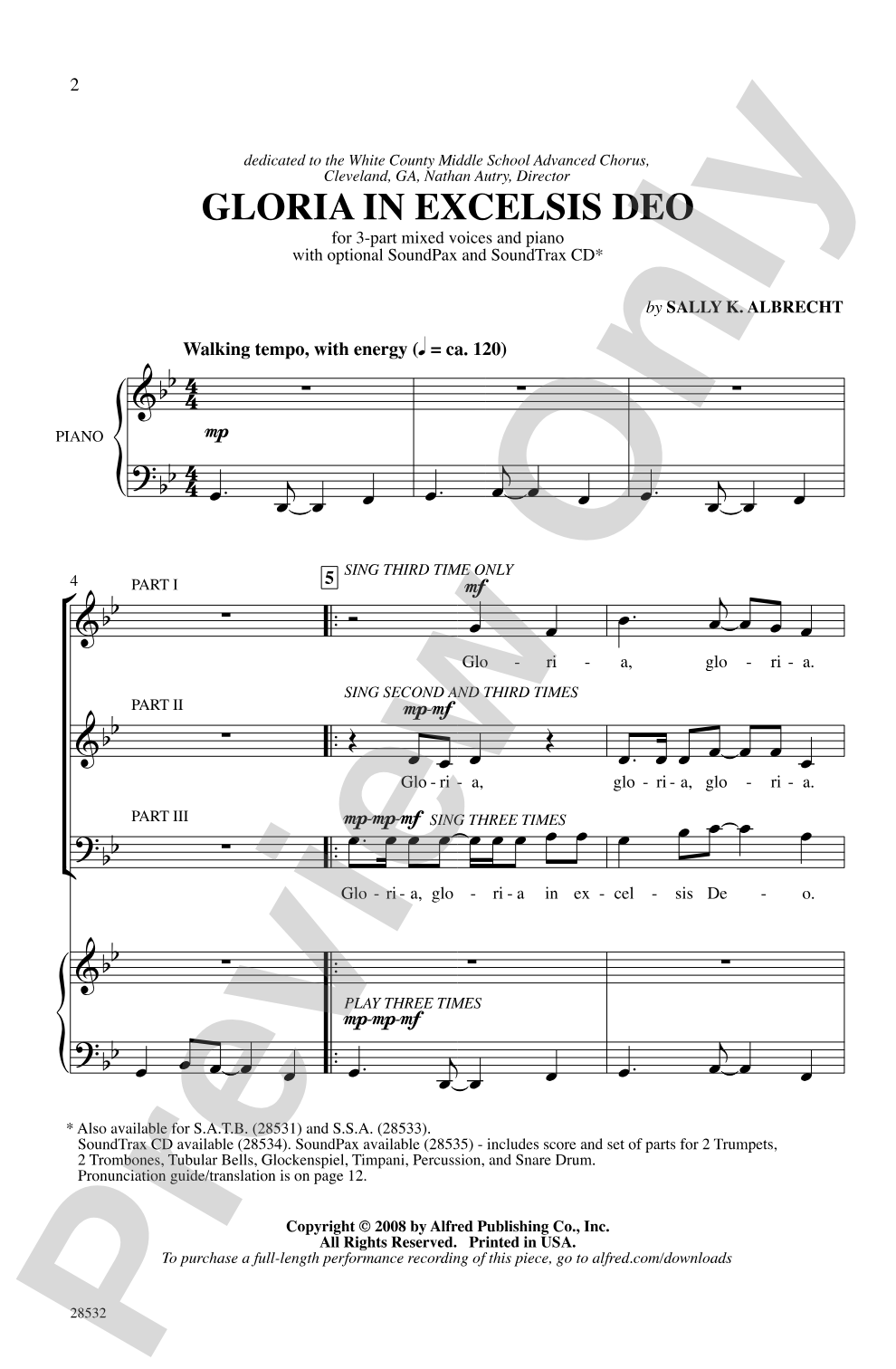
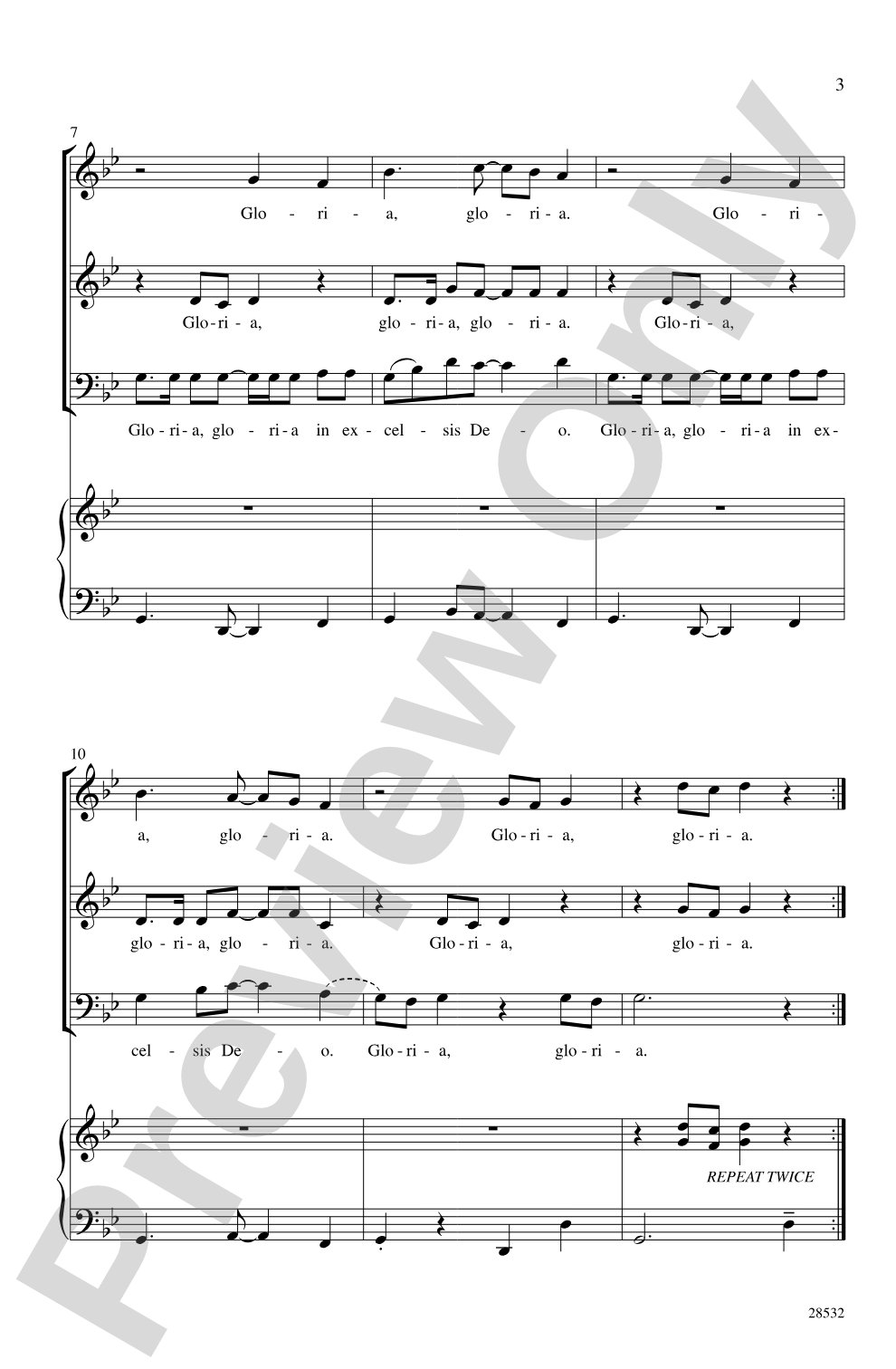
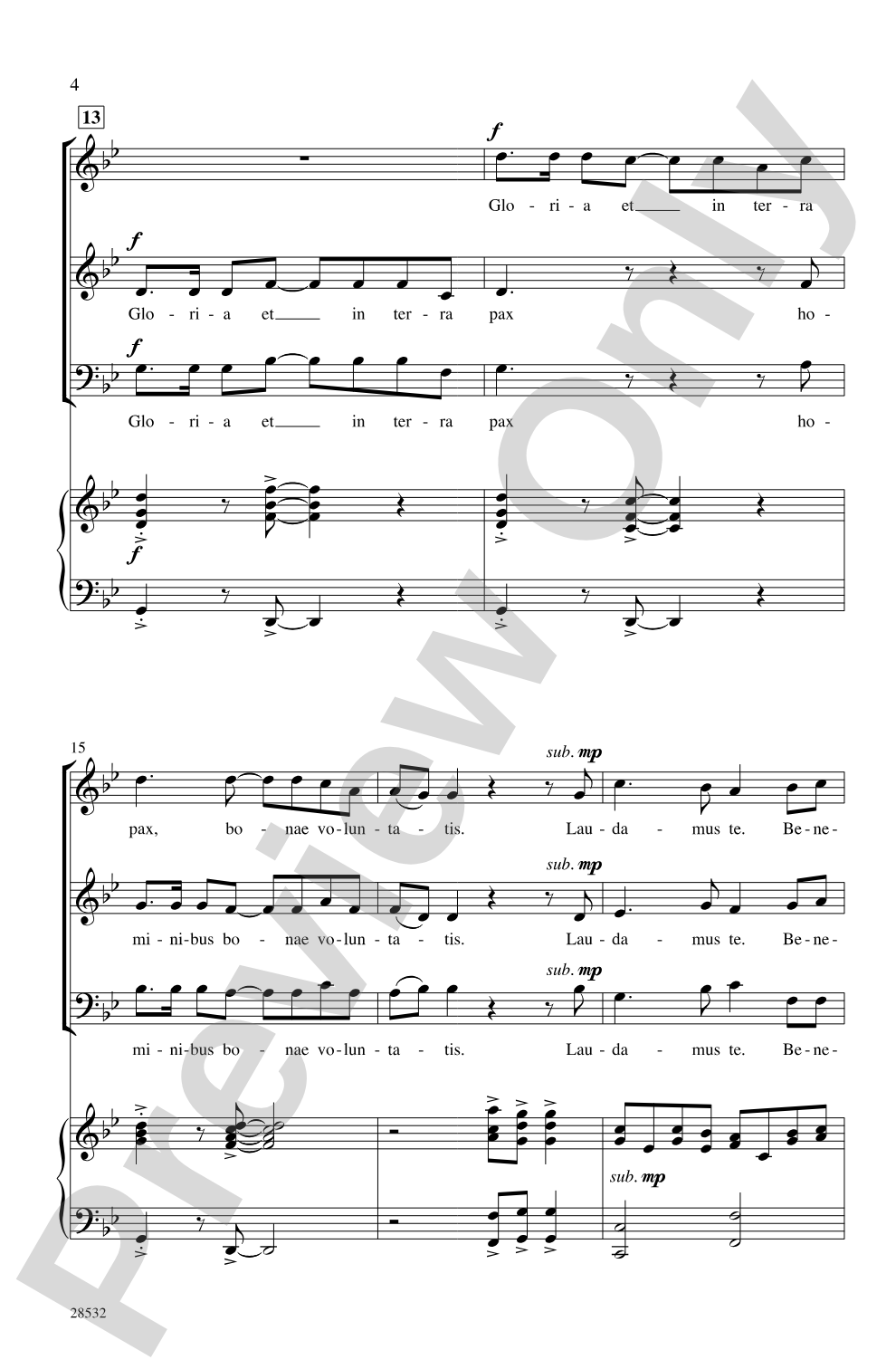

Gloria in Excelsis Deo: 3-Part Mixed Choral Octavo
Words and music by Sally K. Albrecht
Item: 00-PO-0000471

$1.75
Minimum order quantity: 20 copies
Pickup currently not available
Related Items
Gloria in Excelsis Deo: SoundTrax Digital Audio Download |
$24.95
|
View | |
Gloria in Excelsis Deo: SATB Choral Octavo |
$1.75
|
View | |
Gloria in Excelsis Deo: SSA Choral Octavo |
$1.75
|
View | |
Gloria in Excelsis Deo: Choral SoundPax |
$30.00
|
View | |
Gloria in Excelsis Deo: SATB Choral Octavo |
$1.75
|
View | |
Gloria in Excelsis Deo: 3-Part Mixed Choral Octavo |
$1.75
|
View | |
Gloria in Excelsis Deo: SSA Choral Octavo |
$1.75
|
View | |
Gloria in Excelsis Deo: Choral Octavo SoundTrax CD |
$24.95
|
View | |
Gloria in Excelsis Deo: Choral SoundPax |
$30.00
|
View |
Description
An artful setting of the familiar "Gloria" text, which features infections rhythms, layered melody lines, and fantastic optional percussion parts . . . all in a minor key. Effective as a processional, or perfect for a dynamic change of pace in your program. Impressive for concerts or contests any time of year.


Don't just read it, hear it, play along with it, and watch your students grow with it. In MakeMusic Cloud, Gloria in Excelsis Deo: 3-Part Mixed Choral Octavo comes alive with professional accompaniment, adjustable tempo, and built-in practice tools that turn solo practice into real progress.
Open in the Player
Jump straight in and assign it today.
Start Your Free Trial
Open this title and explore the full library in minutes.
Sample Audio
1
Audio File
--:--
0:00
0:00
Sample Video
No sample videos found.
Additional Details
Series:
Alfred Choral Designs
Publisher:
Alfred Music
Page Count:
12
SKU:
00-PO-0000471
More about this title
About the Composer: Sally K. Albrecht

Sally K. Albrecht has shaped American choral music for over forty years as a composer, conductor, and publishing director. Her catalog exceeds 600 choral works and 75 musicals and songbooks, earning her ASCAP Special Music Awards annually since 1987. She has conducted honor choirs at major venues including Lincoln Center, Carnegie Hall, and The Kennedy Center, and spent three decades leading choral and vocal publications at Alfred Music and other major houses.
Albrecht holds degrees from Rollins College (B.A. in Music and Theater, 1976), the University of Miami (M.A. in Drama, 1977; M.M. in Accompanying, 1979), and has taught at Oakland University, Jersey City State College, and Meredith College. A native of Cleveland, Ohio, she was honored as a Distinguished Alumna by both the University of Miami Frost School of Music and Rollins College in 2021, and previously chaired the Board of Trustees for the Omicron Delta Kappa National Leadership Honor Society.
Why we love this
Albrecht's setting trades predictability for rhythmic vitality and harmonic freshness; the minor key context gives a familiar text surprising emotional depth without sacrificing accessibility for three-part ensembles. The optional percussion parts invite meaningful collaboration across your ensemble and lift what could be a straightforward processional into a programmatic moment worth planning around.
What to expect
A minor-key processional that combines reverence with forward momentum. Layered melodies create depth without overwhelming singers, while the optional percussion adds a contemporary sheen that keeps the familiar text from feeling static.
Who it's for
Three-part mixed choirs looking for sacred repertoire with contemporary rhythmic energy and textural sophistication. This works well for developing and intermediate ensembles that are ready to balance independent melodic lines while maintaining harmonic accuracy.
How to get the most out of it
- Lock in the infectious rhythms by drilling sections independently first; the layered melodies sit much cleaner once the rhythmic foundation is secure across all parts.
- If including the optional percussion parts, establish the percussion framework early in rehearsal so singers can anchor their phrasing to the instrumental color rather than fighting against it.
- Lean into the minor key's darker tone during the opening phrases, then let the harmonic movement carry the text's proclamatory nature through the middle and closing sections.
- The recorded accompaniment is essential for parts to hear their lines clearly; use it regularly in sectionals and full rehearsals to build confidence before removing it.
How to use it
Program this as a dynamic shift within a concert built around traditional sacred music, or open a program with it as a processional that immediately signals a thoughtful, energetic approach to the repertoire. Its suitability for both liturgical settings and concert performances makes it versatile across the entire calendar year.
Skills your students will build
- Singing independent melodic lines within three-part textures
- Maintaining rhythmic precision in syncopated and uneven metric patterns
- Balancing blend and tuning in minor-key harmonic progressions
- Coordinating with optional instrumental parts and recorded accompaniment
- Interpreting sacred text through contrasting minor-key harmonic color