
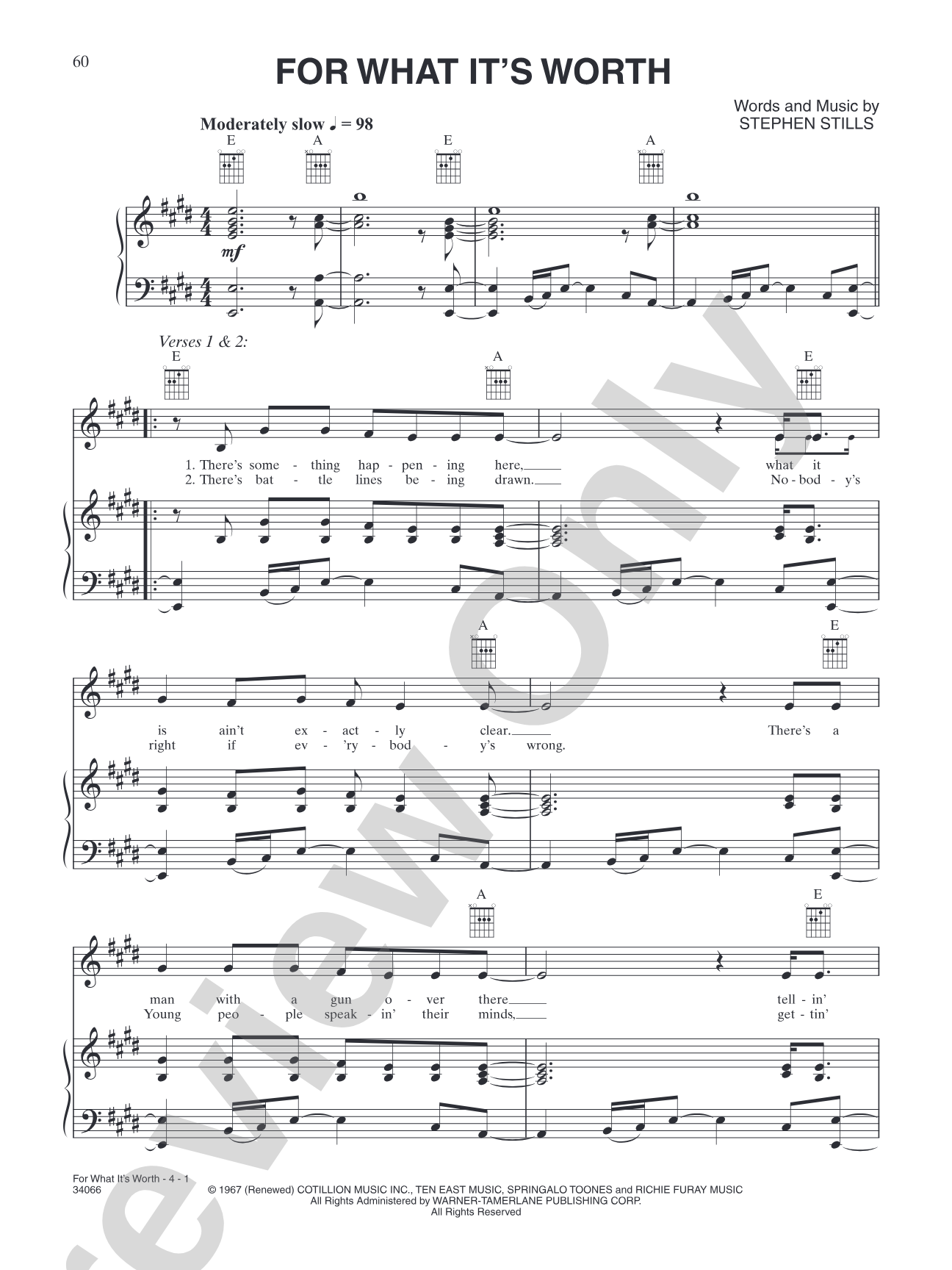

For What It's Worth: Piano/Vocal/Chords
Item: 00-PSP-000416
$4.99
One moment…
Description
Woodstock Sheet Music Anthology contains 24 songs performed at the original 1969 Woodstock festival, plus four bonus songs that helped define the peace and love generation. Woodstock proved to be a touchstone for baby boomers. Whether you were there or not, you can now relive the festival through the music of Canned Heat; Country Joe McDonald; The Who; Janis Joplin; Jimi Hendrix; Crosby, Stills, Nash, and Young; and many others with this piano/vocal songbook. Also included is an historical essay putting each song in perspective of the three-day event. Titles: Bad Moon Rising * Everyday People * Feelin' Alright * Going Up the Country * Hey Joe * My Generation * Piece of My Heart * St. Stephen * The Weight * White Rabbit * and more.


For What It's Worth: Piano/Vocal/Chords isn't in MakeMusic Cloud just yet...but it could be. Let us know you'd like to see it, and you'll help shape what comes next. In the meantime, start a free trial and dive into thousands of interactive titles your students can play along with today.
Request This Title
Tell us you want it.
Start Your Free Trial
Explore everything that's ready to play right now.
Sample Audio
No sample audio found.
Sample Video
No sample videos found.
Additional Details
Publisher:
Alfred Music
Page Count:
172
SKU:
00-PSP-000416
More about this title
About the Composer: Stephen Stills
Stephen Stills co-founded Buffalo Springfield in 1966 and became one of the era's most influential songwriters, known for his sophisticated harmonic sense and genre-blending approach. His work with Buffalo Springfield, Crosby, Stills, Nash & Young, and as a solo artist shaped the sound of rock music from the late 1960s onward, combining folk, rock, blues, and country influences with distinctive guitar work and vocal arrangements.
Why we love this
This song captures the urgent political energy of its moment while remaining musically accessible for intermediate pianists and singers. The chord progression and melody sit naturally for most voices, and the straightforward structure makes it ideal for teaching how powerful songwriting doesn't require complexity.
What to expect
Direct and unflinching. The song moves with purposeful energy, driven by its central question and urgent vocal delivery. There's an immediacy to both the lyrics and the harmonic movement that keeps listeners engaged without flashy ornamentation.
Who it's for
Pianists and singers exploring rock and pop repertoire from the 1960s, as well as classroom musicians studying songwriting and music history. High school and adult amateur musicians will find the arrangement approachable while remaining true to the original's intent.
How to get the most out of it
- Balance the vocal line over the piano accompaniment; the lyrics carry the song's message, so clarity matters more than fullness
- Pay attention to the rhythmic drive in the accompaniment pattern to maintain the song's forward momentum without rushing
- Approach the vocal phrasing conversationally rather than melodramatically; understatement often makes the lyrics land harder
- Use dynamics to build intensity through repetition rather than changing the tempo or adding embellishment
How to use it
Pair this with other Woodstock-era songs from the folio to build a thematic concert around 1960s counterculture and songwriting activism. It works equally well as a standalone feature for a singer-pianist recital or as part of a broader pop and rock survey.
Skills your students will build
- Reading and performing rock-style chord progressions
- Balancing vocal melody with rhythmic piano accompaniment
- Interpreting lyric-driven phrasing and conveying text meaning through performance
- Understanding historical context and the relationship between music and social movements