
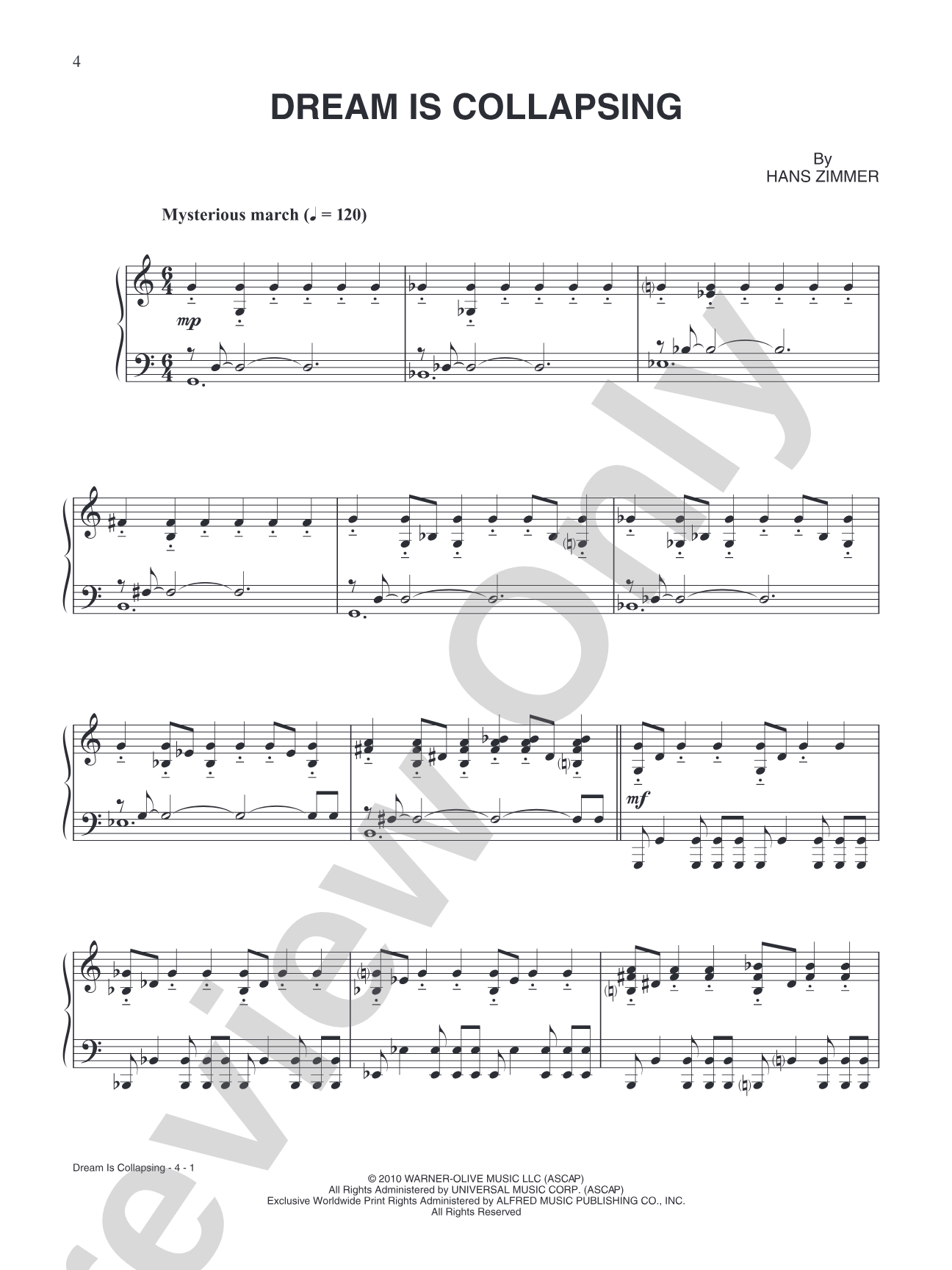

Dream Is Collapsing (from "Inception"): Piano
Music by Hans Zimmer
Item: 00-XS-0000194
$4.99
Pickup currently not available
Description
Titles: Dream Is Collapsing * Dream Within a Dream * Mombasa * Time.


Dream Is Collapsing (from "Inception"): Piano isn't in MakeMusic Cloud just yet...but it could be. Let us know you'd like to see it, and you'll help shape what comes next. In the meantime, start a free trial and dive into thousands of interactive titles your students can play along with today.
Request This Title
Tell us you want it.
Start Your Free Trial
Explore everything that's ready to play right now.
Sample Audio
No sample audio found.
Sample Video
No sample videos found.
Additional Details
Publisher:
Alfred Music
Page Count:
36
SKU:
00-XS-0000194
More about this title
About the Composer: Hans Zimmer
Hans Zimmer is a German film composer whose orchestral and electronic soundtracks have shaped contemporary cinema since the 1980s. His work across genres—from action and science fiction to drama and animation—demonstrates mastery of both traditional orchestration and modern production techniques. Zimmer's approach to scoring combines harmonic sophistication with immediate emotional impact, making his music accessible to both general audiences and musicians studying film composition.
In the concert hall and practice room, Zimmer's compositions offer pianists insight into how cinematic narrative translates into keyboard writing. His use of repetitive motifs, layered textures, and dynamic range creates music that rewards careful attention to pedaling, voicing, and tempo control. Teachers and students value his work for its musical substance alongside its cultural relevance.
Why we love this
This collection captures some of Zimmer's most architecturally interesting film music in idiomatic piano arrangements. The pieces demand real musicianship—careful voicing, precise rhythmic control, and sophisticated use of the pedal—while remaining within reach of intermediate pianists. Programming these alongside more traditional repertoire signals to students that contemporary film scoring is legitimate concert material with genuine musical depth.
What to expect
These piano arrangements capture the architectural tension and introspection of Zimmer's Inception score. The writing balances minimalist repetition with sudden harmonic shifts, creating a sense of instability and forward propulsion. You move between moments of hypnotic rhythmic focus and broader harmonic landscapes, always aware of the pressure building beneath the surface.
Who it's for
Intermediate to late intermediate pianists seeking repertoire that connects concert performance with contemporary music culture. Students preparing for recitals, auditions, or concert programs benefit from the technical and expressive demands of these pieces. Teachers introducing students to film scoring and modern compositional approaches will find this collection both musically substantial and engaging.
How to get the most out of it
- Pay attention to register and spacing in the left hand. Zimmer's orchestral writing often layers multiple instrumental voices, and your pedal choices determine whether these layers blend or separate. Experiment with half-pedal and flutter pedaling to achieve definition without muddiness.
- Approach dynamic changes as architectural decisions, not mere volume shifts. These pieces build tension through accumulation of texture and harmonic motion; let your physical approach to the keyboard reflect that structural logic.
- Honor the repetitive elements without letting them become mechanical. Subtle variations in tone color, attack, and sustain keep ostinatos and rhythmic figures alive across multiple statements.
- Use the recorded accompaniment to understand how your part fits within the fuller orchestral texture, then gradually learn to carry the emotional weight of the passage on your own.
How to use it
Include one or two selections on a recital program alongside 19th-century or classical works to illustrate the continuity of serious musical thought across eras. The collection works equally well in a thematic concert exploring modern cinematic music or as a bridge in a program that moves from traditional repertoire toward contemporary composition. These pieces also serve as compelling practice material for students developing facility with modern harmonic language and layered textures.
Skills your students will build
- Pedal technique including half-pedaling and flutter-pedaling for textural clarity
- Voice independence and register awareness in polyphonic textures
- Rhythmic precision and ostinato performance without mechanical inflection
- Harmonic listening and chord voice-leading in contemporary contexts
- Dynamic control and structural phrasing across longer formal spans
- Reading modern notation and film music conventions