
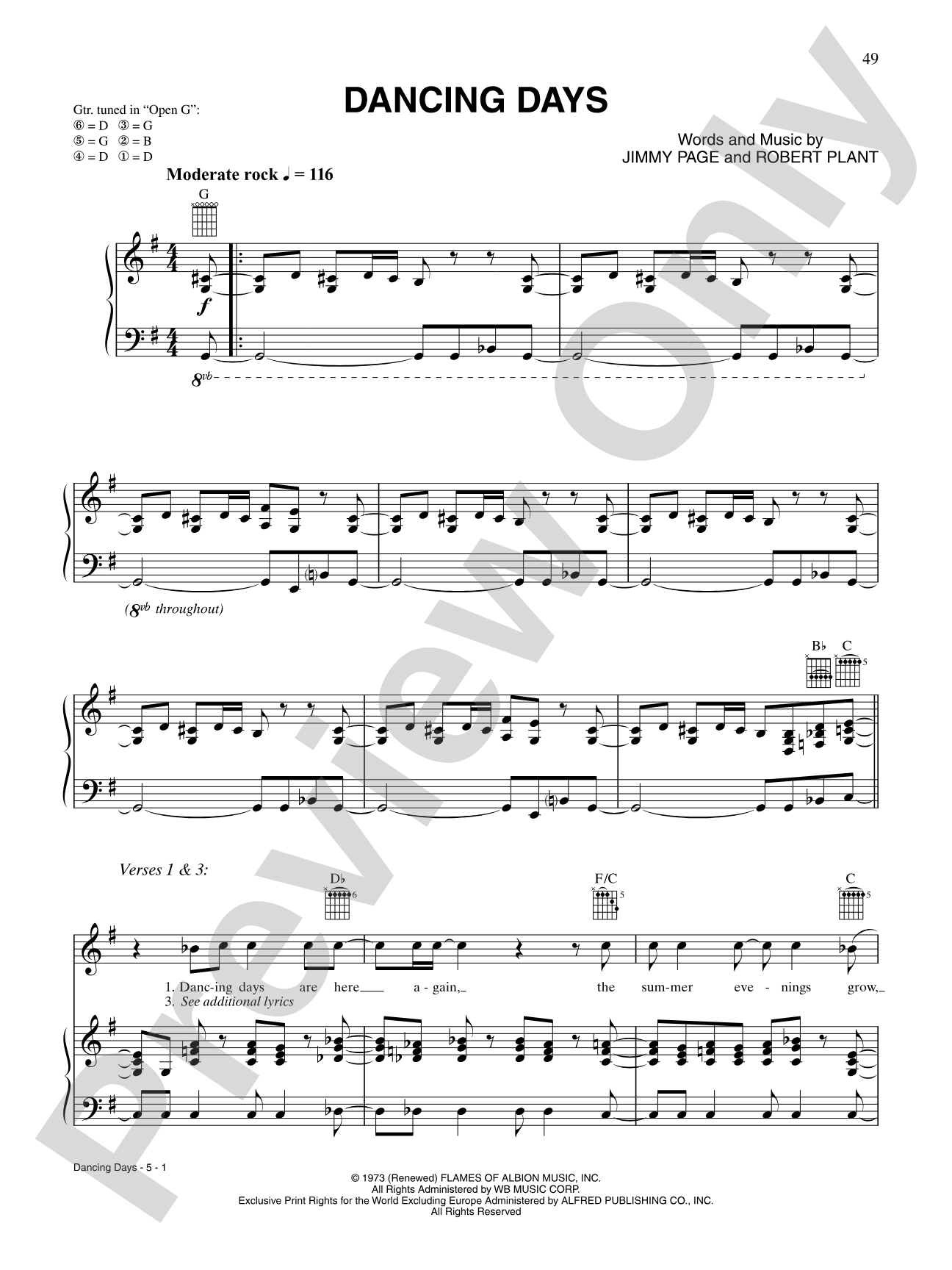

Dancing Days: Piano/Vocal/Chords
Led Zeppelin
Item: 00-XS-0000049
$4.99
Pickup currently not available
Related Items
The Crunge: Authentic Guitar TAB |
$5.99
|
View | |
Dancing Days: Authentic Guitar TAB |
$9.99
|
View | |
No Quarter: Authentic Guitar TAB |
$5.99
|
View | |
The Ocean: Authentic Guitar TAB |
$9.99
|
View | |
The Rain Song: Authentic Guitar TAB |
$9.99
|
View | |
The Song Remains The Same: Authentic Guitar TAB |
$9.99
|
View | |
D'yer Mak'er: Authentic Guitar TAB |
$5.99
|
View | |
Over The Hills And Far Away: Authentic Guitar TAB |
$9.99
|
View | |
The Crunge: Piano/Vocal/Chords |
$5.99
|
View | |
Dyer Maker: Piano/Vocal/Chords |
$5.99
|
View | |
The Song Remains the Same: Piano/Vocal/Chords |
$9.99
|
View | |
Led Zeppelin: Houses of the Holy Platinum Album Edition: Piano/Vocal/Chords Book |
$19.95
|
View | |
Led Zeppelin: Houses of the Holy Platinum Album Edition: Authentic Guitar TAB Book |
$24.99
|
View | |
Led Zeppelin: Houses of the Holy Platinum Album Edition: Drum Transcriptions Book |
$19.95
|
View | |
Led Zeppelin: Houses of the Holy Platinum Album Edition: Authentic Bass TAB Book |
$16.99
|
View |
Description
Emboldened by the success of Led Zeppelin IV and the classic "Stairway to Heaven," Led Zeppelin's fifth album marked a broad stylistic expansion by Britain's pre-eminent band of the '70s. Drawing from more than 30 years of documentation, interviews, and recorded footage, this book delivers unprecedented accuracy and, for the first time, lyrics officially certified by Robert Plant. Titles: The Crunge * D'Yer Mak'er * Dancing Days * No Quarter * The Ocean * Over the Hills and Far Away * Rain Song * The Song Remains the Same.


Dancing Days: Piano/Vocal/Chords isn't in MakeMusic Cloud just yet...but it could be. Let us know you'd like to see it, and you'll help shape what comes next. In the meantime, start a free trial and dive into thousands of interactive titles your students can play along with today.
Request This Title
Tell us you want it.
Start Your Free Trial
Explore everything that's ready to play right now.
Sample Audio
No sample audio found.
Sample Video
No sample videos found.
Additional Details
Series:
Alfred's Platinum Album Editions
Publisher:
Alfred Music
Page Count:
72
SKU:
00-XS-0000049
More about this title
About the Composer: Jimmy Page
Jimmy Page revolutionized rock guitar in the late 1960s and early 1970s as the architect of Led Zeppelin's sound. His approach to composition combined blues fundamentals with studio experimentation, Eastern tonalities, and dynamic song structures that moved far beyond three-minute radio formats. Page's work as both composer and producer shaped the aesthetic of hard rock and heavy metal for generations.
As a session guitarist and producer before forming Led Zeppelin, Page developed a deep understanding of how songs are built in the studio. His compositions for the band's fifth album showcase the full range of his vision: from orchestral arrangements to acoustic fingerstyle work to heavy riff-driven tracks. His influence on rock composition remains fundamental to how musicians approach songwriting, arrangement, and the integration of diverse musical styles within a single album.
Why we love this
This collection captures one of rock's most adventurous albums at a moment when Led Zeppelin was expanding far beyond their blues-rock foundation. The inclusion of lyrics officially certified by Robert Plant for the first time adds authenticity that singers and pianists will appreciate, while the chord notations make these arrangements accessible to musicians working across multiple skill levels. Eight songs offer substantial variety in mood, texture, and technical demand, making this book a rich resource for pianists exploring how rock composition functions beyond simple verse-chorus structures.
What to expect
These songs span a vast emotional and sonic landscape. You'll move from the crisp funk-inflected groove of 'The Crunge' to the introspective, layered beauty of 'Rain Song,' then shift again to the propulsive energy of 'The Ocean.' The album's ambition is palpable throughout; these are not simple songs, and playing them requires attention to orchestration, dynamic contrast, and the kind of dynamic space that separates composition from mere technical display.
Who it's for
Pianists and singers performing in jazz cafes, recital settings, or informal ensembles will find substantial material here. This collection also suits advanced high school musicians and college-level students interested in rock composition, arrangement techniques, and how studio-era production translates to live performance. Accompanists seeking rock repertoire beyond standard pop charts will appreciate the depth and sophistication of these arrangements.
How to get the most out of it
- Study the original recordings alongside the sheet music to hear how dynamics and texture shift within each song; the page can only convey so much about when to pull back or push forward.
- Balance melody and harmony when playing piano/vocal arrangements; resist the urge to fill every space with accompaniment figures, especially in spacious songs like 'No Quarter' and 'Rain Song'.
- Pay attention to chord voicings as compositional choices rather than interchangeable options; these voicings were deliberate in the original arrangements and carry the song's character.
- Experiment with tempo and feel in rehearsal before settling on a single approach; songs like 'D'Yer Mak'er' benefit from exploring where the groove sits most naturally for your ensemble.
How to use it
Use this book to program concert segments that showcase rock as a legitimate compositional tradition. A pianist or pianist-singer duo can perform a thoughtful three-song set that demonstrates range, or a larger ensemble might select individual songs for a broader rock-focused concert. These arrangements also work well in educational settings where students are learning how major rock artists approached song structure and arrangement.
Skills your students will build
- Reading and performing chord-notated arrangements in rock idiom
- Interpreting dynamics and texture from minimal notation
- Coordinating melody, harmony, and rhythm in piano/vocal contexts
- Understanding how studio-era rock songwriting translates to live performance
- Recognizing and performing non-standard song structures and key changes