

City of Stars: SAB Choral Octavo
Music from the Motion Picture La La Land
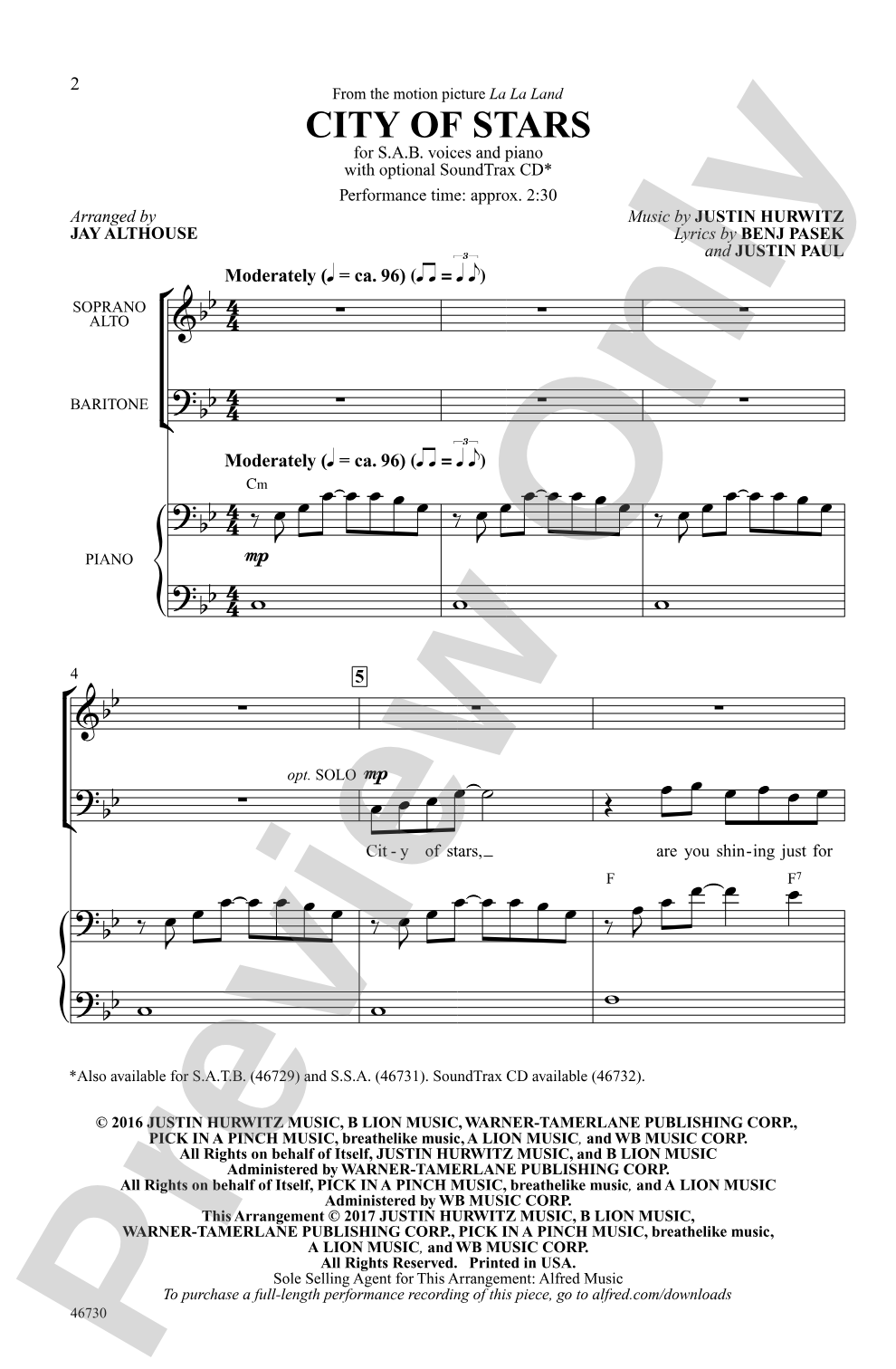
Music by Justin Hurwitz, lyrics by Benj Pasek and Justin Paul / arr. Jay Althouse
Item: 00-PO-0005773

$2.00
Minimum order quantity: 20 copies
One moment…
Related Items
City of Stars: SoundTrax Digital Audio Download |
$29.99
|
View | |
City of Stars: SATB Choral Octavo |
$2.00
|
View | |
City of Stars: SSA Choral Octavo |
$2.00
|
View | |
City of Stars: SATB Choral Octavo |
$2.00
|
View | |
City of Stars: SAB Choral Octavo |
$2.00
|
View | |
City of Stars: SSA Choral Octavo |
$2.00
|
View | |
City of Stars: Choral Octavo SoundTrax CD |
$29.99
|
View |
Description
And the Oscar goes to . . . this, the signature song from critically acclaimed and highly awarded La La Land. Winner of Best Original Song at the Academy Awards®, the Golden Globes, and the Critic's Choice Movie Awards, this melancholy yet hopeful ballad features a haunting tune and a distinctive piano accompaniment that are instantly recognizable and extremely well suited for choral groups.


Don't just read it, hear it, play along with it, and watch your students grow with it. In MakeMusic Cloud, City of Stars: SAB Choral Octavo comes alive with professional accompaniment, adjustable tempo, and built-in practice tools that turn solo practice into real progress.
Open in the Player
Jump straight in and assign it today.
Start Your Free Trial
Open this title and explore the full library in minutes.
Sample Audio
1
Audio File
--:--
0:00
0:00
Sample Video
No sample videos found.
Additional Details
Series:
Alfred Pop Choral Series
Publisher:
Alfred Music
Page Count:
8
SKU:
00-PO-0005773
More about this title
About the Composer: Justin Hurwitz
Justin Hurwitz is a composer who has established himself as a master of contemporary film scoring, particularly in works that blend orchestral sensibility with intimate emotional resonance. His approach to melody and harmonic color earned him Academy Award recognition for "City of Stars" and has made him a sought-after voice for projects requiring both sophistication and accessibility.
Beyond film, Hurwitz's work demonstrates deep knowledge of traditional composition and arrangement, giving his popular music an architectural quality that translates remarkably well to ensemble settings. His willingness to write music that serves emotional storytelling while remaining singable and dramatically engaging makes his compositions valuable repertoire for choral ensembles.
Why we love this
Arrangers Jay Althouse understands what makes a pop ballad work for ensemble voices without stripping away its cinematic power. The SAB voicing is both accessible for mixed groups and sophisticated enough that your singers will connect with the emotional weight of the piece. Programming an Oscar-winning song that your audience already loves removes the barrier to entry and lets your singers focus on musicianship rather than learning unfamiliar material.
What to expect
The arrangement preserves the melancholy and quiet hopefulness of the original score while creating space for three-part harmony to add warmth and depth. Piano figures that shimmer beneath the melody evoke both intimacy and cinematic scale, inviting singers and listeners alike into a moment of reflection and longing.
Who it's for
Directors of mixed choirs with singers of intermediate to advancing ability will find this piece especially valuable. The SAB voicing makes it accessible to groups with lighter lower-voice sections, while the emotional demands and harmonic sophistication suit singers ready to engage with contemporary film music seriously.
How to get the most out of it
- Shape the melody with dynamic subtlety in the verses; the power of this song lives in restraint and vulnerability rather than volume.
- Balance the piano accompaniment carefully so it supports without overshadowing the voices, especially during the exposed moments in the opening.
- Use the recorded accompaniment to lock ensemble cohesion, but prepare your singers to sit slightly back in the mix rather than pushing against it.
- Pay attention to consonant timing in the SAB voicing; clean attacks on sustained chords will reveal the harmonic color that makes this arrangement distinctive.
How to use it
This works beautifully as a centerpiece in a concert of contemporary music or as a bridge in a program mixing classical and popular repertoire. The emotional arc and instant recognition factor make it an excellent choice for benefit concerts, community events, or end-of-year celebrations where you want professional artistry paired with audience connection.
Skills your students will build
- Sustained legit singing in a contemporary idiom
- Balancing individual voice parts within a three-part texture
- Dynamic shaping and phrasing of a pop melody in choral context
- Tuning suspended and extended harmonic sonorities
- Blending with instrumental accompaniment