
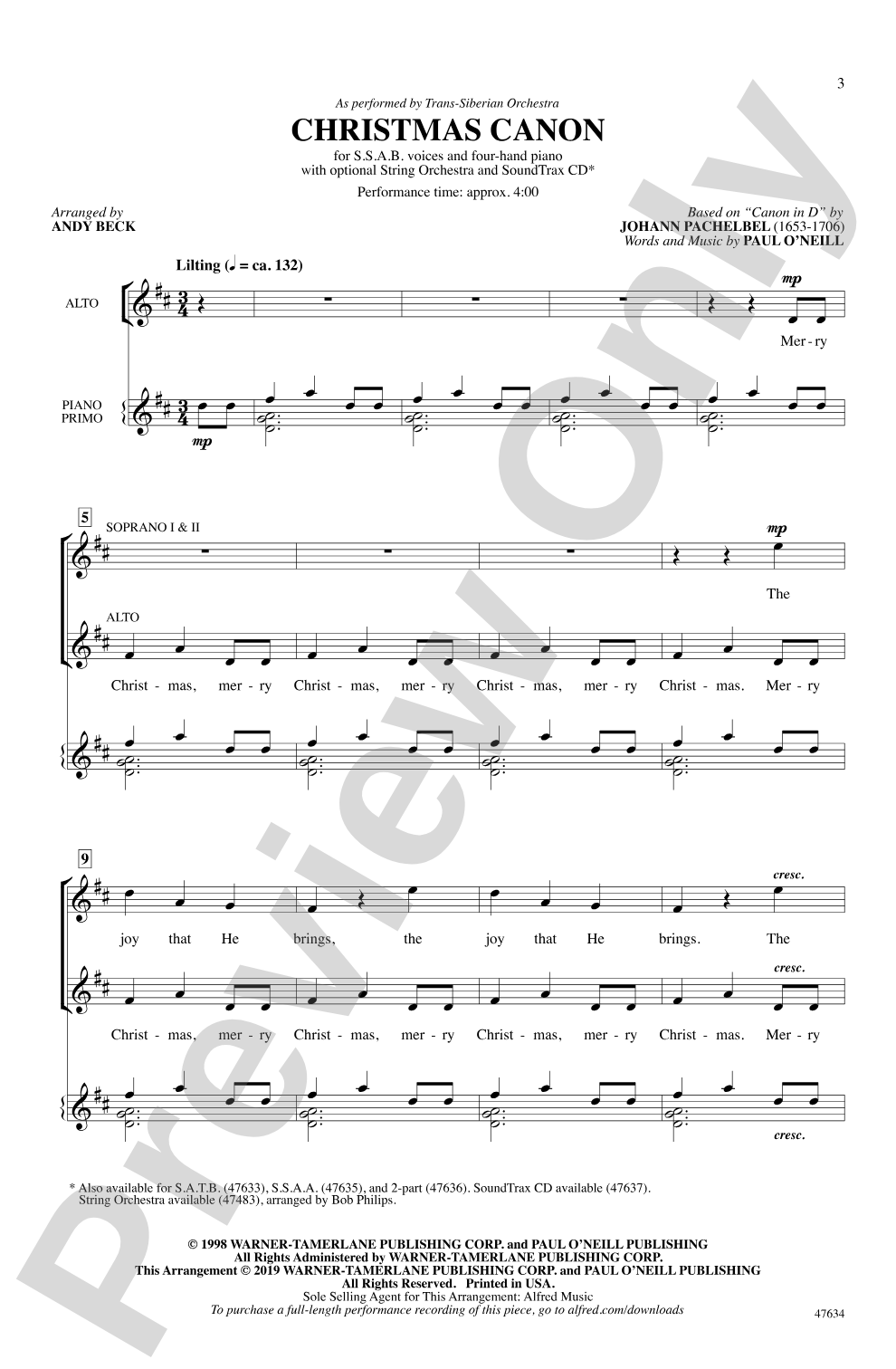

Christmas Canon: SSAB Choral Octavo
Based on Pachelbel's "Canon in D"
Words and music by Paul O'Neill / arr. Andy Beck
Item: 00-PO-0006053
$2.10
Minimum order quantity: 20 copies
One moment…
Related Items
Christmas Canon: SoundTrax Digital Audio Download |
$27.99
|
View | |
Christmas Canon: SATB Choral Octavo |
$2.10
|
View | |
Christmas Canon: SSAA Choral Octavo |
$2.10
|
View | |
Christmas Canon: 2-Part Choral Octavo |
$2.10
|
View | |
Christmas Canon: String Orchestra Conductor Score & Parts |
$70.00
|
View | |
Christmas Canon: SATB Choral Octavo |
$2.10
|
View | |
Christmas Canon: SSAB Choral Octavo |
$2.10
|
View | |
Christmas Canon: SSAA Choral Octavo |
$2.10
|
View | |
Christmas Canon: 2-Part Choral Octavo |
$2.10
|
View | |
Christmas Canon: Choral Octavo SoundTrax CD |
$27.99
|
View | |
Christmas Canon: String Orchestra Conductor Score & Parts |
$70.00
|
View | |
Christmas Canon: String Orchestra Conductor Score |
$9.00
|
View |
Description
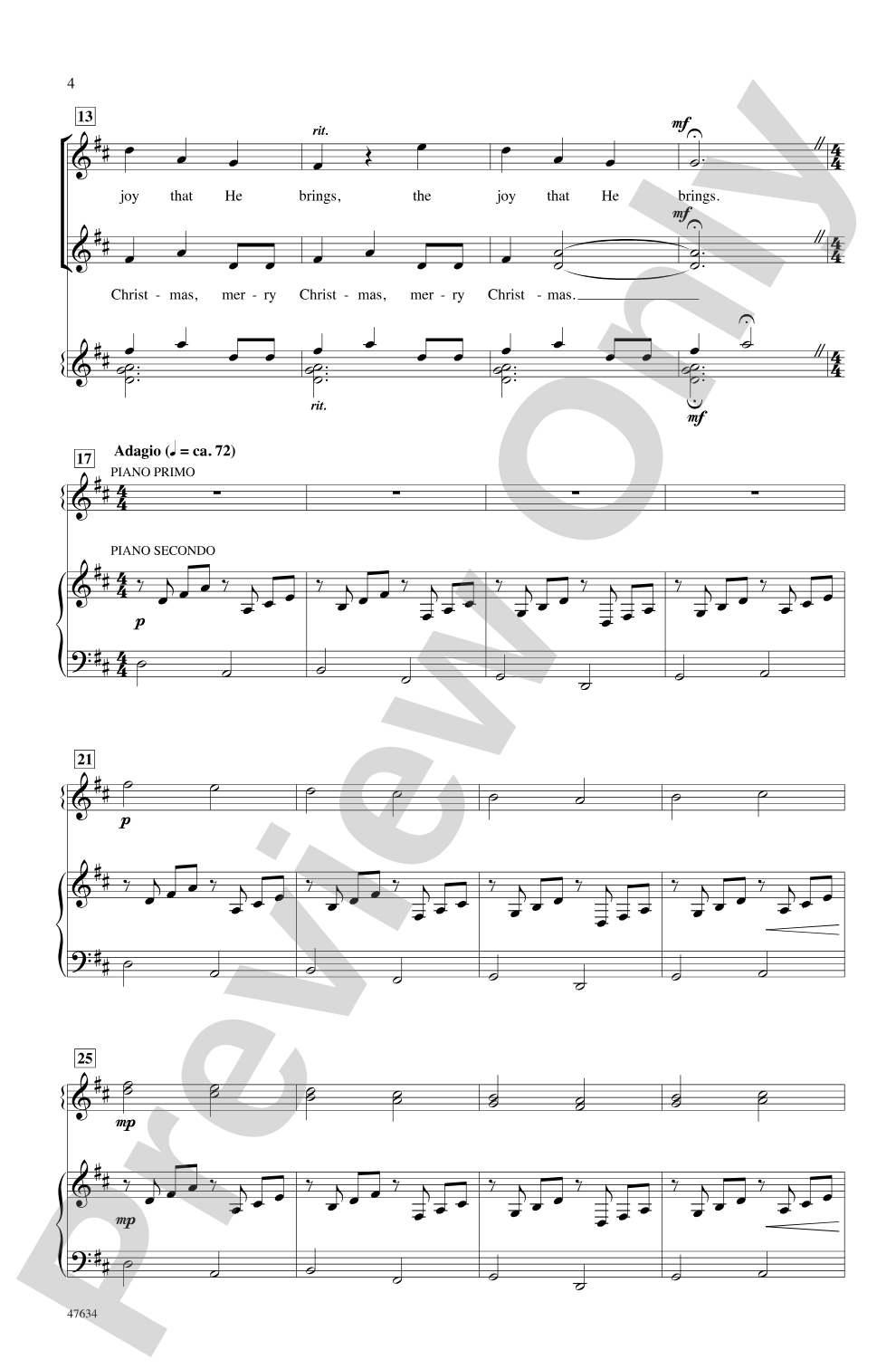
From Trans-Siberian Orchestra's triple platinum album, Christmas Eve and Other Stories, this respectful treatment of Pachelbel's Canon features patterned vocal parts that can be quickly taught and layered. The four-hand piano accompaniment is for two players at one piano, but is not difficult to play. Combine with Bob Phillips' string orchestra arrangement or the classical sounding SoundTrax CD. A highlight for any holiday concert!


Christmas Canon: SSAB Choral Octavo isn't in MakeMusic Cloud just yet...but it could be. Let us know you'd like to see it, and you'll help shape what comes next. In the meantime, start a free trial and dive into thousands of interactive titles your students can play along with today.
Request This Title
Tell us you want it.
Start Your Free Trial
Explore everything that's ready to play right now.
Sample Audio
1
Audio File
--:--
0:00
0:00
Sample Video
Additional Details
Series:
Alfred Pop Choral Series
Publisher:
Alfred Music
Page Count:
12
SKU:
00-PO-0006053
More about this title
About the Composer: Paul O'Neill
Paul O'Neill is a composer and lyricist best known for his work with Trans-Siberian Orchestra, where he has shaped the band's distinctive theatrical approach to rock and classical fusion. His arrangements and compositions blend orchestral sophistication with contemporary sensibility, creating music that reaches both concert halls and arena audiences.
In the educational and choral space, O'Neill's work demonstrates how classical forms can be reimagined for modern ensembles without sacrificing musical integrity. His pieces honor traditional structures while making them accessible to singers of varying experience levels.
Why we love this
This arrangement captures the hypnotic logic of Pachelbel's Canon while freeing your singers from the burden of learning complex counterpoint from scratch. The patterned vocal parts stack intuitively, so your ensemble hears results almost immediately, building confidence and musicality without weeks of rehearsal overhead. It's the rare holiday piece that feels genuinely substantial rather than obligatory.
What to expect
The piece has an almost meditative quality, with vocal lines that echo and reinforce each other like voices ringing through a cathedral. There's dignity in the treatment, this isn't a novelty arrangement, yet the contemporary recording source gives it an approachable, almost intimate feel that resonates with audiences who know the Trans-Siberian Orchestra version.
Who it's for
This works for choirs with limited rehearsal time and mixed ability levels. The piece accommodates both directors seeking a sophisticated sound and singers who need straightforward, repetitive material to build confidence. Holiday programs benefit from having at least one choral selection that sounds substantial without demanding weeks of preparation.
How to get the most out of it
- Layer the parts gradually during rehearsals. Start with one voice part, add the second, then the third and fourth. This reveals how each line contributes to the overall harmonic progression and keeps singers engaged rather than lost.
- Balance the four-hand piano part by having the player closer to the keyboard handle the bass line for clarity while the second player focuses on the upper accompaniment figures.
- Emphasize legato phrasing across phrase boundaries so the vocal lines feel like they're flowing rather than stopping and starting. This transforms predictable harmonic movement into something graceful.
- If using the string orchestra arrangement, rehearse a few sectionals with piano alone first so singers own their parts before the added texture of strings arrives.
How to use it
Place this as a centerpiece in your Christmas concert rather than filler between heavier pieces. Its unhurried pacing and familiar harmonic foundation create a natural moment of reflection in a program that might otherwise rush from one high-energy selection to the next. The piece also works well as a concluding number before a finale or as the opening that sets a sophisticated tone.
Skills your students will build
- Layering independent vocal lines while maintaining ensemble awareness
- Sustaining legato phrasing over repeated harmonic progressions
- Blending with three or four voice parts of equal importance
- Listening to and locking with a four-hand piano accompaniment
- Building confidence through quickly achievable musical results