
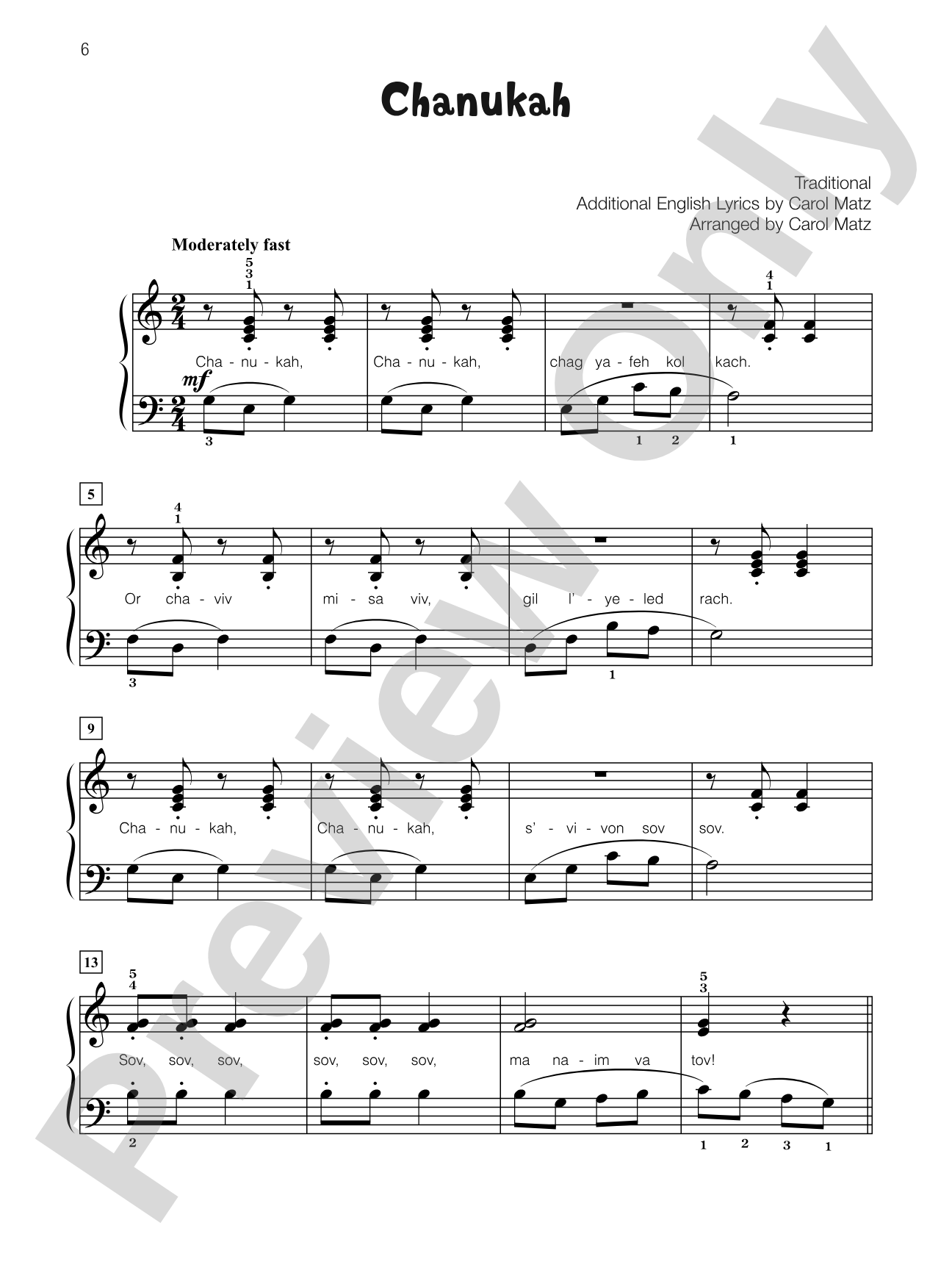

Chanukah - Piano Solo with Lyrics: Piano Solo with Lyrics
12 Appealing Piano Arrangements
Arranged by Carol Matz
Level: Elementary / Late Elementary
Item: 00-PS-0017341
$4.99
Pickup currently not available
Related Items
Adon Olam - Piano Solo with Lyrics (with Optional Duet Accompaniments): Piano Solo with Lyrics |
$4.99
|
View | |
Chad Gadya - Piano Solo with Lyrics (with Optional Duet Accompaniments): Piano Solo with Lyrics |
$4.99
|
View | |
Eiliyahu Hanavi - Piano Solo with Lyrics: Piano Solo with Lyrics |
$4.99
|
View | |
Haman, A Wicked Man - Piano Solo with Lyrics: Piano Solo with Lyrics |
$4.99
|
View | |
Hamotzi - Piano Solo with Lyrics: Piano Solo with Lyrics |
$4.99
|
View | |
Hatikva (National Anthem of Israel) - Piano Solo with Lyrics: Piano Solo with Lyrics |
$4.99
|
View | |
Ma Nishtana? (from "The Four Questions") - Piano Solo with Lyrics (with Optional Duet Accompaniments): Piano Solo with Lyrics |
$4.99
|
View | |
My Dreidel - Piano Solo with Lyrics: Piano Solo with Lyrics |
$4.99
|
View | |
Rock of Ages (Ma'oz Tzur) - Piano Solo with Lyrics (with Optional Duet Accompaniments): Piano Solo with Lyrics |
$4.99
|
View | |
Sh'ma Yisrael - Piano Solo with Lyrics (with Optional Duet Accompaniments): Piano Solo with Lyrics |
$4.99
|
View | |
Zum Gali Gali - Piano Solo with Lyrics: Piano Solo with Lyrics |
$7.99
|
View | |
Famous & Fun Jewish Songs, Book 3: Piano Book |
$7.99
|
View |
Description
Carol Matz's Famous & Fun Jewish Songs, Book 3 is filled with well-known, beloved Hebrew melodies. The collection contains songs for various Jewish holidays, Israeli, and Yiddish folk songs, as well as treasured traditional pieces. The arrangements can be used to supplement any method. Titles: Adon Olam * Chad Gadya * Chanukah * Eiliyahu Hanavi * Haman, A Wicked Man * Hamotzi * Hatikva * Ma Nishtana? * My Dreidel * Rock of Ages (Ma'oz Tzur) * Sh'ma Yisrael * Zum Gali Gali. A Federation Festivals 2024-2028 selection.


Chanukah - Piano Solo with Lyrics: Piano Solo with Lyrics isn't in MakeMusic Cloud just yet...but it could be. Let us know you'd like to see it, and you'll help shape what comes next. In the meantime, start a free trial and dive into thousands of interactive titles your students can play along with today.
Request This Title
Tell us you want it.
Start Your Free Trial
Explore everything that's ready to play right now.
Sample Audio
No sample audio found.
Sample Video
No sample videos found.
Additional Details
Series:
Famous & Fun
Publisher:
Alfred Music
Page Count:
24
SKU:
00-PS-0017341
More about this title
About the Arranger: Carol Matz

Carol Matz brings three decades of experience as both a composer and an educator to her arrangements for young pianists. A classically trained musician who studied composition, arranging, and orchestration at the University of Miami, she has created over 300 published works and earned recognition for her Famous & Fun series through Alfred Music. Her teaching background informs every piece she writes; she understands what engages students at each level and what builds real musicianship.
Matz has shared her pedagogical insights across North America, Europe, and the Pacific region through workshops and presentations. Her versatility spans orchestral writing, jazz, chamber music, and studio arrangements, but her gift lies in translating complex musical ideas into forms that challenge and inspire elementary pianists without overwhelming them.
Why we love this
Matz respects the integrity of these beloved Hebrew melodies while making them genuinely playable and engaging for elementary hands. The arrangement sits perfectly in the elementary range without sacrificing musicality or cultural authenticity, allowing students to explore Jewish liturgical and folk traditions through a repertoire that feels substantive rather than simplified.
What to expect
The piece carries the warmth and familiarity of a song passed down through generations, with harmonic language that feels both accessible and slightly textured by its folk origins. Playing it brings a sense of cultural participation and celebration, even at a beginner's technical level.
Who it's for
Elementary and late elementary pianists exploring cultural repertoire and holiday programming. Students who benefit from learning songs with historical and spiritual significance alongside standard method work, and recital programs seeking pieces that connect to winter concert themes or interfaith community events.
How to get the most out of it
- Connect the melody phrases to their lyrical content; knowing the Hebrew words and their meaning will shape your phrasing and dynamics even when playing without singing.
- Pay attention to any modal or minor inflections in the harmonic accompaniment, which often reflect the character of traditional Hebrew music and should be voiced clearly.
- Balance transparency in the left hand with a singing right hand line; these songs rely on clean presentation of melody and supporting harmony rather than virtuosic figuration.
How to use it
Feature this as a recital solo during winter concert season, particularly in December programming or during a Chanukah celebration. It pairs well with other seasonal or cultural selections and offers students a meaningful alternative to purely secular holiday music while remaining appropriate for diverse audiences.
Skills your students will build
- Reading lyrics and coordinating melody with text (even as an instrumental arrangement)
- Playing minor-key melodies with secure intonation and phrase shape
- Balancing melody and accompaniment across both hands
- Interpreting folk music idioms and understanding how cultural context informs musical expression