
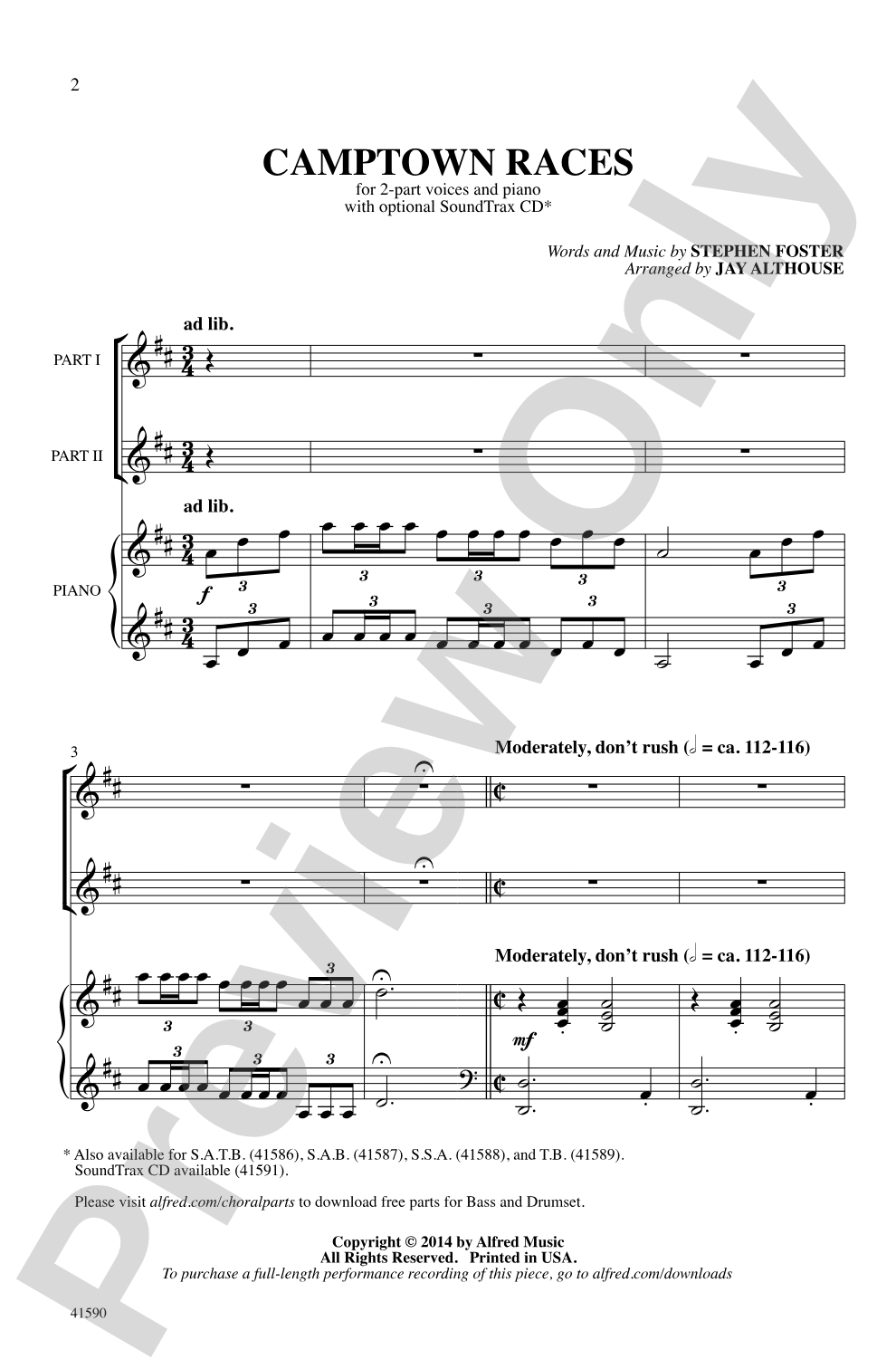
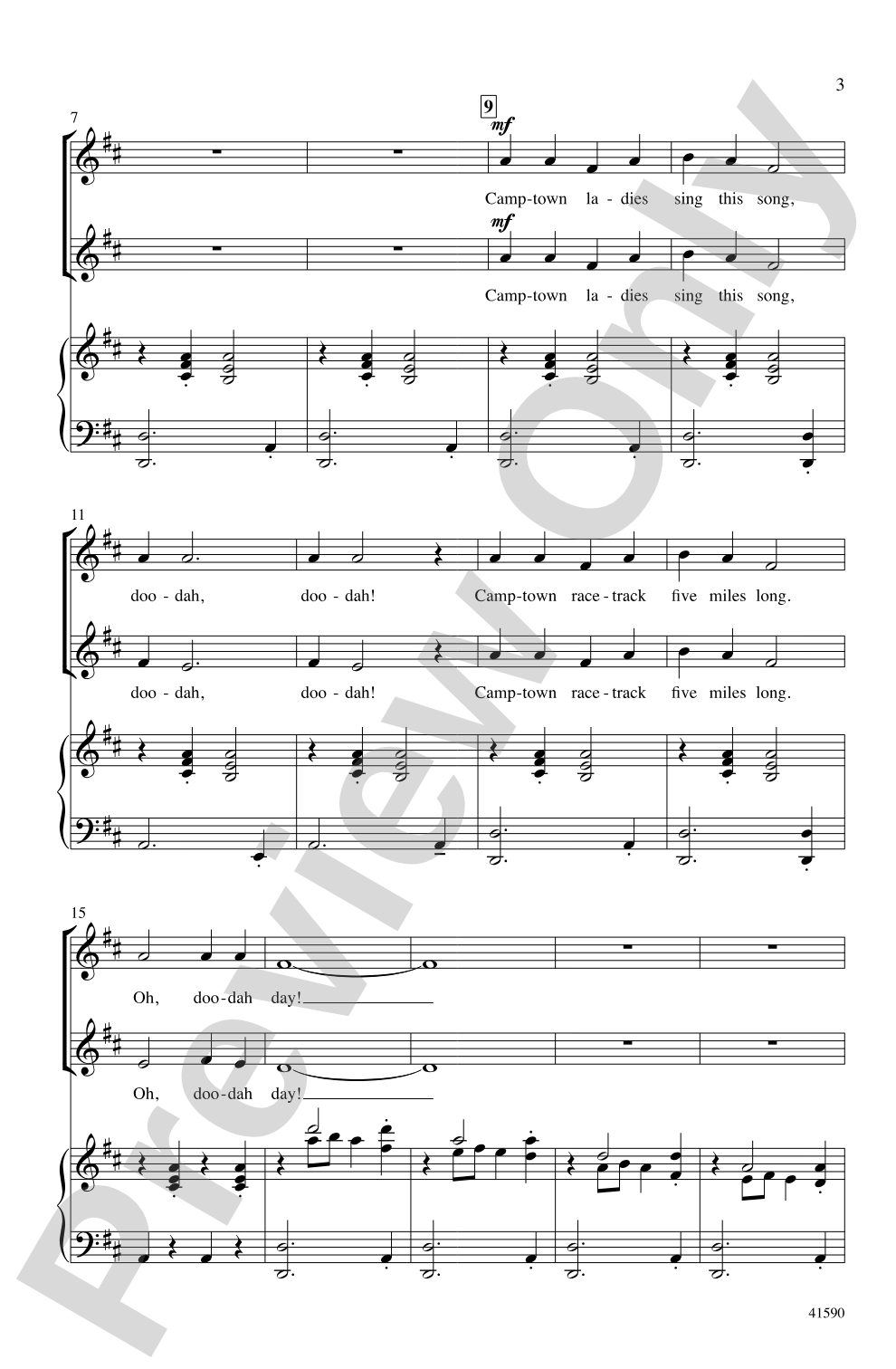

Camptown Races: 2-Part Choral Octavo
Words and music by Stephen Foster / arr. Jay Althouse
Item: 00-PO-0001815

$1.85
Minimum order quantity: 20 copies
Pickup currently not available
Description
Jay's particularly folky accompaniment features a jaunty piano with optional bass and percussion (available free at alfred.com/choralparts). Fully arranged with new harmonic and rhythmic content on each subsequent verse. Rollicking and fun, "doo-dah day!"


Don't just read it, hear it, play along with it, and watch your students grow with it. In MakeMusic Cloud, Camptown Races: 2-Part Choral Octavo comes alive with professional accompaniment, adjustable tempo, and built-in practice tools that turn solo practice into real progress.
Open in the Player
Jump straight in and assign it today.
Start Your Free Trial
Open this title and explore the full library in minutes.
Sample Audio
1
Audio File
--:--
0:00
0:00
Sample Video
No sample videos found.
Additional Details
Series:
Alfred Choral Designs
Publisher:
Alfred Music
Page Count:
12
SKU:
00-PO-0001815
More about this title
About the Composer: Stephen Foster
Stephen Foster (1826-1864) composed some of the most enduring American folk songs ever written. Born in Pennsylvania, Foster had little formal training but possessed an instinctive gift for melody and an ear for the rhythms of vernacular speech. His songs were written for minstrel shows, parlor singing, and public entertainment, which meant they needed to be singable, memorable, and emotionally direct. Foster's catalog includes "Oh! Susanna," "Swanee River," "Old Folks at Home," and "Camptown Races" (full title: "Camptown Races or De Camptown Races"), all of which remain central to American musical culture more than 150 years after his death.
For music educators, Foster's work represents a crucial bridge between folk tradition and composed song. His melodies sit comfortably in the voice, his texts capture character and humor, and his harmonic language is simple enough for young singers to grasp yet sophisticated enough to reward musical interpretation. Teaching Foster means teaching genuine American vernacular song, not a simplified imitation of it.
Why we love this
Jay Althouse's arrangement keeps the essential bounce and charm of Foster's original while giving each verse fresh harmonic and rhythmic invention. The optional percussion and bass parts mean you can scale the accompaniment to match what your ensemble needs, and the recorded accompaniment opens up performance possibilities without requiring a pianist in rehearsal. For contest or festival settings, this arrangement offers genuine musical substance in an accessible package.
What to expect
Energy and wit define this piece. The jaunty rhythm propels the story forward, and the humor in Foster's text (Camptown is a racing venue, the race is ridiculous, everyone loses) shines through. Each verse feels like a fresh turn of phrase, thanks to Althouse's varied accompaniment, so singers stay engaged even after multiple repetitions.
Who it's for
This arrangement works for middle school, high school, and community choirs looking for a dependable, fun contest or concert piece. Two-part voicing keeps it accessible for younger singers or less experienced ensembles, while Althouse's harmonic choices keep it musically satisfying for more advanced groups.
How to get the most out of it
- Establish the rhythmic pocket early in rehearsal. The jaunty swing of this piece depends on dancers landing securely on beats, so lock in the pulse before worrying about blend.
- Balance the piano accompaniment so singers can hear the harmonic underpinnings without being overpowered. Althouse's varied harmonies reward careful listening.
- Take the text seriously. "Doo-dah day" sounds silly, but it's the whole joke. Commitment to character and text clarity makes the humor land.
- If you add the optional bass and percussion parts, rehearse them separately first so the rhythm section understands how they anchor the accompaniment.
How to use it
Program this as a show-opener or closer at a winter or spring concert. Its upbeat character and short length make it an excellent palette cleanser between more serious pieces, or a satisfying finale if your program leans toward folk and Americana. For festival programming, it holds its own against more contemporary arrangements while honoring Foster's original voice.
Skills your students will build
- Singing in two-part harmony with secure inner voicing
- Responding to piano accompaniment with varied rhythmic and harmonic content
- Text clarity and rhythmic precision in a syncopated folk melody
- Interpreting character and humor through musical commitment