
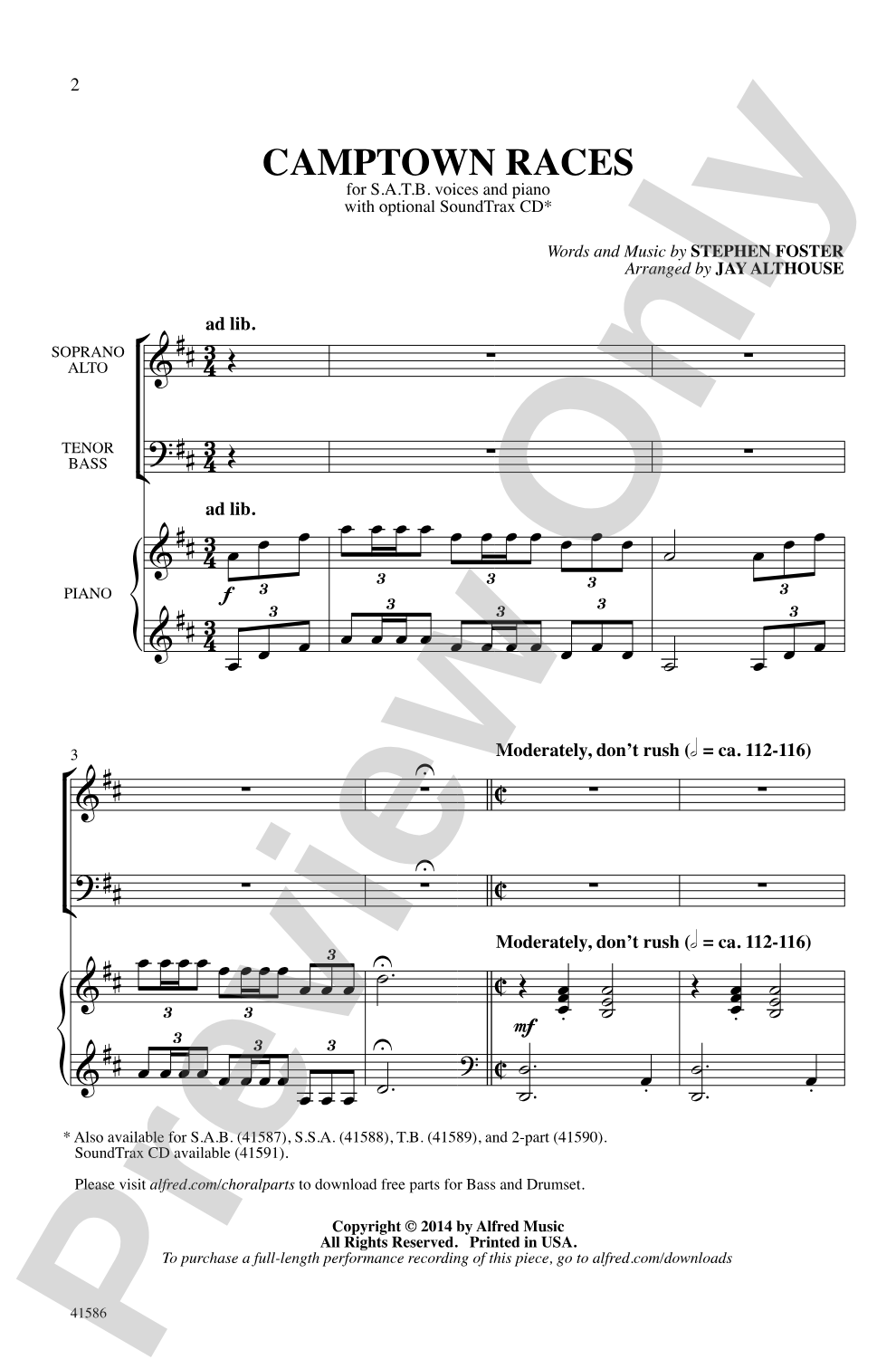

Camptown Races: SATB Choral Octavo
Words and music by Stephen Foster / arr. Jay Althouse
Item: 00-PO-0001811
$1.85
Minimum order quantity: 20 copies
Pickup currently not available
Description
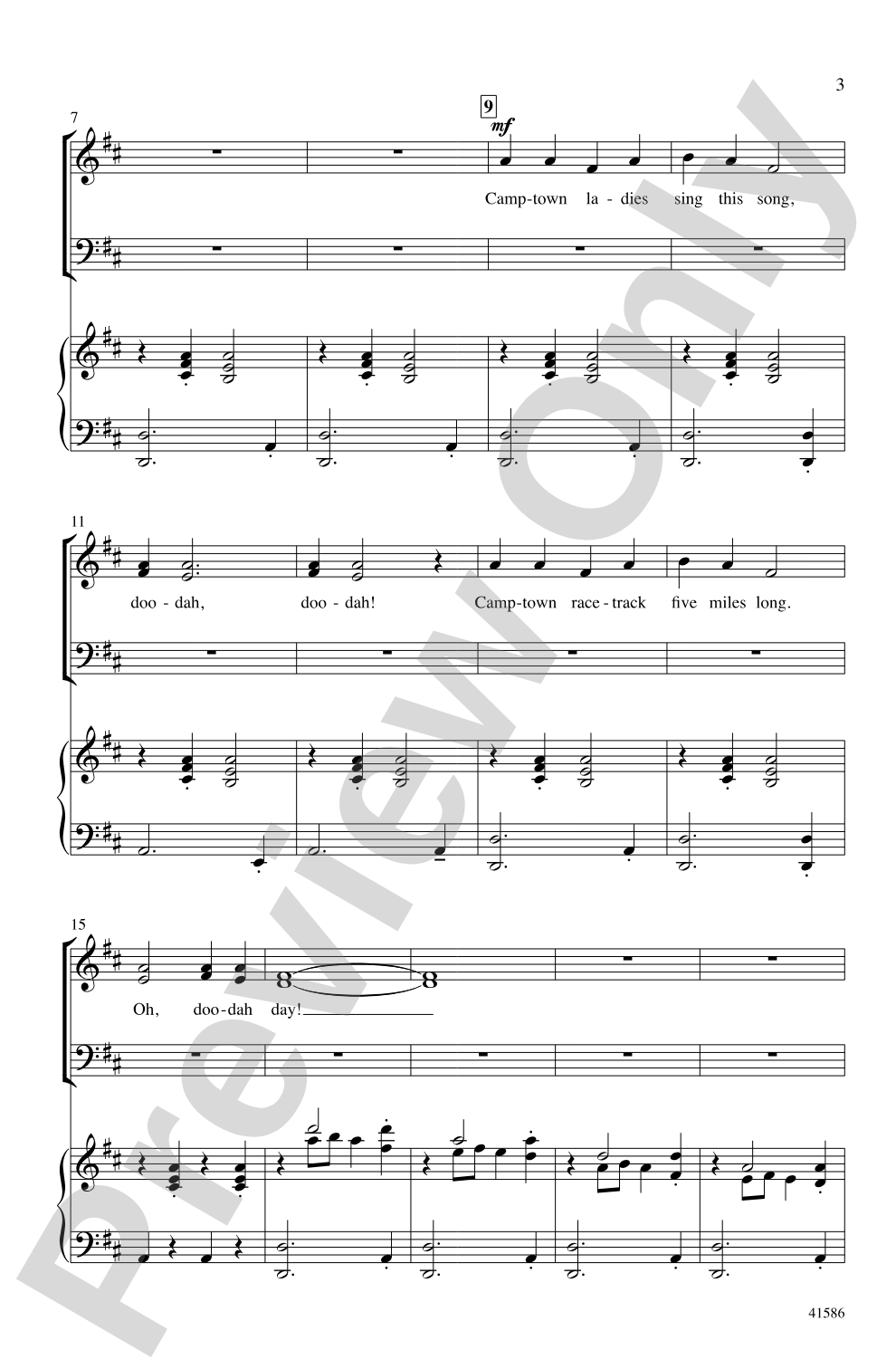
Jay's particularly folky accompaniment features a jaunty piano with optional bass and percussion (available free at alfred.com/choralparts). Fully arranged with new harmonic and rhythmic content on each subsequent verse. Rollicking and fun, "doo-dah day!"


Camptown Races: SATB Choral Octavo isn't in MakeMusic Cloud just yet...but it could be. Let us know you'd like to see it, and you'll help shape what comes next. In the meantime, start a free trial and dive into thousands of interactive titles your students can play along with today.
Request This Title
Tell us you want it.
Start Your Free Trial
Explore everything that's ready to play right now.
Sample Audio
1
Audio File
--:--
0:00
0:00
Sample Video
No sample videos found.
Additional Details
Series:
Alfred Choral Designs
Publisher:
Alfred Music
Page Count:
12
SKU:
00-PO-0001811
More about this title
About the Composer: Stephen Foster
Stephen Foster (1826-1864) shaped American popular song during the 19th century more than any composer of his era. His melodies became the soundtrack to American life, performed in parlors, on riverboats, and in minstrel shows, and his harmonic sensibility influenced generations of songwriters who followed.
Foster's gift was accessibility paired with genuine musicality. He understood what audiences wanted to sing and remember, yet he composed with care and craft. Songs like "Oh! Susanna," "Beautiful Dreamer," and "Camptown Races" remain part of the American cultural memory because they balance simplicity with character. For music educators, Foster's work offers straightforward melody, clear phrase structure, and the kind of directness that makes choral rehearsals productive and rewarding.
Why we love this
Jay Althouse's arrangement respects Foster's melodic integrity while injecting genuine character into each verse. The harmonic and rhythmic evolution keeps singers engaged across the full piece rather than settling into a single, static groove. Arrangers who handle folk material this thoughtfully strike the balance between honoring tradition and making it feel fresh to contemporary singers.
What to expect
Rollicking and unpretentious, with a fiddle-band energy that feels both nostalgic and playful. The shifting harmonic colors and rhythmic variations create forward momentum, so the piece never feels static even as it celebrates a simple, beloved melody. Singers experience the satisfaction of quick musical progress paired with genuine entertainment value.
Who it's for
SATB choirs at high school and community levels who want a piece that's immediately enjoyable to sing and reliable for festival contests. Choirs with limited rehearsal time benefit from Foster's melodic strength and Althouse's clear, singable writing. Directors seeking repertoire that engages audiences while challenging singers in manageable ways find this arrangement hits the mark.
How to get the most out of it
- Set a tempo that lets the percussive elements (when used) breathe without becoming rushed; the jaunty character comes from precision, not speed.
- Balance the soprano line against the harmonic foundation so melody cuts through without forcing. The accompaniment already provides fullness.
- Consider the recorded accompaniment option during early sectional rehearsals to establish pitch security and rhythmic accuracy before switching to live piano.
- Articulate the "doo-dah" text phrase with rhythmic clarity and matching vowels across all four parts for maximum charm and precision.
How to use it
Program this as an opener or closer on a concert that includes other American repertoire, or as a spirit-lifter between more serious works. The piece works equally well in contest settings and casual performance contexts. Its clarity and infectious character make it an excellent choice for community-building moments when you want singers and audiences aligned in pure enjoyment.
Skills your students will build
- Sustaining character and energy across multiple verse repetitions with evolving harmonic and rhythmic content
- Blending four-part harmony while maintaining clear melodic projection
- Coordinating with piano accompaniment and optional percussion parts
- Articulation and rhythmic precision in folk-style phrasing