
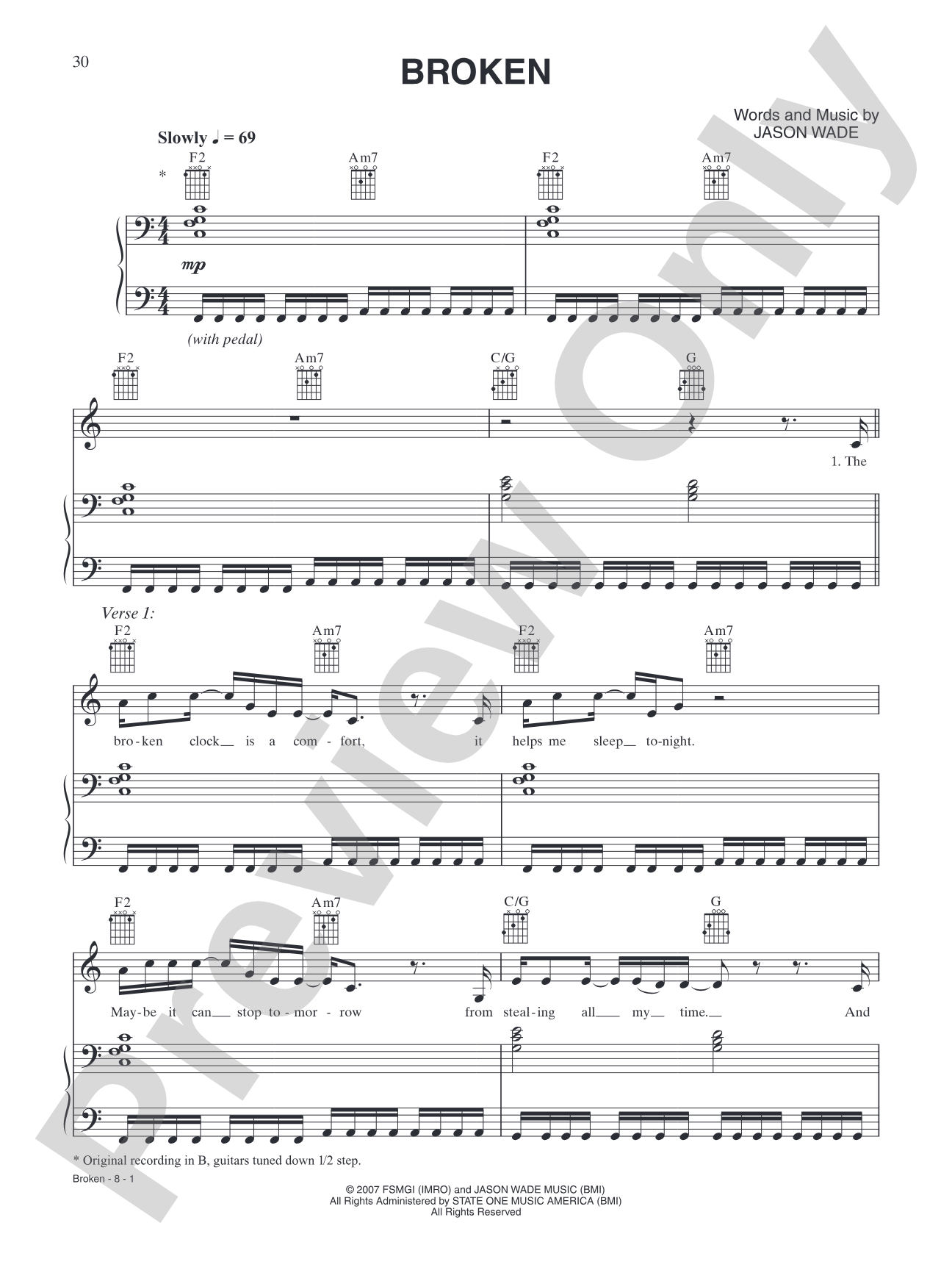
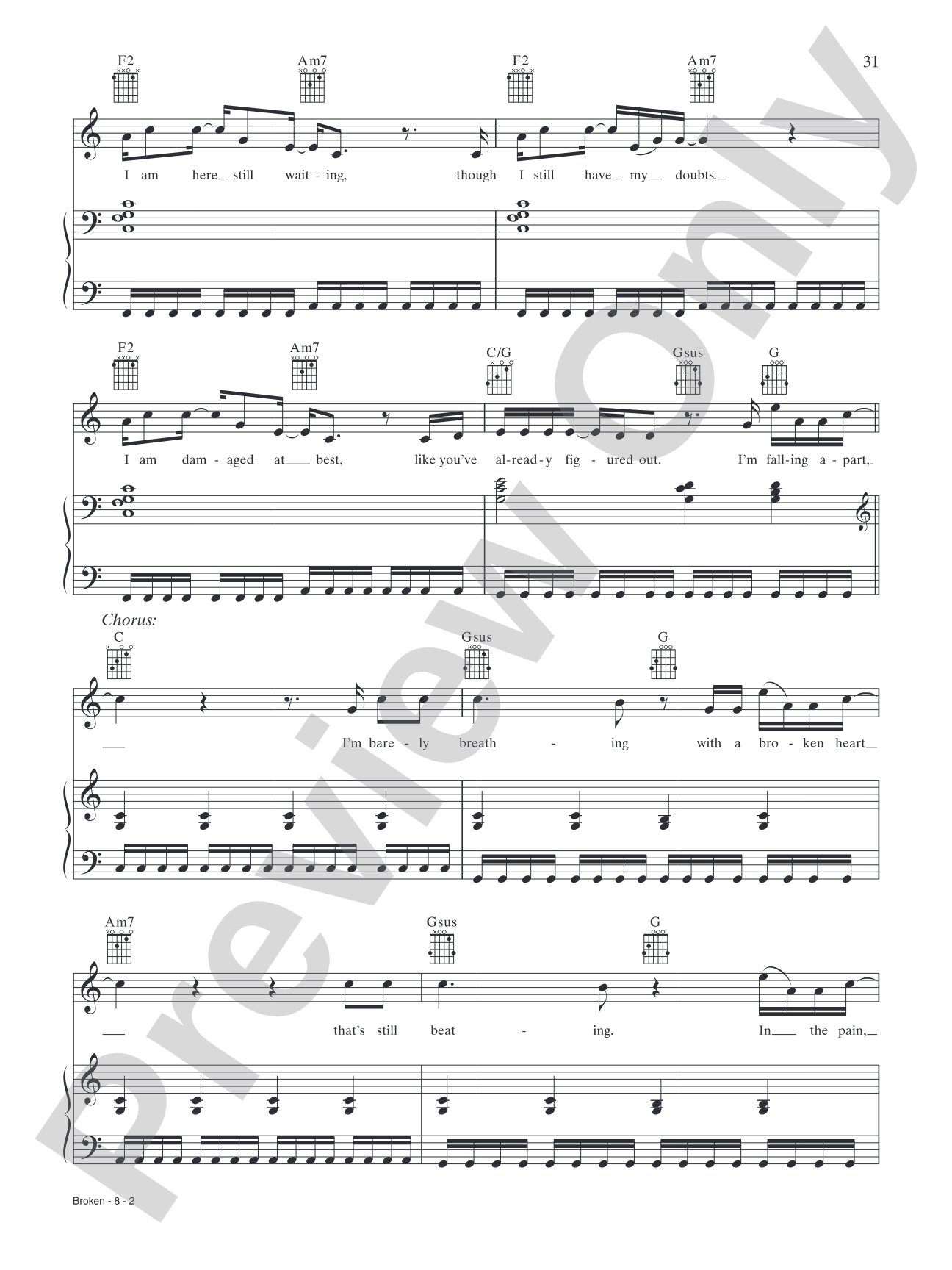

Broken: Piano/Vocal/Chords
The Biggest Hits * The Greatest Artists (Deluxe Annual Edition)
Item: 00-PS-0010982
$5.99
Pickup currently not available
Related Items
Careless Whisper: Piano/Vocal/Chords |
$5.99
|
View | |
Supermassive Black Hole: Piano/Vocal/Chords |
$4.99
|
View | |
15 Step: Piano/Vocal/Chords |
$5.99
|
View | |
Footprints in the Sand: Piano/Vocal/Chords |
$4.99
|
View | |
All Summer Long: Piano/Vocal/Chords |
$5.99
|
View | |
Second Chance: Piano/Vocal/Chords |
$4.99
|
View | |
Whatever You Like: Piano/Vocal/Chords |
$5.99
|
View | |
Let It Rock: Piano/Vocal/Chords |
$5.99
|
View | |
I Hate This Part: Piano/Vocal/Chords |
$5.99
|
View | |
Live Your Life: Piano/Vocal/Chords |
$5.99
|
View | |
Stuck With Each Other: Piano/Vocal/Chords |
$4.99
|
View |
Description
Pick up the deluxe annual edition of 2009 Greatest Pop & Rock Hits and play all the best songs of 2009 now! This unique compilation includes songs from every genre, from popular ballads by Jennifer Hudson, Beyoncé, and pop sensations Katy Perry and Kelly Clarkson, to best-selling rock singles such as Nickelback's "Gotta Be Somebody," Bruce Springsteen's "Working on a Dream," and Lifehouse's "Broken." Collect all 32 songs now and learn the best hits of the year! Titles: 1, 2, 3, 4 (Plain White T's) * 15 Step (Radiohead) * All Summer Long (Kid Rock) * Angels on the Moon (Thriving Ivory) * At Last (Beyoncé) * Broken (Lifehouse) * Careless Whisper (Seether) * Crush (David Archuleta) * Decode (Paramore) * Footprints in the Sand (Leona Lewis) * Gotta Be Somebody (Nickelback) * Home Sweet Home (Carrie Underwood) * Hot N Cold (Katy Perry) * I Hate This Part (Pussycat Dolls) * If Today Was Your Last Day (Nickelback) * Let It Rock (Kevin Rudolf) * Live Your Life (T.I. featuring Rihanna) * My Life Would Suck Without You (Kelly Clarkson) * Never Far Away (Jim Brickman featuring Rush of Fools) * One Step at a Time (Jordin Sparks) * Second Chance (Shinedown) * Shuttin' Detroit Down (John Rich) * Stuck with Each Other (Shontelle featuring Akon) * Supermassive Black Hole (Muse) * Thinking of You (Katy Perry) * What About Now (Daughtry) * What Do I Do with My Heart (Eagles) * Working on a Dream (Bruce Springsteen) * What's Right Is Right (Taylor Hicks) * Whatever You Like (T.I.) * You Pulled Me Through (Jennifer Hudson).


Discover MakeMusic Cloud: thousands of interactive titles your students can play along with today.
Sample Audio
No sample audio found.
Sample Video
No sample videos found.
Additional Details
Series:
Greatest Hits
Publisher:
Alfred Music
Page Count:
208
SKU:
00-PS-0010982
More about this title
About the Composer: Jason Wade
Jason Wade is the lead vocalist and primary songwriter of Lifehouse, the rock band that emerged in the early 2000s with a blend of post-grunge sensibility and accessible melodies. His songwriting emphasizes emotional directness and memorable hooks, qualities that have made Lifehouse's catalog a staple of contemporary rock radio and a frequent choice for music educators seeking repertoire that resonates with students.
Why we love this
This collection captures a genuine snapshot of what students were hearing on the radio in 2009, which means you're teaching repertoire they already know and care about. The 32-song folio spans multiple genres and vocal ranges, making it genuinely useful for mixed ensembles, jazz combos, and piano students at varying levels rather than a one-size-fits-none compilation.
What to expect
A time capsule of accessible melodies and driving rhythms. The songs range from intimate acoustic moments to radio-ready hooks, creating a collection that feels both immediate and varied. Expect straightforward chord progressions that support vocal storytelling, energetic rhythms that invite ensemble participation, and emotional directness that connects easily with performers and listeners.
Who it's for
Pianists preparing audition or recital repertoire with contemporary material, vocalists working through accessible pop and rock standards, and music teachers building a hybrid collection for ensemble or private lesson use. This folio works equally well for high school singers preparing for solos and piano students exploring genre beyond classical tradition.
How to get the most out of it
- Scan the chord voicings before memorizing the melody; the guitar-influenced chord structures in rock-oriented songs like "Broken" reveal the harmonic movement better than reading lyrics alone.
- Treat the piano part as a sketch rather than a definitive arrangement. Lift from the original recordings to understand whether the piano doubles the vocal line, provides countermelody, or establishes rhythm section feel.
- Balance vocal phrasing with the written piano part by listening to how the recorded version handles breath breaks and rubato, particularly in ballads like "At Last."
- Experiment with the dynamics marked in the chart; many 2009 pop and rock songs benefit from understated verses that suddenly open up for the chorus.
How to use it
Extract individual titles for jazz ensemble arrangements, pop choir sets, or recital openers. The rock and pop selections work well as palate cleansers between classical or contemporary art songs in a mixed recital, and the ballads provide accessible entry points for students beginning to explore contemporary vocal literature.
Skills your students will build
- Reading chord symbols and improvising accompaniment figures
- Phrasing contemporary melodies over steady rhythmic foundations
- Navigating popular song form (verse, chorus, bridge) without formal movement markers
- Balancing written notation with stylistic interpretation drawn from recorded versions
- Sight-reading through extensive single-song exposure across multiple genres