
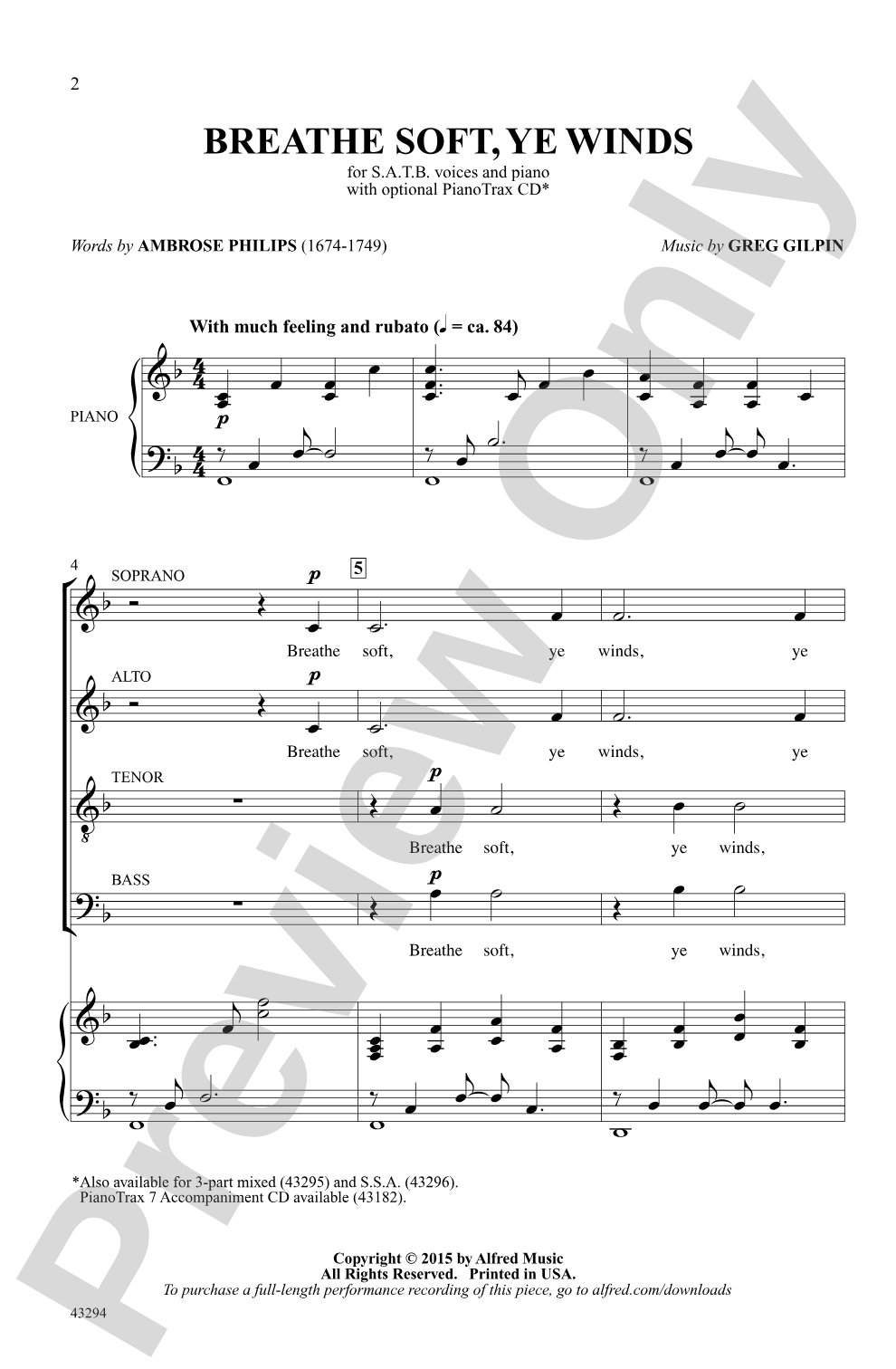
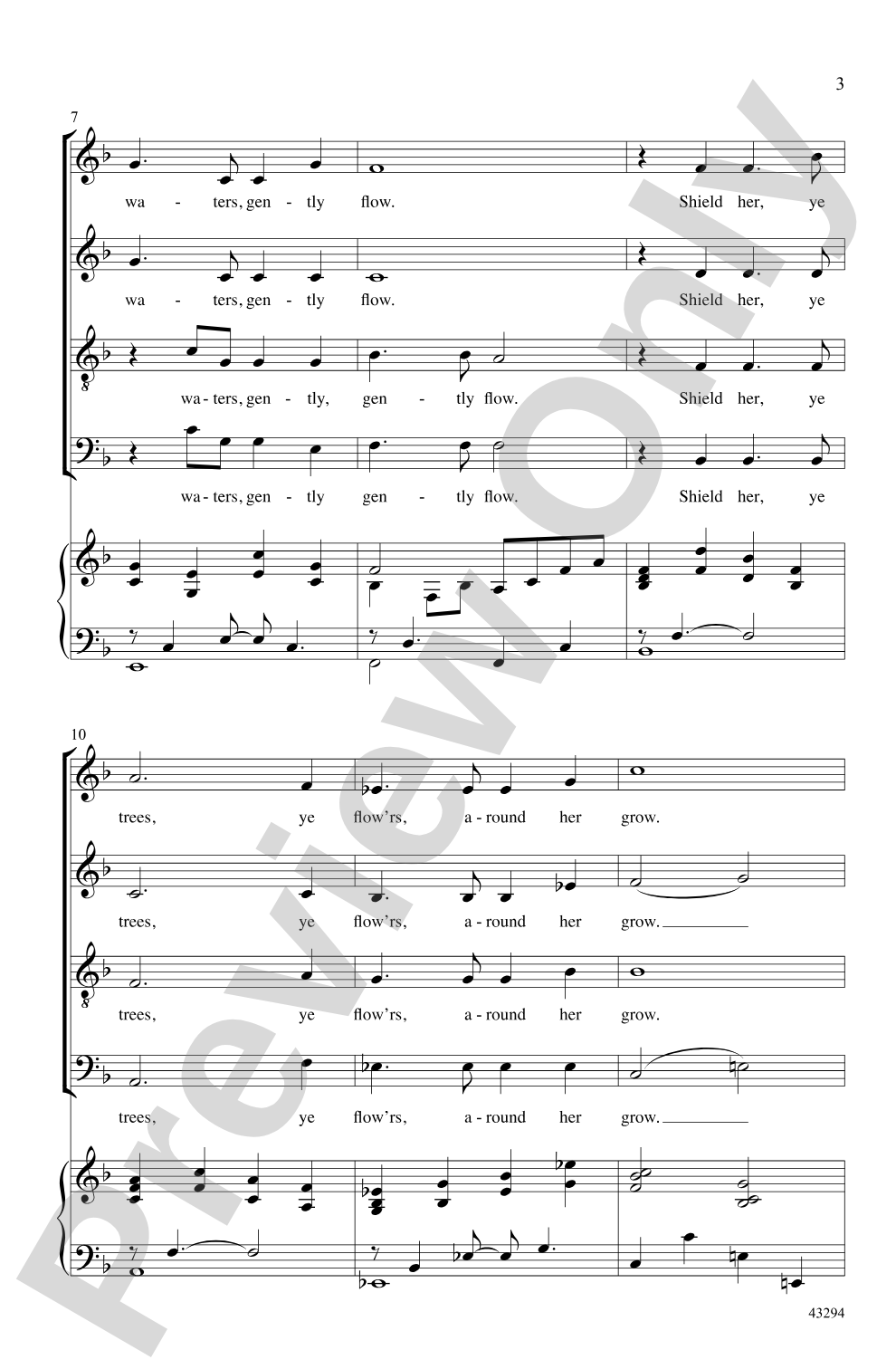

Breathe Soft, Ye Winds: SATB Choral Octavo
Words by Ambrose Philips, music by Greg Gilpin
Item: 00-PO-0003260
$1.90
Minimum order quantity: 20 copies
Pickup currently not available
Related Items
Breathe Soft, Ye Winds: PianoTrax Digital Download |
$9.99
|
View | |
Breathe Soft, Ye Winds: 3-Part Mixed Choral Octavo |
$2.05
|
View | |
Breathe Soft, Ye Winds: SSA Choral Octavo |
$1.90
|
View | |
Breathe Soft, Ye Winds: SATB Choral Octavo |
$1.90
|
View | |
Breathe Soft, Ye Winds: 3-Part Mixed Choral Octavo |
$2.05
|
View | |
Breathe Soft, Ye Winds: SSA Choral Octavo |
$1.90
|
View |
Description
Greg Gilpin's skillful writing and sensitive interpretation create an expressive piece that brings understanding to this poignant text. Stunning in its simplicity, intelligent voice leading, practical ranges, and clear phrasing allow choirs to sound their very best in no time at all. Mature, yet manageable.


Breathe Soft, Ye Winds: SATB Choral Octavo isn't in MakeMusic Cloud just yet...but it could be. Let us know you'd like to see it, and you'll help shape what comes next. In the meantime, start a free trial and dive into thousands of interactive titles your students can play along with today.
Request This Title
Tell us you want it.
Start Your Free Trial
Explore everything that's ready to play right now.
Sample Audio
1
Audio File
--:--
0:00
0:00
Sample Video
Additional Details
Series:
Alfred Choral Designs
Publisher:
Alfred Music
Page Count:
12
SKU:
00-PO-0003260
More about this title
About the Composer: Greg Gilpin

Greg Gilpin is an ASCAP award-winning composer and arranger whose work has been performed at prestigious venues including Carnegie Hall, Lincoln Center, Ryman Auditorium, Sydney Opera House, Royal Festival Hall, and Harpa Concert Hall. Beyond his compositions and conducting, Gilpin serves as Director of Educational Choral Publications for Shawnee Press and has earned recognition in film scoring, including a Best Score award for the short film "Rosie's Rescue."
Gilpin's contributions to choral music education extend across multiple roles: he holds memberships in ACDA, NAfME, SAG-AFTRA, and maintains Life Loyal Member status in Phi Mu Alpha Sinfonia. His work combines technical sophistication with pedagogical accessibility, consistently delivering pieces that challenge musicians without overwhelming them.
Why we love this
Gilpin understands what makes a piece singable without sacrificing musical substance. The voice leading here is genuinely intelligent; parts move logically and rest where singers need them to breathe, yet the harmonic language never feels oversimplified. Your choir will sound polished quickly because the writing itself does much of the work.
What to expect
There's a hushed, introspective quality to this piece. The harmonic language unfolds gently, creating moments of genuine stillness punctuated by understated warmth. It feels like a conversation held at close range, intimate without sentimentality.
Who it's for
This works beautifully for choirs that want to program something mature without requiring extensive rehearsal time. Directors leading mixed ensembles at concert or festival level will find the practical ranges and clear voice leading allow singers to focus on interpretation rather than technical survival.
How to get the most out of it
- Balance the inner voices carefully during sustained sections. Altos and tenors often carry harmonic color in Gilpin's writing, so resist the urge to let them disappear beneath the outer parts.
- Attend closely to phrase shape and text emphasis. Even simple melodies gain expressive depth when you honor the emotional arc of the poetic language.
- Consider the acoustic properties of your venue. This piece rewards clarity and space; overly aggressive dynamics in smaller rooms will flatten the sensitivity of the writing.
How to use it
Place this piece strategically in a concert's emotional arc. It pairs well with other secular choral works that explore quiet reflection or nature imagery, and works especially effectively as a transition piece between larger, more energetic selections. The poetic text and literary sensitivity make it a natural fit for programs built around thematic programming.
Skills your students will build
- Sensitive text interpretation in secular choral literature
- Voice leading literacy through part independence without harmonic complexity
- Sustained tone production and breath phrasing across longer musical lines
- Balance and blend in four-part writing with emphasis on inner voices