
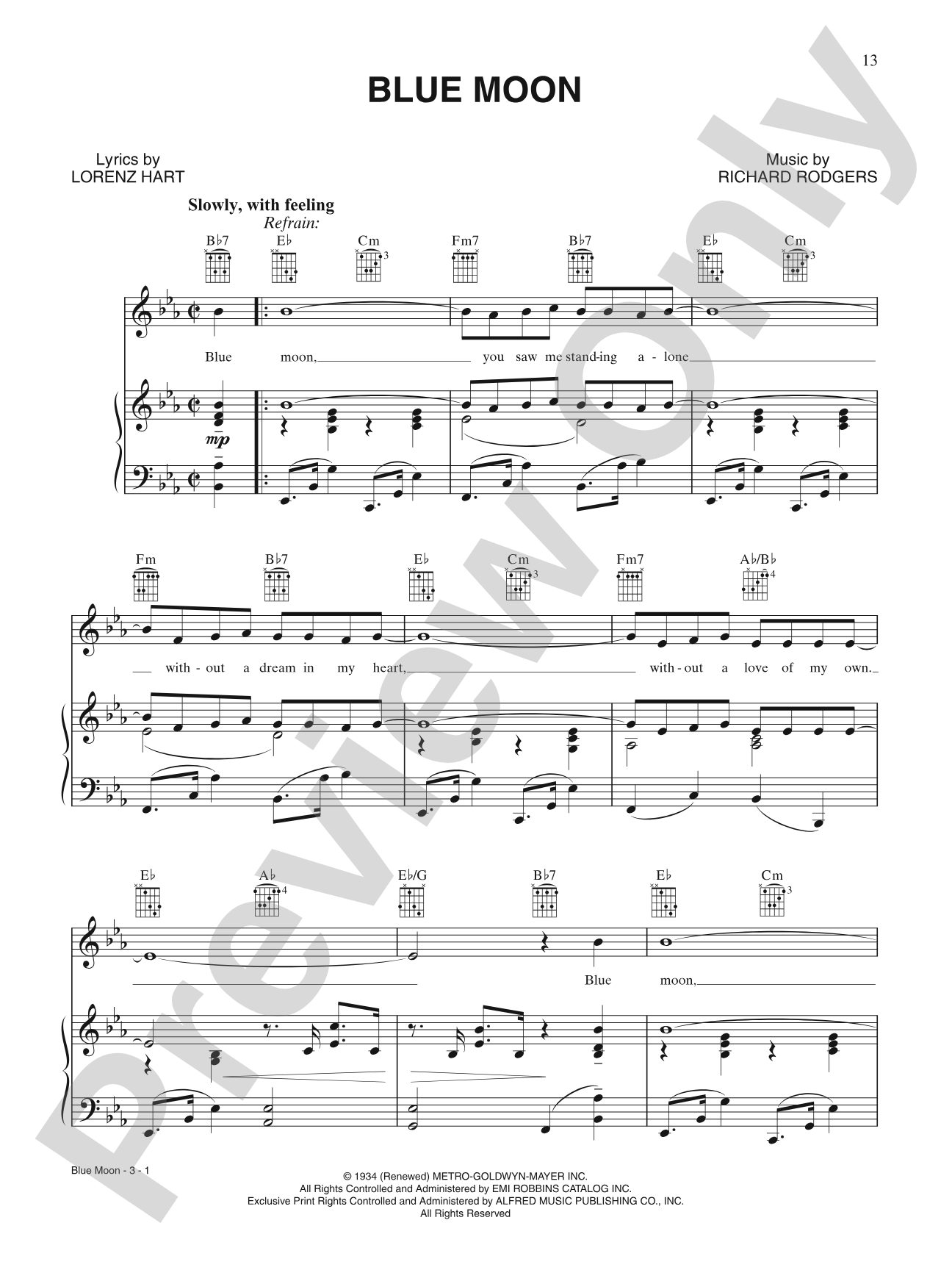

Blue Moon: Piano/Vocal/Chords
20 Great American Songbook and Jazz Favorites
Item: 00-PS-0015564
$4.99
One moment…
Related Items
Laura: Piano/Vocal/Chords |
$4.99
|
View | |
The Shadow of Your Smile: Piano/Vocal/Chords |
$4.99
|
View | |
I'm in the Mood for Love: Piano/Vocal/Chords |
$4.99
|
View | |
Moonlight Serenade: Piano/Vocal/Chords |
$4.99
|
View | |
I Put a Spell on You: Piano/Vocal/Chords |
$4.99
|
View | |
My Man: Piano/Vocal/Chords |
$4.99
|
View | |
Over the Rainbow: Piano/Vocal/Chords |
$4.99
|
View | |
Ain't Misbehavin': Piano/Vocal/Chords |
$4.99
|
View | |
Straighten Up and Fly Right: Piano/Vocal/Chords |
$4.99
|
View | |
Don't Sit Under the Apple Tree (With Anyone Else But Me): Piano/Vocal/Chords |
$4.99
|
View | |
Top-Requested Standards Sheet Music: Piano/Vocal/Guitar Book |
$14.99
|
View |
Description
The crowd-pleasing standards in this sheet music collection belong in every musician's repertoire. This songbook contains 20 piano/vocal arrangements of classic songs that are guaranteed to delight audiences of all ages. Complete lyrics and chord symbols are included. Titles: Ain't Misbehavin' * At Last * Blue Moon * Don't Get Around Much Anymore * Don't Sit Under the Apple Tree * I Put a Spell on You * I'm in the Mood for Love * Laura * Misty * Moonlight Serenade * My Man * Theme from New York, New York * Orange Colored Sky * Over the Rainbow * The Pink Panther * The Shadow of Your Smile * Straighten Up and Fly Right * Take Five * What a Wonderful World * Whatever Lola Wants.


Blue Moon: Piano/Vocal/Chords isn't in MakeMusic Cloud just yet...but it could be. Let us know you'd like to see it, and you'll help shape what comes next. In the meantime, start a free trial and dive into thousands of interactive titles your students can play along with today.
Request This Title
Tell us you want it.
Start Your Free Trial
Explore everything that's ready to play right now.
Sample Audio
No sample audio found.
Sample Video
No sample videos found.
Additional Details
Series:
Top-Requested Sheet Music
Publisher:
Alfred Music
Page Count:
80
SKU:
00-PS-0015564
More about this title
About the Composer: Richard Rodgers
Richard Rodgers (1902-1979) shaped American musical theater and popular song for five decades. His melodic gift and harmonic sophistication made him one of the most performed composers in history, whether through his legendary partnerships with lyricist Lorenz Hart or Oscar Hammerstein II.
For music educators, Rodgers' work represents the gold standard of singable, accessible melody paired with harmonic depth. His songs reward both casual performers and serious musicians, making them ideal teaching and performance vehicles across skill levels.
Why we love this
This folio gathers twenty songs that audiences genuinely want to hear, spanning jazz standards, beloved show tunes, and timeless ballads from a composer whose work defines the American songbook. The chord symbols and complete lyrics make these pieces equally useful in the practice room, the recital hall, or the jazz ensemble rehearsal. You'll program these pieces again and again because they work.
What to expect
These songs carry the warmth and sophistication of a golden age of American songwriting. Whether you're exploring the bluesy swagger of 'I Put a Spell on You,' the romantic elegance of 'Laura,' or the uplifting optimism of 'What a Wonderful World,' each arrangement honors the song's character while remaining accessible to performers at this level.
Who it's for
Pianists building a recital or performance repertoire will find immediately gratifying, audience-tested material here. Vocalists preparing for jazz jam sessions, standards-based performances, or musical theater auditions gain authentic arrangements with full chord symbols for improvisation and collaboration.
How to get the most out of it
- Balance the vocal line against the piano accompaniment rather than burying it. These melodies are strong enough to shine forward even with full harmonic support underneath.
- Treat the chord symbols as a foundation, not a ceiling. Improvise and reharmonize where the style allows, especially in jazz-forward pieces like 'Take Five' and 'I'm in the Mood for Love'.
- Pay attention to the lyrical phrasing and storytelling in ballads like 'Misty' and 'The Shadow of Your Smile.' Let the text shape your tempo and dynamics rather than locking into a metronomic beat.
- In uptempo standards, clarity of articulation in the piano part keeps the groove propulsive without sacrificing warmth.
How to use it
Slot individual pieces into solo recitals or chamber programs as stylistic contrast to classical repertoire. Use them as cohesive programming around a standards or American songbook theme, letting the collection's range of tempos and moods shape a complete concert arc.
Skills your students will build
- Reading chord symbols and realizing harmonies at the keyboard
- Balancing vocal line projection with accompaniment texture
- Jazz phrasing and syncopation in popular song idioms
- Navigating swing rhythms and interpreting swing notation
- Text interpretation and lyrical phrasing in sung repertoire