
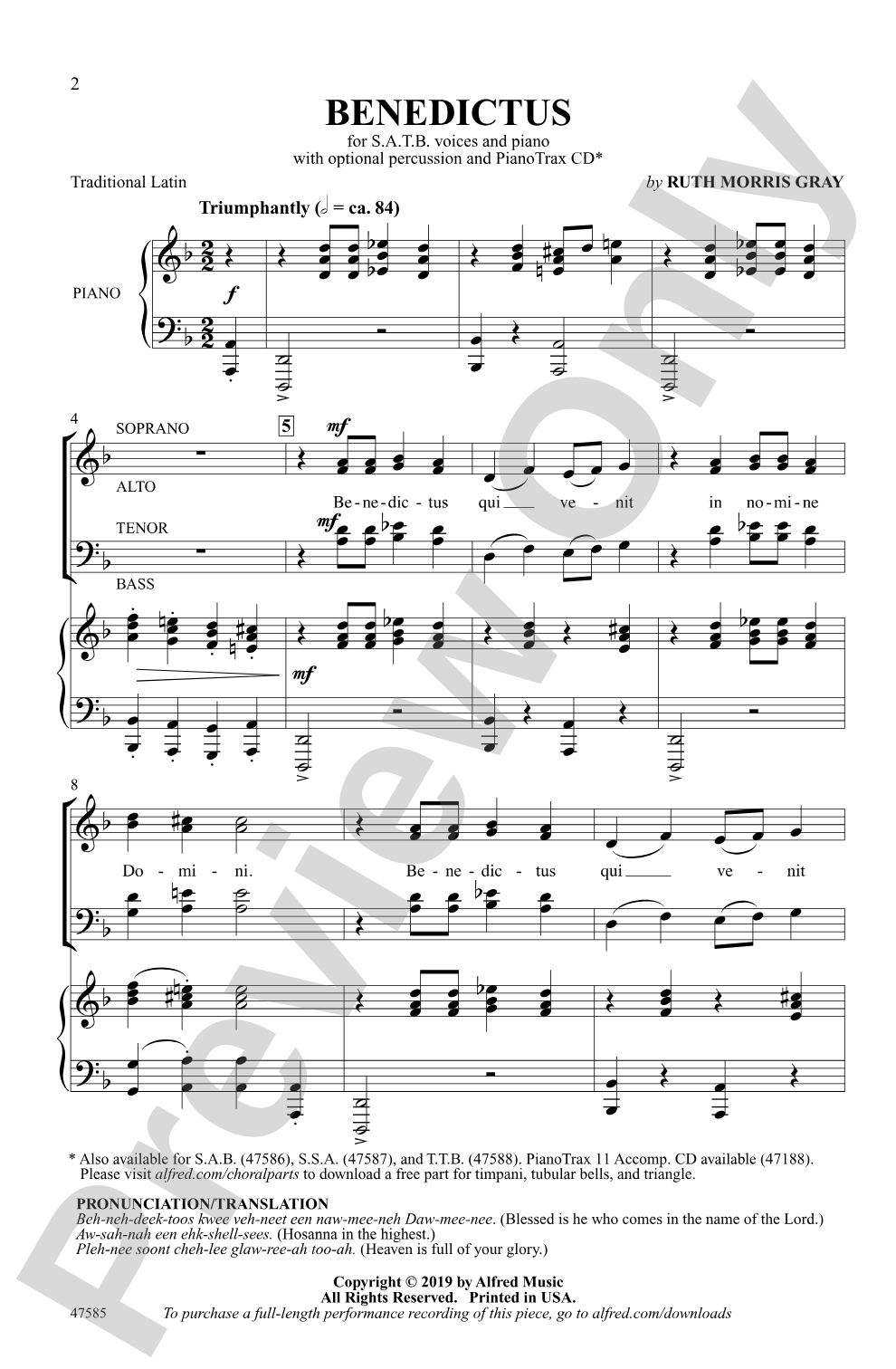
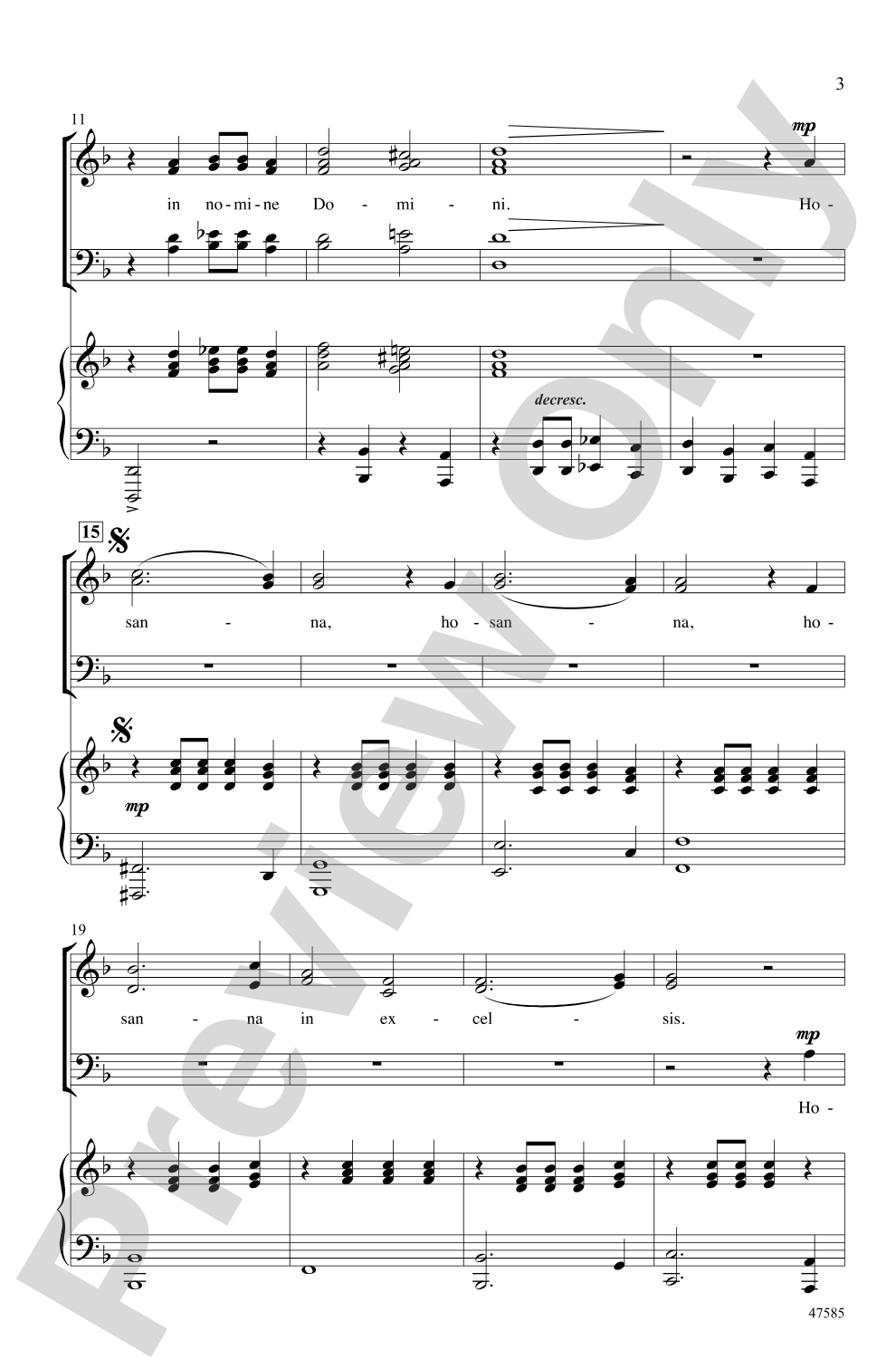

Benedictus: SATB Choral Octavo
By Ruth Morris Gray
Item: 00-PO-0005946
$2.05
Minimum order quantity: 20 copies
Pickup currently not available
Related Items
Benedictus: SAB Choral Octavo |
$2.05
|
View | |
Benedictus: SSA Choral Octavo |
$2.05
|
View | |
Benedictus: TTB Choral Octavo |
$2.05
|
View | |
Benedictus: SATB Choral Octavo |
$2.05
|
View | |
Benedictus: SAB Choral Octavo |
$2.05
|
View | |
Benedictus: SSA Choral Octavo |
$2.05
|
View | |
Benedictus: TTB Choral Octavo |
$2.05
|
View |
Description
A bombastic and stately theme, based on stacked modal harmonies, gives a triumphant air to this contemporary setting of the traditional Latin text. Hushed B and C sections offer contrast before recapitulating the grandiose opening and an even fuller final cadence. Timpani, tubular bells, and triangle (which may be downloaded for free) may be performed by a single percussionist and add to the riveting drama.


Benedictus: SATB Choral Octavo isn't in MakeMusic Cloud just yet...but it could be. Let us know you'd like to see it, and you'll help shape what comes next. In the meantime, start a free trial and dive into thousands of interactive titles your students can play along with today.
Request This Title
Tell us you want it.
Start Your Free Trial
Explore everything that's ready to play right now.
Sample Audio
1
Audio File
--:--
0:00
0:00
Sample Video
Additional Details
Series:
Alfred Choral Designs
Publisher:
Alfred Music
Page Count:
8
SKU:
00-PO-0005946
Instrumentation:
Percussion
More about this title
About the Composer: Ruth Morris Gray

Ruth Morris Gray serves as Director of Choirs at Rosemead High School in California, where she has led the choral program since 2004. She also teaches piano and has built a prolific compositional catalog of more than 100 published choral works. Her training spans multiple institutions: she holds a Bachelor of Music in Piano Performance and Composition from Biola University, a Master of Arts in Music Composition from UC Santa Barbara, and earned her California Single Subject Music Credential from California State University, Northridge.
Beyond her work in the classroom and rehearsal hall, Gray actively composes, performs, and arranges music for choral ensembles. She brings her diverse musical background and performance experience directly into her compositions, creating works that challenge and engage singers at all levels.
Why we love this
Gray's stacked modal harmonies create a sophisticated harmonic language that sounds fresh without demanding excessive ensemble maturity. The architecture of this piece is particularly elegant: the bombastic opening hooks listeners immediately, while the contrasting B and C sections (marked "hushed") give your singers breathing room to explore dynamic nuance before the climactic return. Percussion parts that a single performer can manage mean you're not scrambling to find three instrumentalists.
What to expect
The opening announces itself with stately grandeur, invoking reverence through layered modal sonorities that feel both ancient and modern. The sudden shift to hushed vulnerability creates an almost sacred intimacy before building back toward triumph, leaving audiences with a sense of ceremonial majesty that lingers.
Who it's for
SATB choirs with solid intonation skills and the ability to sustain modal harmony without tonal drift. This work suits accomplished high school choirs, collegiate ensembles, and community choirs seeking a contemporary piece with liturgical resonance but secular context.
How to get the most out of it
- Balance the modal harmonies by doubling the root positions during sectional rehearsals; once singers hear the harmonic function, remove doublings gradually to let the shimmering quality emerge.
- Conduct the hushed B and C sections with deliberate restraint to prevent sopranos and tenors from drifting sharp in the sustained passages; precise tempo control here intensifies the contrast with what follows.
- Coordinate with your percussionist early regarding the timpani, tubular bells, and triangle parts (available as free downloads); the triangle especially needs rhythmic clarity to cut through the choral texture without sounding thin.
- Shape the final cadence with a slight ritardando and full dynamic commitment; this is where the piece demands ensemble cohesion and vocal confidence.
How to use it
Program this as a concert opener or closer where its grandiose opening can command attention and its dramatic arc gives audiences a memorable anchor point for the evening. The Latin text and spiritual character pair naturally with sacred repertoire, though the contemporary harmonic language works equally well on secular programs celebrating choral achievement.
Skills your students will build
- Singing in modal harmonic contexts (particularly stacked tertian harmonies outside traditional major/minor tonality)
- Managing sustained, exposed four-part writing without tonal slippage
- Dynamic contrast and control across multiple sections with distinct textural demands
- Coordinate with percussion to balance choral texture with triangle, timpani, and tubular bells
- Executing text-driven phrasing and diction in Latin