
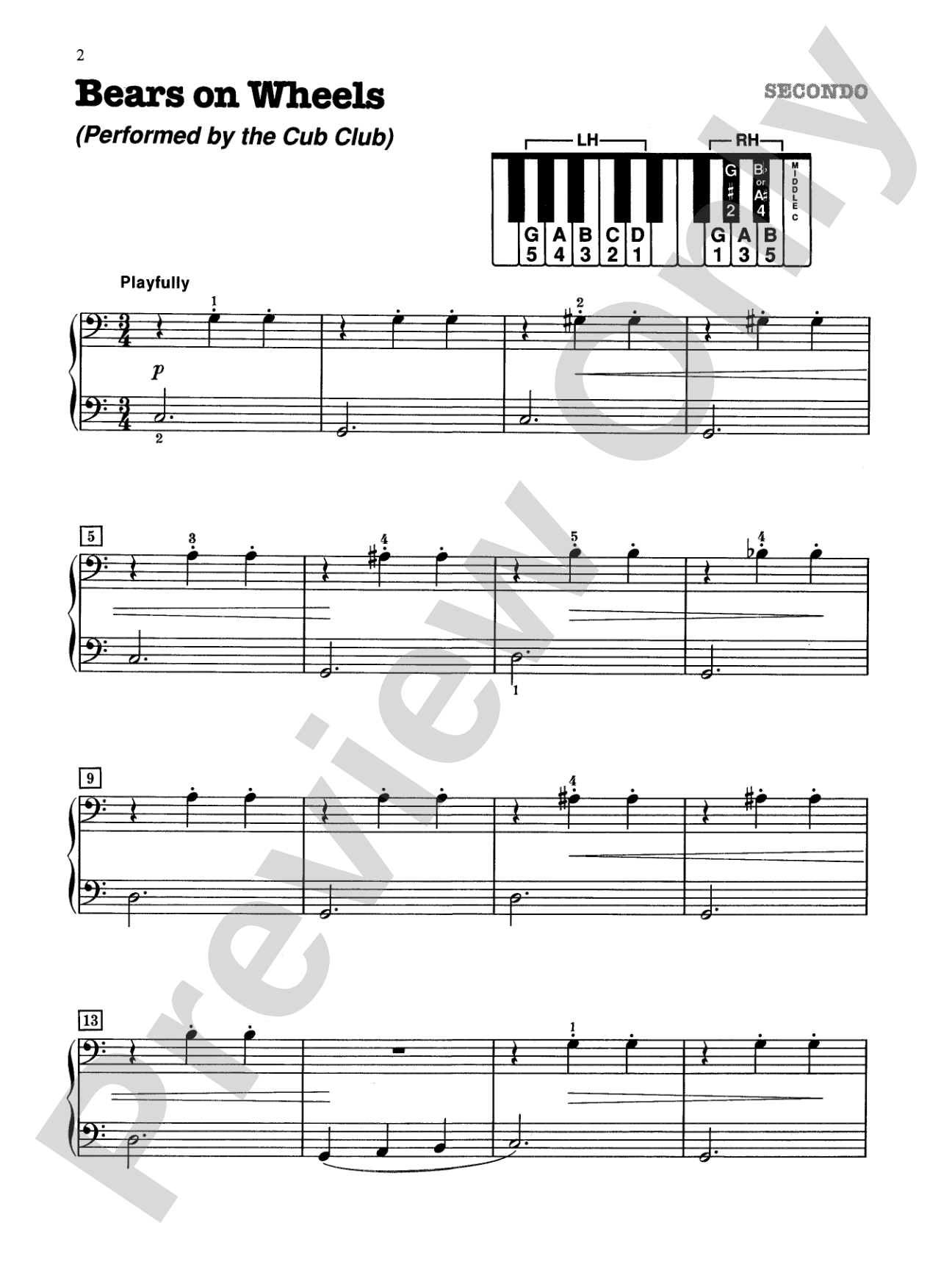

Bears on Wheels (Performed by the Cub Club) - Piano Duet (1 Piano, 4 Hands): Piano Duet (1 Piano, 4 Hands)
Elementary Duets for 1 Piano, 4 Paws
By Margaret Goldston
Level: Elementary
Item: 00-PS-0017537
$4.99
Pickup currently not available
Related Items
Babbling Bears (Can You Bear It?) - Piano Duet (1 Piano, 4 Hands): Piano Duet (1 Piano, 4 Hands) |
$4.99
|
View | |
Bear Hug (A Lullaby) - Piano Duet (1 Piano, 4 Hands): Piano Duet (1 Piano, 4 Hands) |
$4.99
|
View | |
Steps in the Forest (Furward March!) - Piano Duet (1 Piano, 4 Hands): Piano Duet (1 Piano, 4 Hands) |
$5.99
|
View | |
Duets for Bear Lovers: Piano Duet (1 Piano, 4 Hands) Book |
$5.99
|
View |
Description
A collection of elementary duets for one piano and four paws! The primo and secondo parts are equal in difficulty and the hand positions are shown for each piece. Some pieces feature easy position shifts. An indispensable collection to add variety to the lesson plan and help make practicing the piano become less work and more fun! A Federation Festivals 2024-2028 selection.


Discover MakeMusic Cloud: thousands of interactive titles your students can play along with today.
Sample Audio
1
Audio File
--:--
0:00
0:00
Sample Video
No sample videos found.
Additional Details
Publisher:
Alfred Music
Page Count:
16
SKU:
00-PS-0017537
More about this title
About the Composer: Margaret Goldston

Margaret Goldston built her career as both a composer and studio teacher in North Carolina, where she worked with students across all age ranges and levels. She held a Bachelor of Music in piano performance from Louisiana State University and later studied composition privately with Pulitzer Prize winner Robert Ward. Her achievements included being named Composer of the Year twice by the North Carolina Federation of Music Clubs and earning LSU's Alumnus of the Year honor in 1991.
Goldston's influence extended far beyond her own studio. She led masterclasses and workshops throughout the United States and Canada, and was a regular speaker at NFMC conventions. The Music Teachers National Association recognized her legacy by naming her a Foundation Fellow in 2020, nearly two decades after her death. Her compositions remain fixtures on festival lists and contest bulletins, particularly through the National Federation of Music Clubs.
Why we love this
Duet collections where both players have genuinely interesting material are rare at the elementary level, and this one delivers equally engaging primo and secondo parts so neither student feels like they're accompanying. The hand position guide removes guesswork during preparation, while the careful approach to position shifts means students gain practical technique without struggling through awkward transitions that derail the fun.
What to expect
Playful and approachable, with writing that respects young pianists' emerging abilities while avoiding condescension. These pieces capture the joy of making music together without requiring gymnastic leaps in technique or reading ability.
Who it's for
Elementary piano students who are ready for duet experience but need parts written with their actual skill level in mind. This collection works equally well for private lesson studios seeking motivating shared repertoire and for group piano classes where collaborative learning reinforces ensemble skills.
How to get the most out of it
- Establish the hand positions before rehearsal starts. Have your student mark them in pencil if needed so the physical setup becomes automatic.
- Balance matters less than ensemble awareness at this level. Encourage both players to listen for their partner's part and adjust their touch accordingly rather than worrying about volume hierarchy.
- Work the position shifts separately in slow motion first. Once your student can execute them cleanly at half tempo, the musical flow returns naturally.
How to use it
Slot these into the second half of a spring recital where students perform with their teacher or a peer pianist; the novelty of duet playing energizes audiences. They also serve as reliable unit openers in September when you're rebuilding ensemble confidence after summer and need repertoire that rebuilds the habit of listening across the keyboard.
Skills your students will build
- Reading and maintaining independent rhythmic lines while listening to a partner
- Executing position shifts smoothly without losing rhythmic continuity
- Balance and blend when both parts have equal melodic importance
- Ensemble awareness and listening skills in real time
- Hand position technique specific to each piece's physical setup