
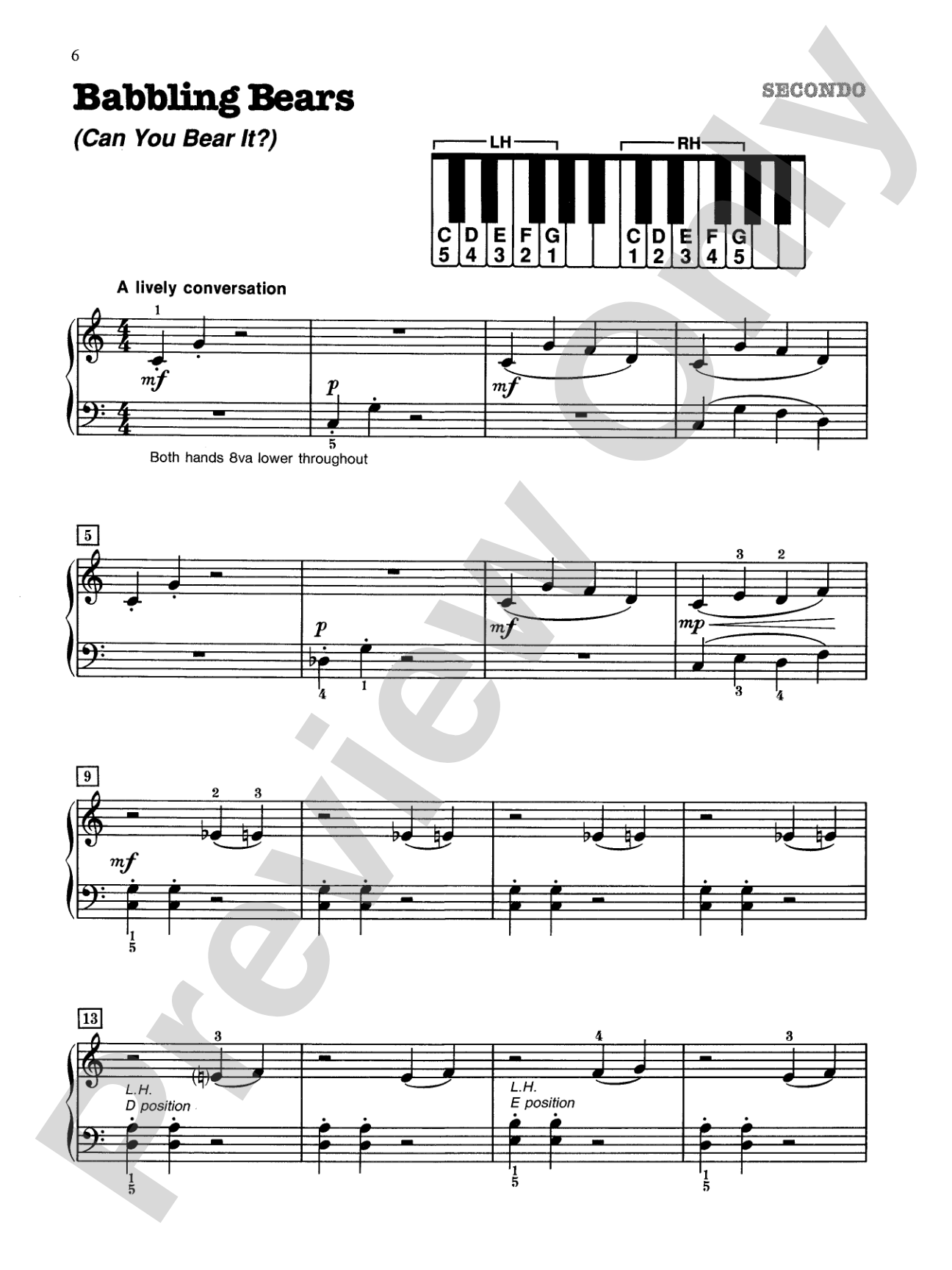

Babbling Bears (Can You Bear It?) - Piano Duet (1 Piano, 4 Hands): Piano Duet (1 Piano, 4 Hands)
Elementary Duets for 1 Piano, 4 Paws
By Margaret Goldston
Level: Elementary
Item: 00-PS-0017535
$4.99
Pickup currently not available
Related Items
Bear Hug (A Lullaby) - Piano Duet (1 Piano, 4 Hands): Piano Duet (1 Piano, 4 Hands) |
$4.99
|
View | |
Bears on Wheels (Performed by the Cub Club) - Piano Duet (1 Piano, 4 Hands): Piano Duet (1 Piano, 4 Hands) |
$4.99
|
View | |
Steps in the Forest (Furward March!) - Piano Duet (1 Piano, 4 Hands): Piano Duet (1 Piano, 4 Hands) |
$5.99
|
View | |
Duets for Bear Lovers: Piano Duet (1 Piano, 4 Hands) Book |
$5.99
|
View |
Description
A collection of elementary duets for one piano and four paws! The primo and secondo parts are equal in difficulty and the hand positions are shown for each piece. Some pieces feature easy position shifts. An indispensable collection to add variety to the lesson plan and help make practicing the piano become less work and more fun! A Federation Festivals 2024-2028 selection.


Discover MakeMusic Cloud: thousands of interactive titles your students can play along with today.
Sample Audio
1
Audio File
--:--
0:00
0:00
Sample Video
No sample videos found.
Additional Details
Publisher:
Alfred Music
Page Count:
16
SKU:
00-PS-0017535
More about this title
About the Composer: Margaret Goldston

Margaret Goldston spent her career bridging the gap between serious musical study and joyful learning. Trained at Louisiana State University and later studying composition with Pulitzer Prize winner Robert Ward, she built a thriving North Carolina studio where she worked with students across all ages and levels. Her commitment to music education earned her recognition as Composer of the Year twice by the North Carolina Federation of Music Clubs, and she remained a sought-after clinician and workshop leader across North America.
Goldston's legacy extends well beyond her lifetime. Her works became fixtures on festival and contest lists nationwide, particularly through the National Federation of Music Clubs Junior Festivals Bulletin. In 2020, seven years after her death, the Music Teachers National Association honored her as a Foundation Fellow, cementing her place among educators who shaped how we teach music to young musicians.
Why we love this
Goldston understood elementary piano students deeply. Each duet gives both players genuinely interesting material rather than relegating one hand to accompaniment, so neither student feels like they're supporting someone else's melody. The labeled hand positions and thoughtful position shifts mean students can focus on listening and balancing sound instead of getting lost in mechanics.
What to expect
These duets capture the gentle humor and movement of the bear theme without resorting to cheap gimmicks. The writing feels musical and grounded, allowing students to experience real ensemble playing: listening, responding, balancing, and making decisions about phrasing together rather than simply playing their own line in isolation.
Who it's for
Elementary pianists ready for duet experience but not yet secure in independent sight-reading. These pieces work equally well for students practicing with their teacher or with a peer, since the equal difficulty means both players stay engaged. Festival participants will recognize this collection as a Federation Festivals selection.
How to get the most out of it
- Play through the piece separately at tempo before combining parts. Students learn their own line securely first, which prevents the primo from rushing and the secondo from lagging.
- Listen for the balance point between the two parts. In duets for this level, neither player should overwhelm the other; encourage the student playing secondo to bring out the bass line without overpowering the top melody.
- Experiment with different character approaches: some pieces benefit from playful energy that matches the bear theme, while others invite lyrical, singing interpretations.
- Use the hand position guides as a teaching tool to preview finger patterns before sight-reading. Students who know where their hands live gain confidence quickly.
How to use it
Scatter these duets throughout the year to break up solo practice and inject collaborative energy into lessons. They work beautifully as warm-ups before student recitals or as encore pieces that let two students share the stage together. For studio events, select a few contrasting duets for students to perform together.
Skills your students will build
- Listening and responding to another part in real time
- Balance and blend between two independent melodic lines
- Reading hand position indicators and executing position shifts smoothly
- Following a steady tempo while maintaining musical independence
- Beginning ensemble concepts: starting together, matching articulation, breathing as a pair