
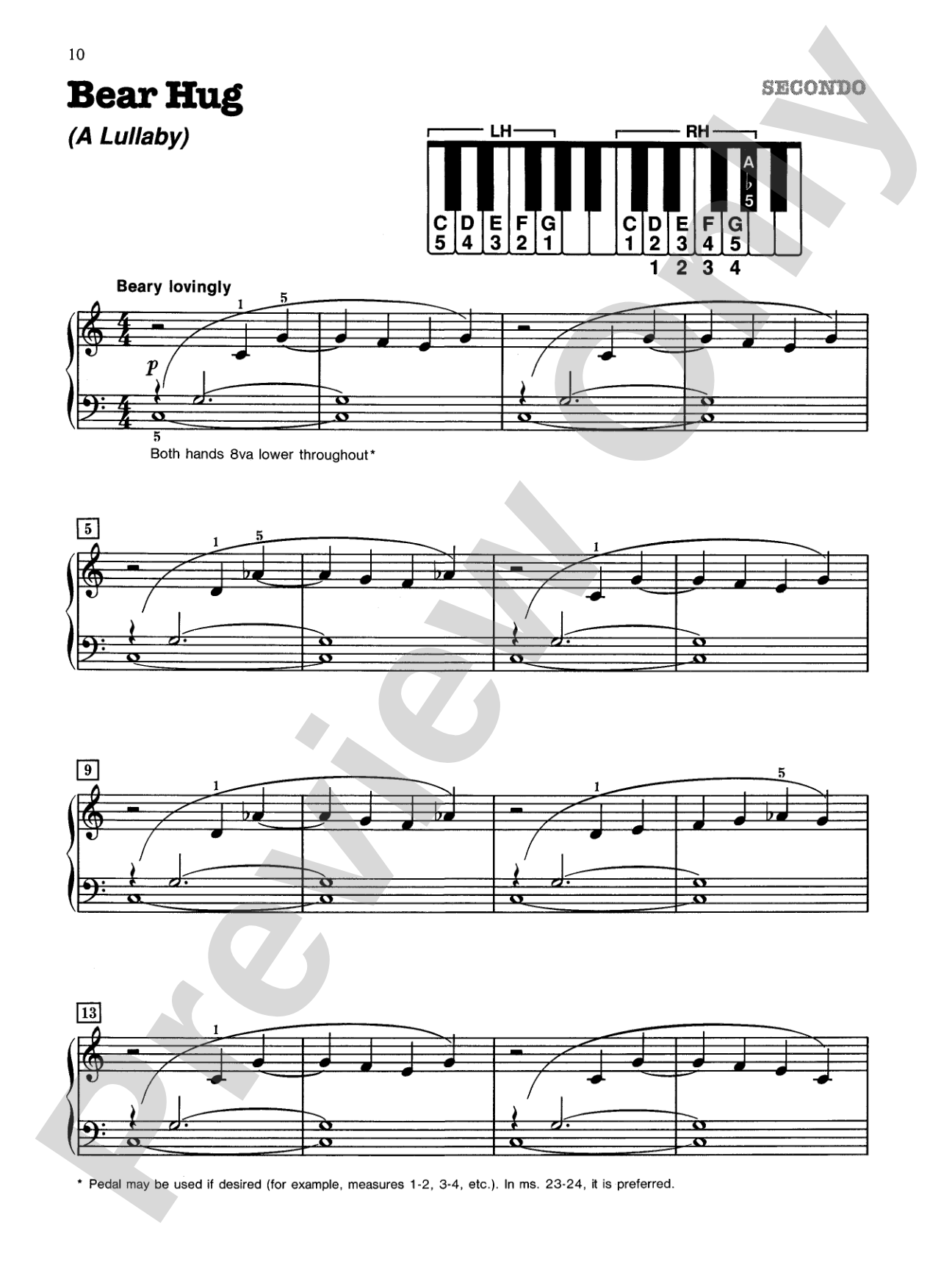

Bear Hug (A Lullaby) - Piano Duet (1 Piano, 4 Hands): Piano Duet (1 Piano, 4 Hands)
Elementary Duets for 1 Piano, 4 Paws
By Margaret Goldston
Level: Elementary
Item: 00-PS-0017536
$4.99
Pickup currently not available
Related Items
Babbling Bears (Can You Bear It?) - Piano Duet (1 Piano, 4 Hands): Piano Duet (1 Piano, 4 Hands) |
$4.99
|
View | |
Bears on Wheels (Performed by the Cub Club) - Piano Duet (1 Piano, 4 Hands): Piano Duet (1 Piano, 4 Hands) |
$4.99
|
View | |
Steps in the Forest (Furward March!) - Piano Duet (1 Piano, 4 Hands): Piano Duet (1 Piano, 4 Hands) |
$5.99
|
View | |
Duets for Bear Lovers: Piano Duet (1 Piano, 4 Hands) Book |
$5.99
|
View |
Description
A collection of elementary duets for one piano and four paws! The primo and secondo parts are equal in difficulty and the hand positions are shown for each piece. Some pieces feature easy position shifts. An indispensable collection to add variety to the lesson plan and help make practicing the piano become less work and more fun! A Federation Festivals 2024-2028 selection.


Discover MakeMusic Cloud: thousands of interactive titles your students can play along with today.
Sample Audio
1
Audio File
--:--
0:00
0:00
Sample Video
No sample videos found.
Additional Details
Publisher:
Alfred Music
Page Count:
16
SKU:
00-PS-0017536
More about this title
About the Composer: Margaret Goldston

Margaret Goldston built her career as both a composer and educator, splitting her time between her North Carolina studio and the broader music community. She studied piano performance at Louisiana State University and later pursued composition privately under Robert Ward, a Pulitzer Prize winner. Her teaching extended across all age levels and her work earned recognition from the North Carolina Federation of Music Clubs, which named her Composer of the Year twice (1983 and 1994).
Goldston's influence on music education lasted well beyond her lifetime. She conducted clinics and masterclasses throughout North America, and her compositions remain fixtures on festival and contest lists, particularly through the National Federation of Music Clubs. The Music Teachers National Association posthumously honored her as a Foundation Fellow in 2020, cementing her legacy as a composer who understood what students needed to learn and grow.
Why we love this
Goldston wrote these duets with the realities of the lesson studio firmly in mind: equal parts for both players, clear hand positions to eliminate guesswork, and genuine musical substance that keeps students engaged. The collection breaks the monotony of solo practice without requiring students to scramble over each other or feel relegated to an accompanying role. A Federation selection speaks to the quality of the writing and its durability in the repertoire.
What to expect
These pieces radiate the warmth suggested by their title. The writing is lyrical without being saccharine, and the duet texture creates immediate intimacy and dialogue. Students discover that two hands on the same keyboard can create something more than the sum of their parts.
Who it's for
This collection works beautifully for elementary students who are ready for duet experience but need equal musical weight in both parts. It's equally valuable for studio teachers looking to reinvigorate lesson time and make partner practice feel like a privilege rather than an obligation.
How to get the most out of it
- Balance the melody between hands. Since both primo and secondo parts deserve attention, establish which voice carries the primary line in each section and adjust dynamics accordingly.
- Mark hand position shifts lightly in pencil before the first rehearsal. Even elementary students benefit from a visual roadmap when the piece moves beyond the initial position.
- Practice the accompaniment part separately if your student is new to duet playing. Solidifying the secondo part builds confidence and allows the student to listen more actively during joint rehearsals.
- Record a rough version on your phone and send it to your student. Hearing how the duet sounds complete often motivates practice between lessons.
How to use it
Pair one or two selections with solo work on a spring or end-of-year studio recital to showcase ensemble awareness. They also serve as anchor repertoire during the festival season, giving students meaningful performance experience without the pressure of a full solo competition schedule.
Skills your students will build
- Reading hand position indicators and executing position shifts smoothly
- Listening to and balancing with a partner while managing their own part
- Sustaining melodic lines while maintaining rhythmic independence
- Understanding how accompaniment figures support and enhance a melody