
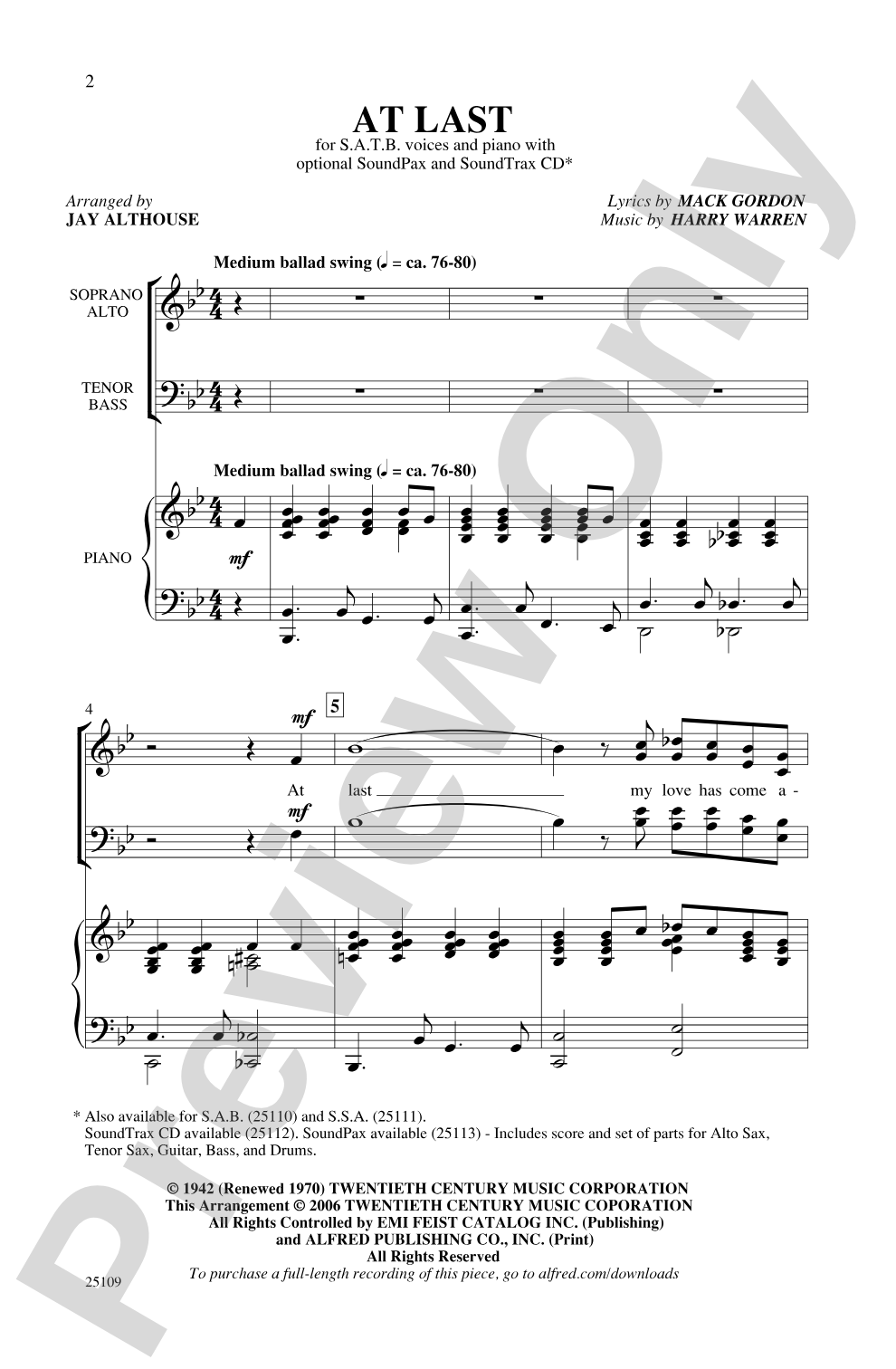
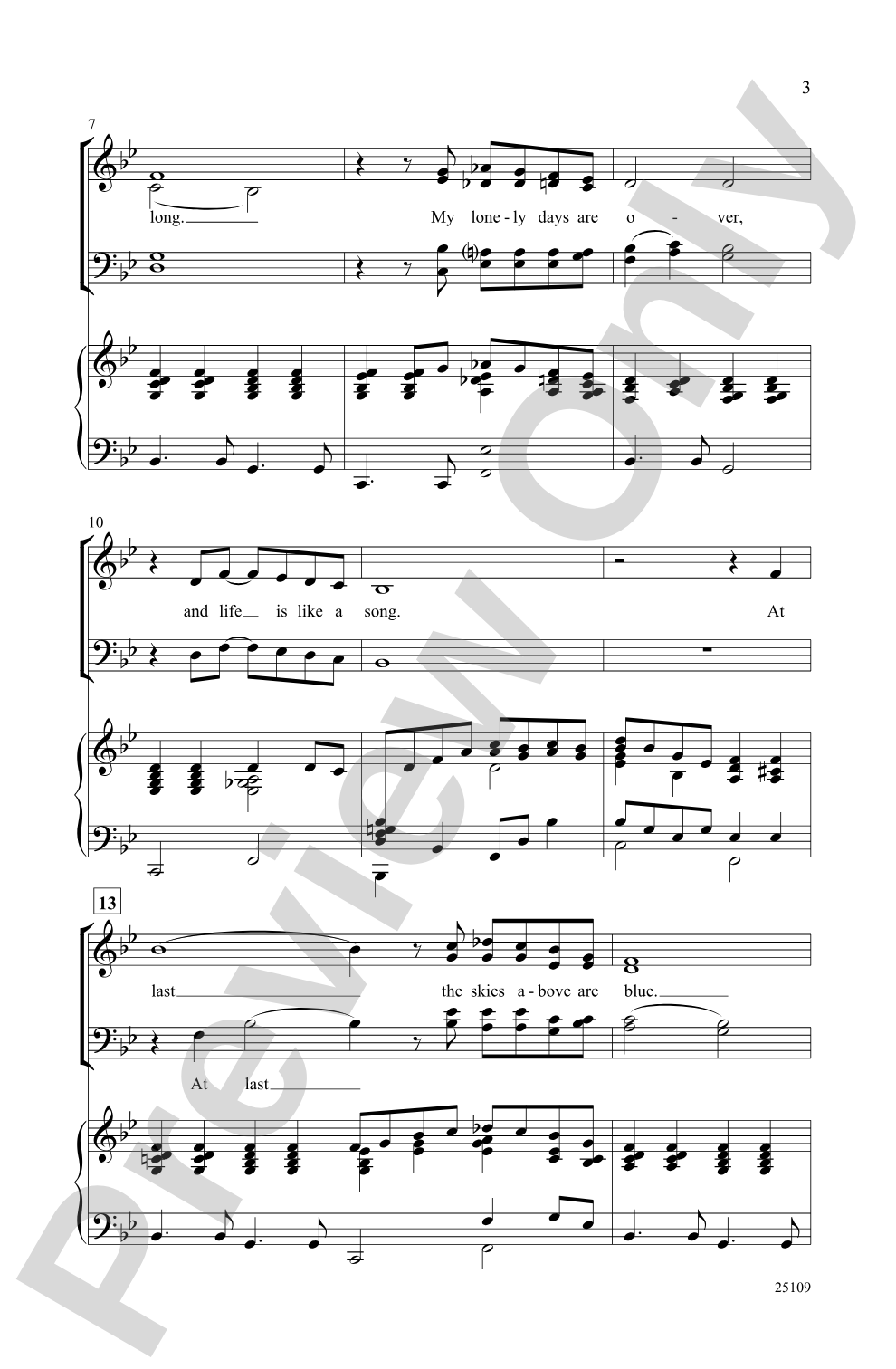

At Last: SATB Choral Octavo
By Mack Gordon and Harry Warren / arr. Jay Althouse
Item: 00-PO-0002238

$2.10
Minimum order quantity: 20 copies
One moment…
Related Items
At Last: SoundTrax Digital Audio Download |
$27.99
|
View | |
At Last: SAB Choral Octavo |
$2.10
|
View | |
At Last: SSA Choral Octavo |
$2.10
|
View | |
At Last: Choral SoundPax |
$25.00
|
View | |
At Last: SATB Choral Octavo |
$2.10
|
View | |
At Last: SAB Choral Octavo |
$2.10
|
View | |
At Last: SSA Choral Octavo |
$2.10
|
View | |
At Last: Choral Octavo SoundTrax CD |
$27.99
|
View | |
At Last: Choral SoundPax |
$25.00
|
View |
Description
Soul and blues singer Etta James made this luscious ballad a hit in 1960, though it was written almost 20 years earlier by the songwriting team of Mack Gordon and Harry Warren. Since then it's been recorded by scores of artists. One of the great ballads of the American song repertoire.


Don't just read it, hear it, play along with it, and watch your students grow with it. In MakeMusic Cloud, At Last: SATB Choral Octavo comes alive with professional accompaniment, adjustable tempo, and built-in practice tools that turn solo practice into real progress.
Open in the Player
Jump straight in and assign it today.
Start Your Free Trial
Open this title and explore the full library in minutes.
Sample Audio
1
Audio File
--:--
0:00
0:00
Sample Video
No sample videos found.
Additional Details
Series:
Alfred Pop Choral Series
Publisher:
Alfred Music
Page Count:
8
SKU:
00-PO-0002238
More about this title
About the Composer: Mack Gordon
Mack Gordon (1904-1959) was one of the most prolific and successful lyricists of the golden age of American songwriting. Working across film, theater, and popular music, Gordon crafted lyrics for some of the era's most enduring standards, often in collaboration with composer Harry Warren. His gift for melodic, singable phrases made his songs instantly memorable and remarkably durable across generations of performers.
Gordon's partnership with Warren produced numerous hits that remain staples of jazz and pop vocal repertoires. His work earned him Academy Award nominations and established him as a master of the popular song form. For choral directors, his lyrics continue to offer rich emotional content and natural phrasing that works beautifully across multiple voice parts.
Why we love this
This arrangement captures the yearning, sophisticated warmth that made the original recording iconic, while remaining accessible for high school and college choirs. The SATB voicing preserves the harmonic richness of the ballad without requiring soloistic demands, letting the ensemble shine on a genuinely great song. Programming this alongside spirituals or other American standards creates a cohesive narrative about vocal music in American culture.
What to expect
A moment of intimate reflection captured in four-part harmony. The song unfolds with gentle longing, built on lush chord changes that feel both comforting and wistful. There's elegance here without pretension, warmth without sentimentality.
Who it's for
High school and college choirs seeking a accessible, musically rewarding standard that connects to American vocal traditions. Singers in these ensembles already have experience with SATB voicing and can handle the subtle emotional demands of a slow ballad without becoming rhythmically uncertain.
How to get the most out of it
- Shape the melody line with subtle dynamic curves rather than constant volume; Etta James's interpretation hinges on her ability to breathe and swell within phrases, and your singers can capture that sensibility in an ensemble context.
- Ensure blend across all four voice parts by having singers listen to their neighbors, not just the melody. The inner voices carry harmonic sophistication that vanishes if they sit behind.
- Use the recorded accompaniment to lock the tempo and harmonic foundation early in rehearsals, allowing singers to focus on vowel consistency and intonation before adding interpretive nuance.
- Take advantage of the recorded version of the original; play it at least once to let singers hear how the song was meant to breathe. Their understanding of the emotional arc will inform every rehearsal that follows.
How to use it
This works as a centerpiece for a pops or standards-based concert, or as a poignant contrast in a mixed program that includes classical choral repertoire. Consider pairing it with other classic American songs to create a set that demonstrates the depth of popular songwriting from the mid-20th century. It also pairs naturally with jazz ensemble concerts or cabaret-style performances.
Skills your students will build
- Sustaining legit tone in sustained ballad phrases
- Blending four voice parts in close harmony with chromatic voice leading
- Maintaining intonation across slower tempos with minimal rhythmic drive
- Interpreting a secular standard with historical and cultural awareness
- Singing with jazz-influenced phrasing and breath control