
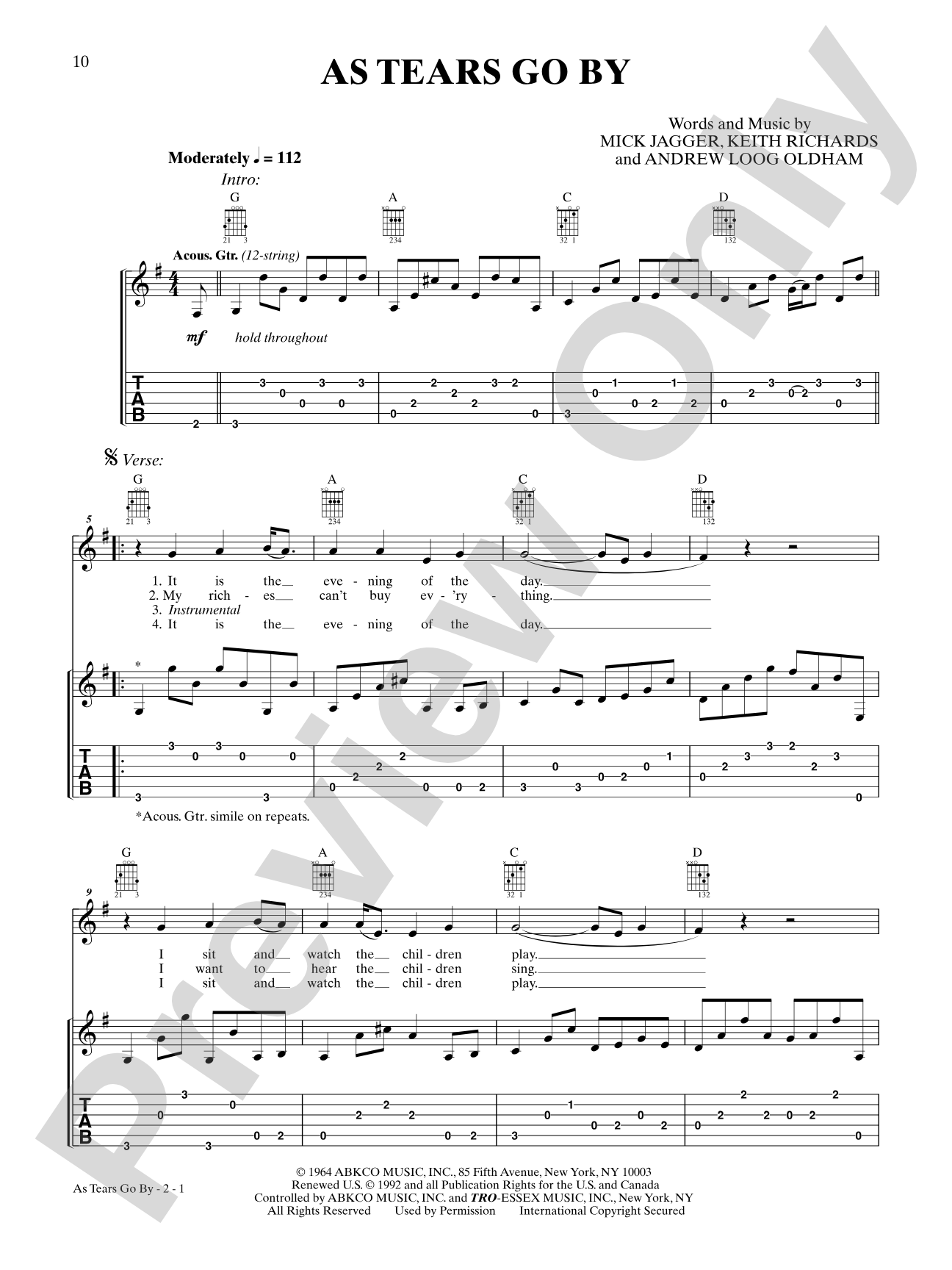

As Tears Go By: Guitar TAB
20 Classic Hits
The Rolling Stones
Item: 00-PS-0013708
$4.99
Pickup currently not available
Related Items
Paint It, Black: Guitar TAB |
$4.99
|
View | |
(I Can't Get No) Satisfaction: Guitar TAB |
$4.99
|
View | |
The Last Time: Guitar TAB |
$4.99
|
View | |
Get Off of My Cloud: Guitar TAB |
$4.99
|
View | |
19th Nervous Breakdown: Guitar TAB |
$5.99
|
View | |
Play with Fire: Guitar TAB |
$4.99
|
View | |
Mother's Little Helper: Guitar TAB |
$4.99
|
View | |
Honky Tonk Women: Guitar TAB |
$4.99
|
View | |
You Can't Always Get What You Want: Guitar TAB |
$5.99
|
View | |
Ruby Tuesday: Guitar TAB |
$4.99
|
View | |
Sympathy for the Devil: Guitar TAB |
$5.99
|
View | |
Brown Sugar: Guitar TAB |
$5.99
|
View | |
Let's Spend the Night Together: Guitar TAB |
$4.99
|
View | |
Under My Thumb: Guitar TAB |
$4.99
|
View | |
Gimme Shelter: Guitar TAB |
$4.99
|
View | |
Let It Bleed: Guitar TAB |
$4.99
|
View | |
No Expectations: Guitar TAB |
$4.99
|
View | |
Jumpin' Jack Flash: Guitar TAB |
$5.99
|
View | |
Wild Horses: Guitar TAB |
$4.99
|
View | |
The Rolling Stones: Easy Guitar TAB Anthology: Easy Guitar TAB Book |
$26.99
|
View |
Description
Featuring 20 of The Rolling Stones greatest hits, each guitar part is carefully arranged in full notation and TAB to be easily playable yet still accurately reflect all of Keith Richard's classic guitar parts with correct fingerings and tunings. Titles: 19th Nervous Breakdown * As Tears Go By * Brown Sugar * Get Off of My Cloud * Gimme Shelter * Honky Tonk Women * Jumpin' Jack Flash * Let it Bleed * Let's Spend The Night Together * Mother's Little Helper * No Expectations * Paint It, Black * Play With Fire * Ruby Tuesday * (I Can't Get No) Satisfaction * Sympathy for the Devil * The Last Time * Under My Thumb * Wild Horses * You Can't Always Get What You Want.


As Tears Go By: Guitar TAB isn't in MakeMusic Cloud just yet...but it could be. Let us know you'd like to see it, and you'll help shape what comes next. In the meantime, start a free trial and dive into thousands of interactive titles your students can play along with today.
Request This Title
Tell us you want it.
Start Your Free Trial
Explore everything that's ready to play right now.
Sample Audio
No sample audio found.
Sample Video
No sample videos found.
Additional Details
Series:
Guitar TAB Anthology
Publisher:
Alfred Music
Page Count:
88
SKU:
00-PS-0013708
More about this title
About the Composer: Mick Jagger
Mick Jagger stands as one of rock and roll's most distinctive voices and prolific songwriters. Working primarily with Keith Richards, he shaped The Rolling Stones' sound across five decades, crafting songs that balanced blues tradition with pop accessibility and lyrical sophistication that evolved from love songs to social commentary.
For guitar students, Jagger's partnership with Richards offers an invaluable catalog. Richards' playing defines classic rock guitar language—economical, groove-driven, and endlessly imitated. Learning these arrangements connects players directly to the source of their influences.
Why we love this
These 20 tracks capture the full arc of Richards' guitar voice across The Stones' most essential work, from the acoustic fingerpicking of "As Tears Go By" to the iconic open-tuning riffs of "Honky Tonk Women" and "Brown Sugar." The TAB notation presents these parts accurately but playably, letting intermediate guitarists access authentic arrangements without the frustration of transcription. Rock students finally have legitimate study material for understanding how to build groove, use alternative tunings, and make minimal notes sound maximum.
What to expect
Opening these pages, you're holding the blueprint for some of rock's most recognizable moments. The interplay between TAB and standard notation makes every riff feel graspable yet respectful of the original; you're not simplifying these songs, you're understanding them. Whether it's the hypnotic drone of "Sympathy for the Devil" or the snappy energy of "Jumpin' Jack Flash," each arrangement channels the loose, precise confidence that defined Richards' playing.
Who it's for
Intermediate to advanced guitarists ready to move beyond chord charts and learn note-for-note classic rock arrangements. Rock ensemble directors can assign individual players from this collection for band or coffeehouse settings. Guitar teachers use this to keep advancing students engaged with repertoire they actually want to play.
How to get the most out of it
- Study the alternate tunings listed for each song before playing. Richards uses open tunings extensively, and retuning between pieces is part of the authentic experience; don't skip it or transpose everything to standard tuning.
- Lock into the pocket with recorded versions of each song. These arrangements are built on specific rhythmic feels and timings that won't reveal themselves from the TAB alone; play along to hear how your part sits with the drums and bass.
- Pay attention to fingering suggestions, especially for the fingerpicking patterns. The notations show Richards' actual left-hand positions, which inform how the note voicings ring and sustain.
- Work through these chronologically by era, not just by difficulty. Tracking how Richards' approach evolved from early blues-based work to the synthesizer-influenced 1980s will deepen your understanding of the guitar part's role in each song's overall sound.
How to use it
Build a Rock Classics solo guitar recital by selecting pieces across the range of difficulty and style here. Pair several of these as a medley for a guitar-focused concert segment, or assign one arrangement per student in a group lesson to perform collectively. These also work beautifully as teaching pieces throughout the year, using different songs to introduce techniques like fingerpicking, alternate tunings, and rhythm-focused accompaniment patterns.
Skills your students will build
- Reading and playing in open G, open D, and other alternate tunings
- Fingerpicking patterns and right-hand independence
- Blues-based rock phrasing and rhythmic pocket
- Chord-based accompaniment with minimal accompaniment techniques
- Interpreting TAB alongside standard notation for fretboard accuracy