
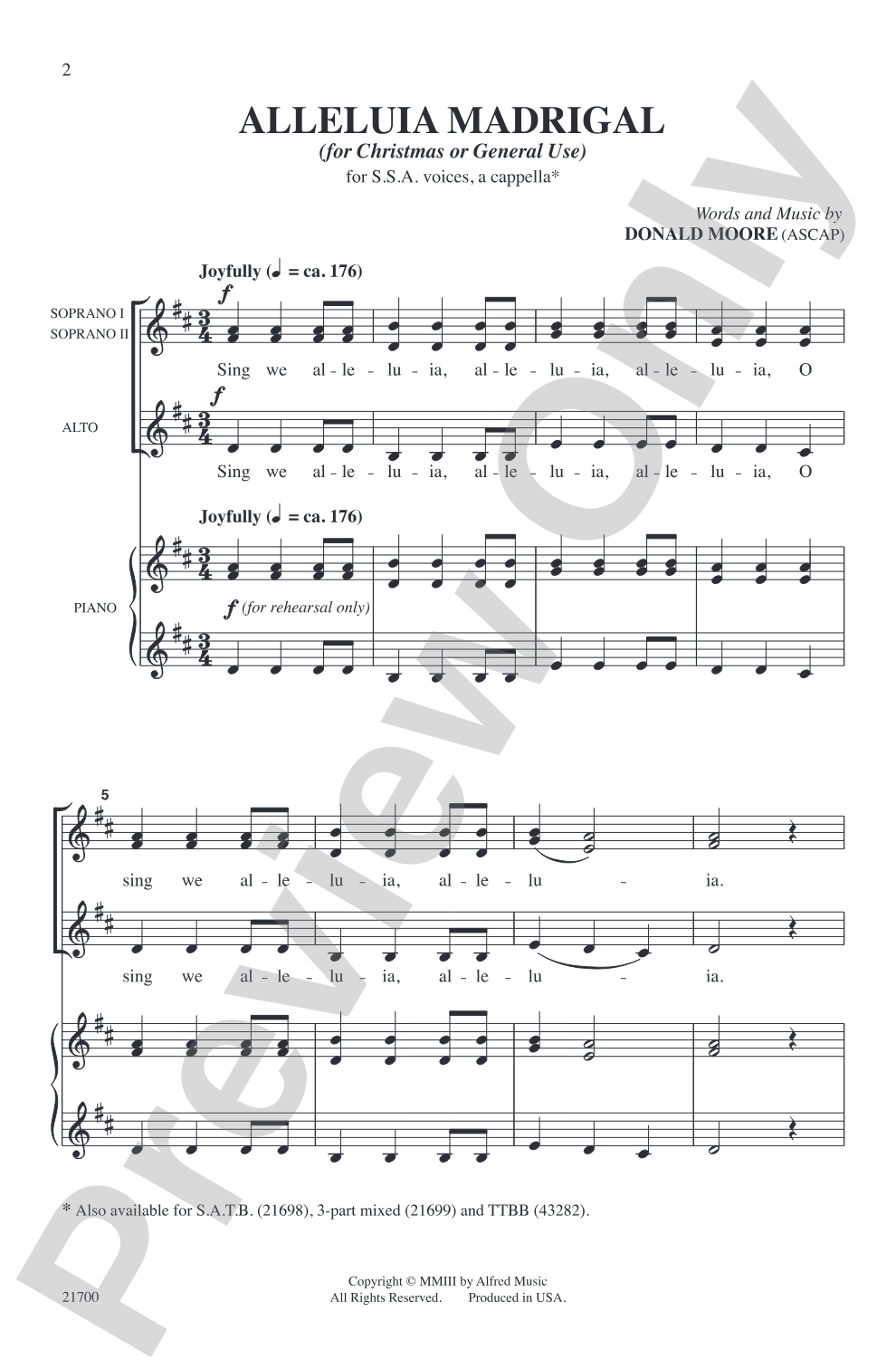

Alleluia Madrigal: SSA, a cappella Choral Octavo
Words and music by Donald Moore
Item: 00-PO-0004286
$2.25
Minimum order quantity: 20 copies
Pickup currently not available
Related Items
Alleluia Madrigal: SATB, a cappella Choral Octavo |
$2.25
|
View | |
Alleluia Madrigal: 3-Part Mixed, a cappella Choral Octavo |
$2.25
|
View | |
Alleluia Madrigal: TTBB, a cappella Choral Octavo |
$1.90
|
View | |
Alleluia Madrigal: SATB, a cappella Choral Octavo |
$2.25
|
View | |
Alleluia Madrigal: 3-Part Mixed, a cappella Choral Octavo |
$2.25
|
View | |
Alleluia Madrigal: SSA, a cappella Choral Octavo |
$2.25
|
View | |
Alleluia Madrigal: TTBB, a cappella Choral Octavo |
$1.90
|
View |
Description
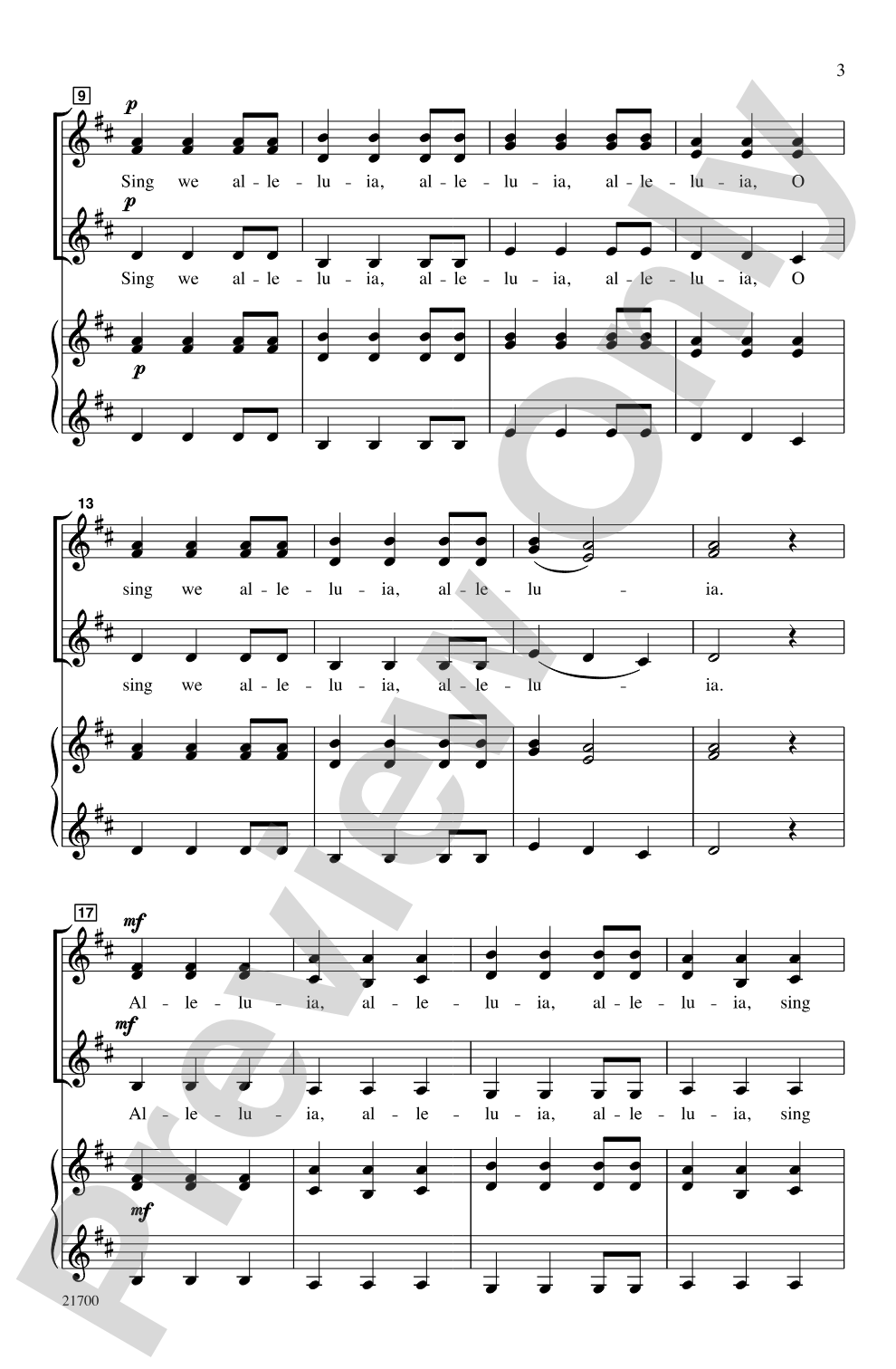
Develop your choir's a cappella skills with this straightforward original madrigal for Christmas or general use. Traditional harmonies, appropriate ranges, and plenty of repetition make it a quick-to-learn piece. Contrasting dynamics and a lilting triple meter create a joyful effect. Now available for four-part men!


Alleluia Madrigal: SSA, a cappella Choral Octavo isn't in MakeMusic Cloud just yet...but it could be. Let us know you'd like to see it, and you'll help shape what comes next. In the meantime, start a free trial and dive into thousands of interactive titles your students can play along with today.
Request This Title
Tell us you want it.
Start Your Free Trial
Explore everything that's ready to play right now.
Sample Audio
1
Audio File
--:--
0:00
0:00
Sample Video
No sample videos found.
Additional Details
Series:
Alfred Archive Edition: Alfred Choral Designs
Publisher:
Alfred Music
Page Count:
8
SKU:
00-PO-0004286
More about this title
About the Composer: Donald Moore

Donald Moore studied organ performance at Kent State University and earned his Master of Arts in Teaching from the same institution. He has served as Organist-Choirmaster at Pilgrim United Church of Christ in Cuyahoga Falls, Ohio, and built a prolific career as a composer, arranger, and author with over 500 published works across sacred, secular, educational, and pop choral genres as well as organ and piano repertoire.
Moore's compositions appear regularly on state contest and festival programs and have been performed at conventions across state, regional, national, and international levels. He is a seventeen-time recipient of the ASCAP Composers Standard Award and was recognized by the American Choral Directors Association Choral Journal as one of 400 composers of significance in American choral music history. His publications span multiple publishers including Alfred Music, Hal Leonard, Heritage Music Press, and others.
Why we love this
Moore writes with genuine understanding of what works in the rehearsal room: straightforward voicing, memorable melodies, and just enough repetition to build confidence without boring singers. The triple meter and dynamic contrast keep the piece engaging and joyful, while the traditional harmonic language ensures your choir sounds polished from early rehearsals onward. This is the kind of piece that lets you spend rehearsal time on artistry rather than decoding notation.
What to expect
Joyful and accessible, this madrigal settles into a lilting waltz-like quality driven by its triple meter. The contrasting dynamics create gentle peaks and valleys that keep the piece moving forward without demanding dramatic intensity, making it feel approachable yet genuinely musical.
Who it's for
This piece suits treble choirs and mixed ensembles seeking solid a cappella repertoire that doesn't demand extensive vocal training or lengthy rehearsal hours. It works well for developing singers who benefit from traditional harmonic language, clear ranges, and repeated material that builds musicality without overwhelming complexity.
How to get the most out of it
- Shape the phrases with gentle dynamic swells rather than holding dynamics static; the 'lilting' quality emerges when singers feel the natural arc of each line.
- Emphasize the text clarity in the repeated sections so each iteration feels fresh and purposeful rather than routine.
- Balance the three voices so the SSA texture creates a unified sound; check that sopranos aren't overpowering the alto and second soprano lines during full voicings.
- Use the triple meter to your advantage by keeping a sense of gentle forward motion; resist the temptation to drag the tempo.
How to use it
Program this alongside other a cappella selections to showcase your choir's unaccompanied capabilities, or use it as a Christmas concert centerpiece for its festive character and proven ability to engage audiences. It also works effectively in spring or end-of-year concerts as a demonstration of ensemble cohesion for developing choirs.
Skills your students will build
- Reading SSA voicing with secure alto and second soprano independence
- Sustaining ensemble intonation without instrumental support
- Shaping phrases using dynamic contrast in triple meter
- Performing with clarity and diction in a cappella settings
- Maintaining consistent ensemble blend across repeated sections