
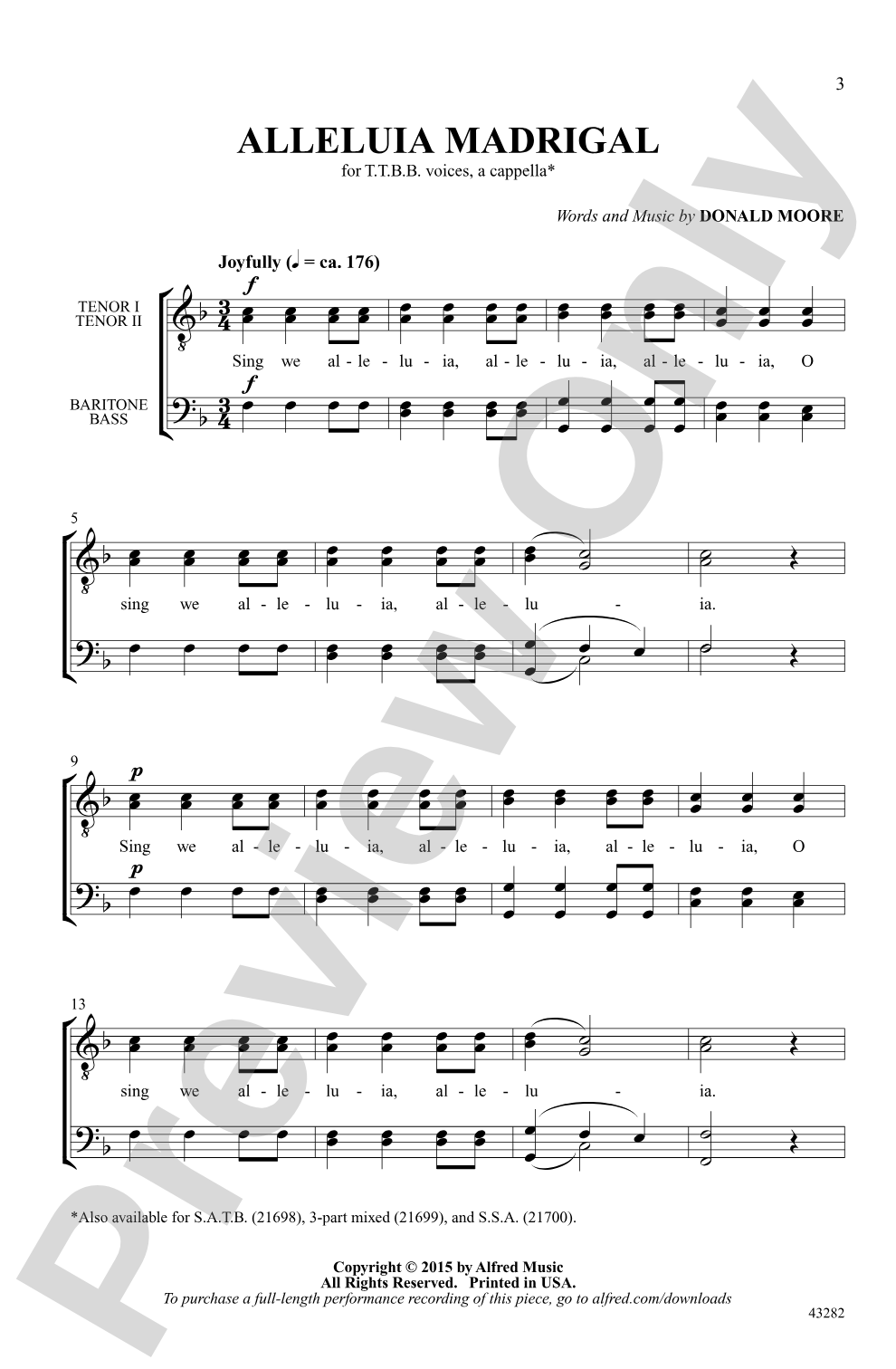

Alleluia Madrigal: TTBB, a cappella Choral Octavo
Words and music by Donald Moore
Item: 00-PO-0003253
$1.90
Minimum order quantity: 20 copies
Pickup currently not available
Related Items
Alleluia Madrigal: SATB, a cappella Choral Octavo |
$2.25
|
View | |
Alleluia Madrigal: 3-Part Mixed, a cappella Choral Octavo |
$2.25
|
View | |
Alleluia Madrigal: SSA, a cappella Choral Octavo |
$2.25
|
View | |
Alleluia Madrigal: SATB, a cappella Choral Octavo |
$2.25
|
View | |
Alleluia Madrigal: 3-Part Mixed, a cappella Choral Octavo |
$2.25
|
View | |
Alleluia Madrigal: SSA, a cappella Choral Octavo |
$2.25
|
View | |
Alleluia Madrigal: TTBB, a cappella Choral Octavo |
$1.90
|
View |
Description
Develop your choir's a cappella skills with this straightforward original madrigal for Christmas or general use. Traditional harmonies, appropriate ranges, and plenty of repetition make it a quick-to-learn piece. Contrasting dynamics and a lilting triple meter create a joyful effect. Now available for four-part men!


Alleluia Madrigal: TTBB, a cappella Choral Octavo isn't in MakeMusic Cloud just yet...but it could be. Let us know you'd like to see it, and you'll help shape what comes next. In the meantime, start a free trial and dive into thousands of interactive titles your students can play along with today.
Request This Title
Tell us you want it.
Start Your Free Trial
Explore everything that's ready to play right now.
Sample Audio
1
Audio File
--:--
0:00
0:00
Sample Video
No sample videos found.
Additional Details
Series:
Alfred Choral Designs
Publisher:
Alfred Music
Page Count:
8
SKU:
00-PO-0003253
More about this title
About the Composer: Donald Moore

Donald Moore earned his Bachelor of Music in organ performance and Master of Arts in Teaching from Kent State University. He has spent his career as Organist-Choirmaster at Pilgrim United Church of Christ in Cuyahoga Falls, Ohio, while building an extraordinary catalog of over 500 published works across sacred, secular, and educational genres.
Moore's compositions appear regularly in state contests and festivals and have been performed at state, regional, national, and international music conventions. A seventeen-time recipient of the ASCAP Composers Standard Award, he was recently recognized by the American Choral Directors Association as one of 400 elite composers of significance in American choral music history. His publications span multiple publishers including Alfred Music, Hal Leonard, and Heritage Music Press.
Why we love this
This madrigal cuts right to what makes men's ensembles tick: straightforward part-writing that doesn't condescend, ranges that sit naturally on all four voices, and harmonic language that feels both traditional and singable. The triple meter and dynamic contrasts give you a joyful piece that learns fast, leaving rehearsal time for refinement rather than basic note-learning.
What to expect
Joyful and intimate at once. The triple meter creates a gentle lilt that feels almost dance-like, while the traditional harmonic language grounds the piece in warm familiarity. This is music that invites the listener in rather than challenging them.
Who it's for
Men's choirs seeking accessible a cappella repertoire that doesn't require weeks of rehearsal to perform with confidence. Singers will appreciate the traditional harmonies and appropriate ranges, while directors will value a piece that learns quickly and works for both Christmas programming and year-round concert use.
How to get the most out of it
- Shape the dynamics sensitively across the contrasting sections; the lilting triple meter will carry the piece forward without driving the tempo.
- Lock the inner parts (tenor 2 and baritone) first to establish harmonic stability, then layer in the outer voices once the foundation is secure.
- Use the repetition as an asset for building consensus on vowel consistency and blend; repetitive passages give singers time to settle into a unified sound.
- Balance the text delivery across all four parts so that "Alleluia" lands with equal weight, avoiding the trap of letting tenors dominate by default.
How to use it
Pair this with other sacred a cappella works to build a complete holiday concert set, or program it as a seasonal showstopper that showcases your men's ensemble's blend and intonation. Its quick-to-learn nature makes it ideal for late-season additions or pop-up performances throughout the year.
Skills your students will build
- Balancing four-part a cappella harmony without instrumental support
- Shaping contrasting dynamic sections in triple meter
- Sustaining consistent vowel formation across extended repetition
- Blending upper and lower voices in TTBB voicing
- Intonation stability in homophonic textures