
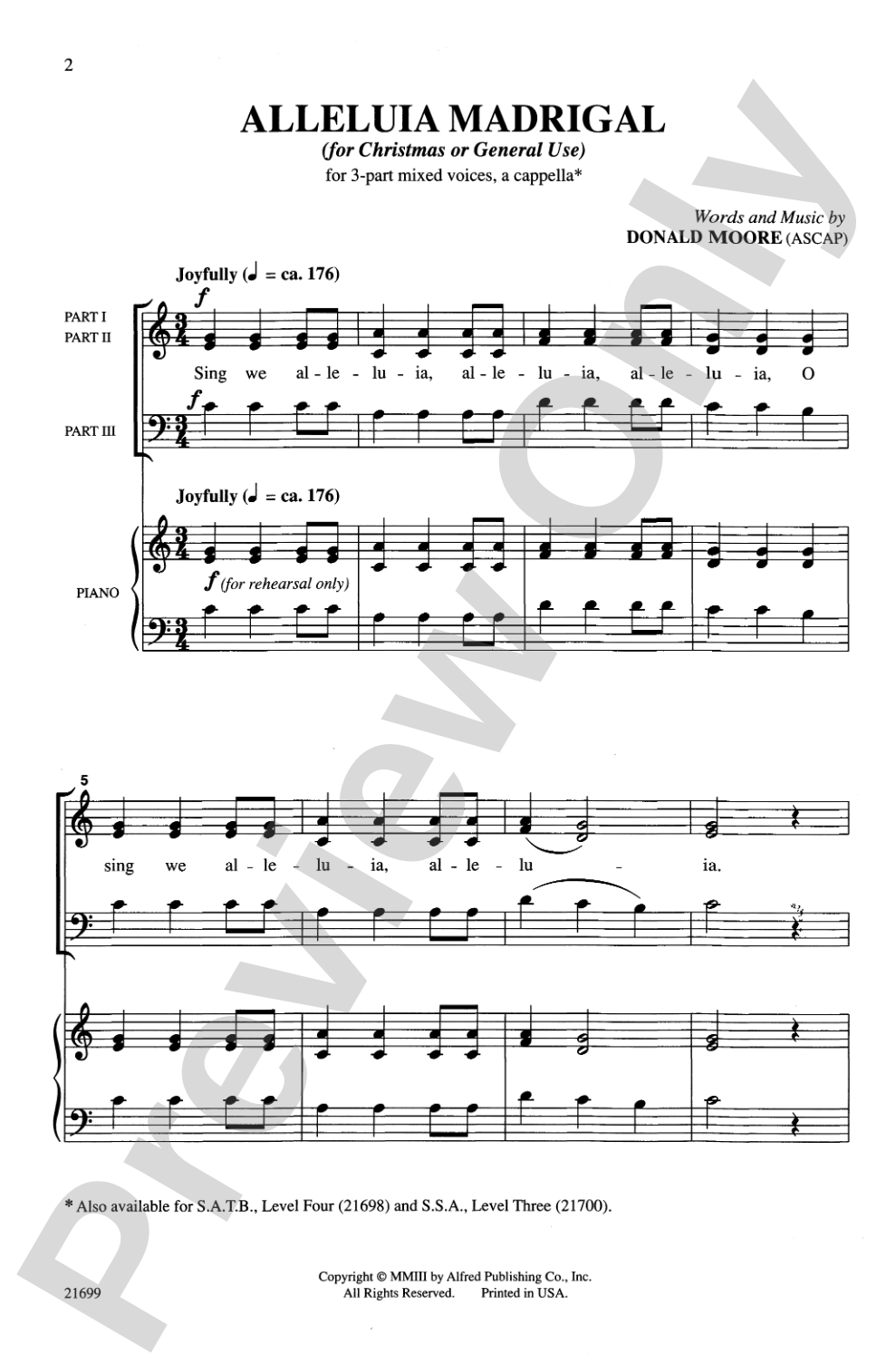
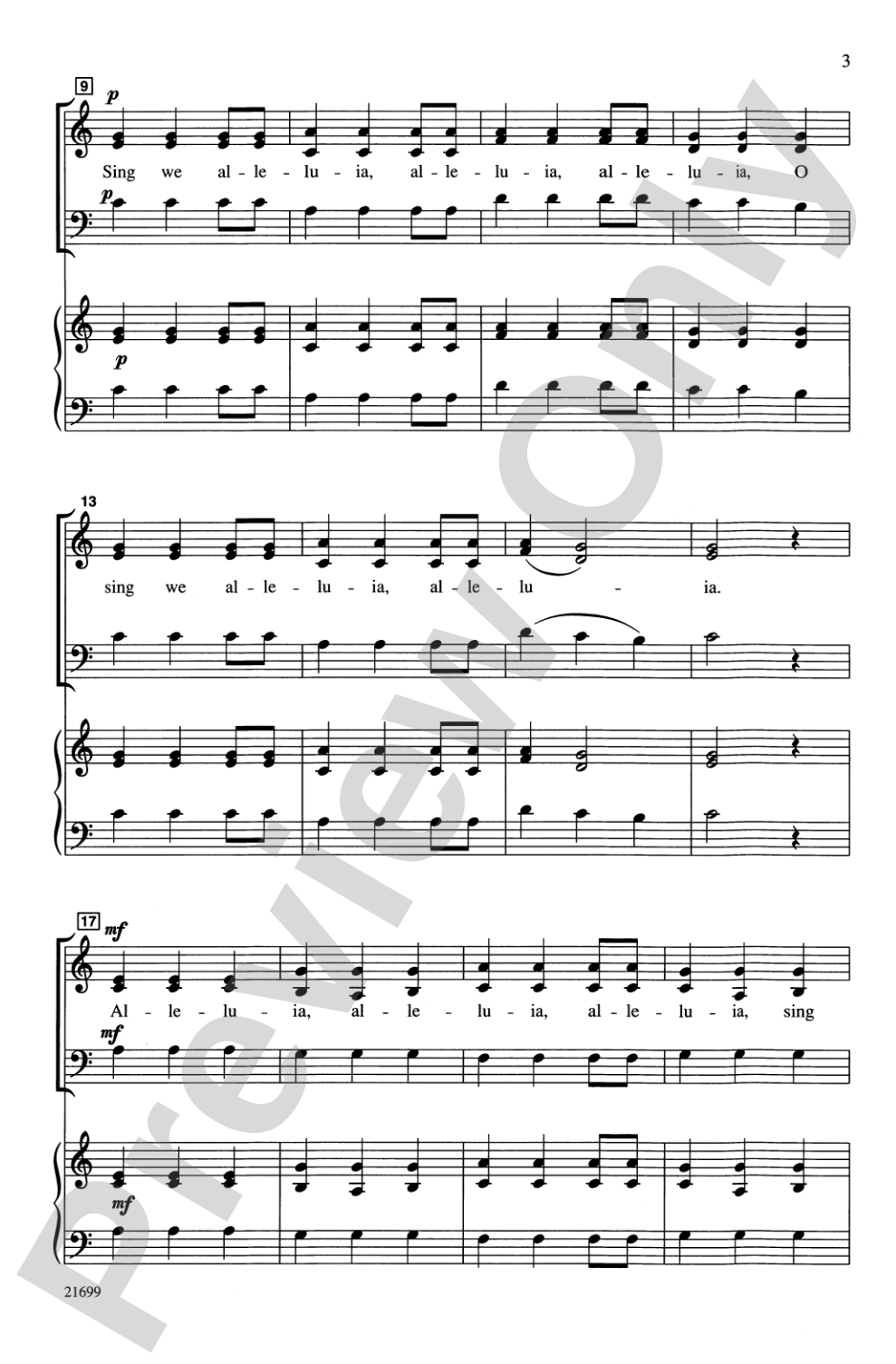

Alleluia Madrigal: 3-Part Mixed, a cappella Choral Octavo
Words and music by Donald Moore
Item: 00-PO-0002202
$2.25
Minimum order quantity: 20 copies
Pickup currently not available
Related Items
Alleluia Madrigal: SATB, a cappella Choral Octavo |
$2.25
|
View | |
Alleluia Madrigal: SSA, a cappella Choral Octavo |
$2.25
|
View | |
Alleluia Madrigal: TTBB, a cappella Choral Octavo |
$1.90
|
View | |
Alleluia Madrigal: SATB, a cappella Choral Octavo |
$2.25
|
View | |
Alleluia Madrigal: 3-Part Mixed, a cappella Choral Octavo |
$2.25
|
View | |
Alleluia Madrigal: SSA, a cappella Choral Octavo |
$2.25
|
View | |
Alleluia Madrigal: TTBB, a cappella Choral Octavo |
$1.90
|
View |
Description
Develop your choir's a cappella skills with this straightforward original madrigal for Christmas or general use. Traditional harmonies, appropriate ranges, and plenty of repetition make it a quick-to-learn piece. Contrasting dynamics and a lilting triple meter create a joyful effect. Now available for four-part men!


Alleluia Madrigal: 3-Part Mixed, a cappella Choral Octavo isn't in MakeMusic Cloud just yet...but it could be. Let us know you'd like to see it, and you'll help shape what comes next. In the meantime, start a free trial and dive into thousands of interactive titles your students can play along with today.
Request This Title
Tell us you want it.
Start Your Free Trial
Explore everything that's ready to play right now.
Sample Audio
1
Audio File
--:--
0:00
0:00
Sample Video
No sample videos found.
Additional Details
Series:
Alfred Archive Edition: Alfred Choral Designs
Publisher:
Alfred Music
Page Count:
8
SKU:
00-PO-0002202
More about this title
About the Composer: Donald Moore

Donald Moore earned his Bachelor of Music in organ performance and Master of Arts in Teaching from Kent State University. He has spent his career as Organist-Choirmaster at Pilgrim United Church of Christ in Cuyahoga Falls, Ohio, while building one of the most prolific catalogs in American choral music with over 500 published compositions across sacred, secular, and educational genres.
His work spans choral octavos, organ and piano pieces, and eight instructional books published by Alfred Music, Hal Leonard, Heritage Music Press, and other major houses. Moore's compositions regularly appear at state and national festivals, and he has received the ASCAP Composers Standard Award seventeen times. The American Choral Directors Association recognized him as one of 400 elite composers of lasting significance in American choral history.
Why we love this
Moore writes with a genuine understanding of what makes an a cappella arrangement singable and satisfying for young choirs. The straightforward harmonies and strategic repetition mean singers can focus on blend and intonation rather than wrestling with complexity, while the contrasting dynamics and lilting triple meter give the piece enough character to feel rewarding on stage.
What to expect
A luminous, accessible madrigal that radiates simple warmth. The lilting triple meter and traditional harmonies create an unhurried, joyful character without sacrificing genuine musicality or a cappella presence.
Who it's for
This piece suits developing choirs working to build a cappella confidence without the demands of dense counterpoint or awkward ranges. It works equally well as an annual Christmas offering or as a general-use piece when you need something that sounds polished after modest rehearsal time.
How to get the most out of it
- Establish a clear pulse in the triple meter early; use a conductor's cue on beat one to lock all three parts together before the singers come in.
- Balance the soprano and alto lines carefully during the opening sections where they carry the harmonic foundation. A cappella singing exposes every part, so rehearse them separately first.
- Shape the dynamics intentionally. Moore's contrasts between soft and fuller passages create the joyful effect; treat each dynamic marking as a structural moment, not an afterthought.
- Exploit the repetition as a strength. Once singers know the material, use repeated sections to refine tone quality and articulation rather than simply running through the piece.
How to use it
Pair this with more complex a cappella repertoire as a confidence-builder earlier in a concert or festival program. It also serves as an excellent holiday concert opener that establishes the season's tone without demanding technical showmanship from singers.
Skills your students will build
- Singing without instrumental support and maintaining pitch accuracy across sustained passages
- Blending three distinct voice parts and balancing harmonic tension and resolution
- Responding to dynamic contrast and shaping phrases expressively within a triple meter
- Singing repetitive sections with renewal of tone and articulation clarity